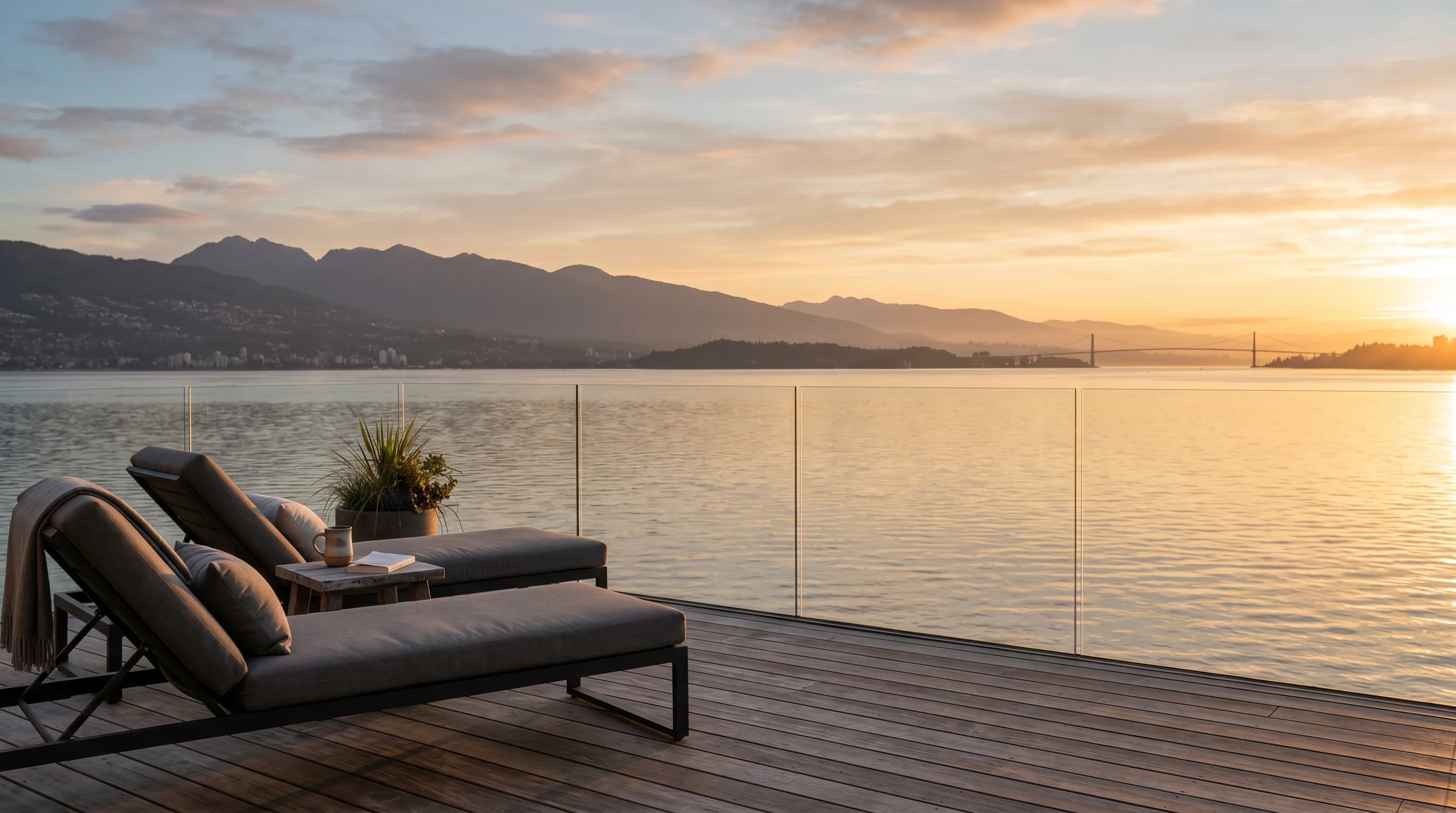
You bought the property for the view. The ocean framed between two arbutus trees. The North Shore mountains catching first light. The horizon you chased across three neighborhoods before finding the right house.
Then comes the railing question — and most homeowners walk into a twenty-year mistake in a single afternoon.
A typical aluminum kit railing blocks 30 to 50 percent of your sightline. A badly specified glass panel fogs every morning on the Sunshine Coast. A horizontal cable system you saw on Pinterest might not have been legal in Vancouver until last September.
This guide is built for view-property homeowners across British Columbia. We've fabricated and installed every system below in our Coquitlam shop, by the same crew that welds the joints. Ten designs we've built for specific BC scenarios — each one engineered to preserve a particular kind of view.
Start at the top if you want to see what just became legal. Or skip to the system that matches your view.
1. Horizontal Black Cable — Vancouver Finally Legalized It
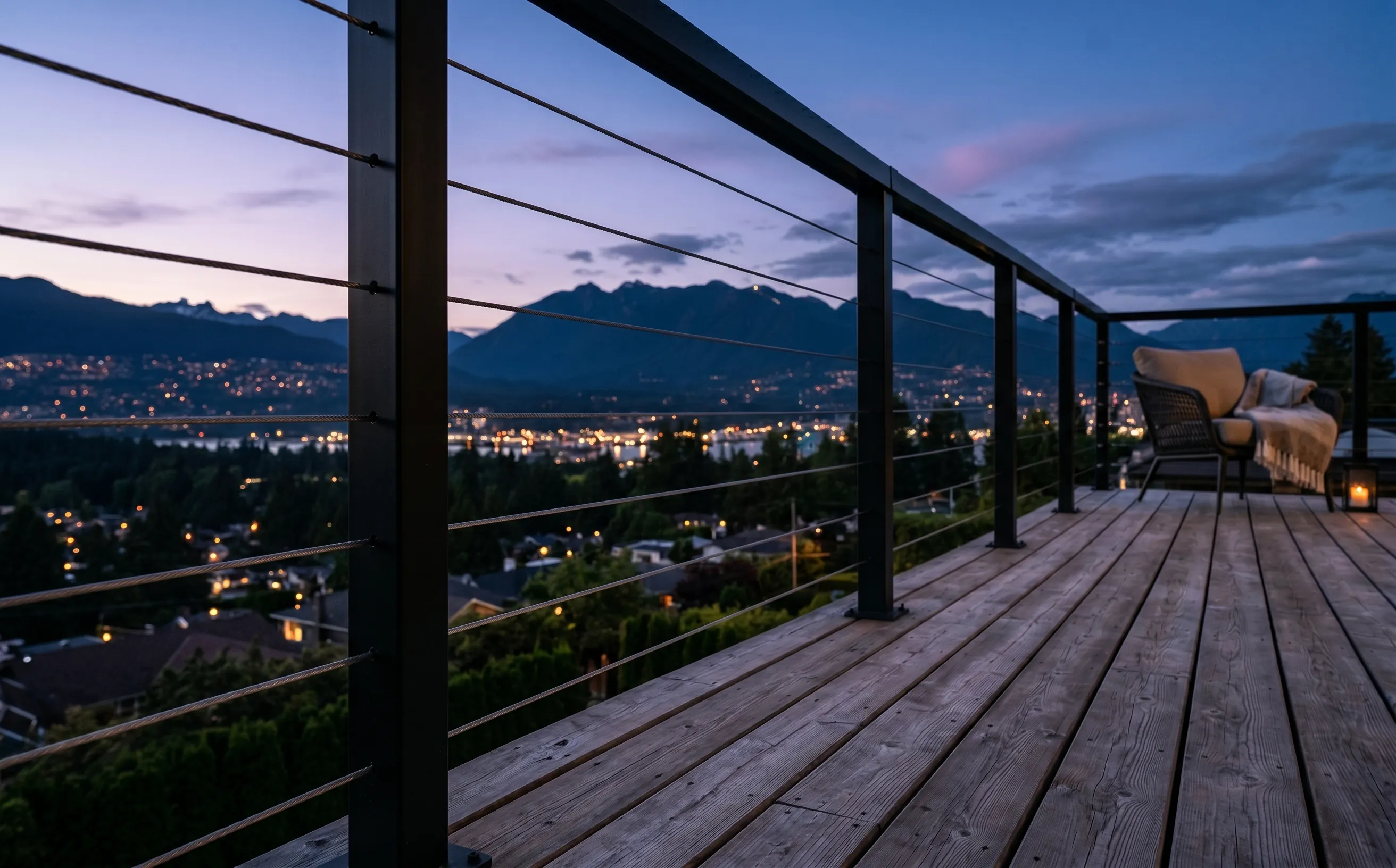
For fifty years, horizontal cable infill was banned in the City of Vancouver. The argument written into the Vancouver Building By-law decades ago was that horizontal lines acted as a ladder for children. Cable railing existed, but it lived outside the city — North Van, West Van, Coquitlam, and anywhere else following the BC Building Code rather than Vancouver's stricter rules.
In September 2025, that changed. The Vancouver Building By-law amendment #14343 legalized horizontal cable guard infill for residential fall heights under 4.2 metres. Overnight, a system that had been the signature look of North Shore mountain homes became available to the rest of the city.
Why it works for view properties: stainless steel cables tensioned between slim powder-coated posts vanish from four metres back. On a deck facing Mount Seymour, Grouse, or the Coast Mountains, the horizontal lines echo the horizon itself — the view isn't interrupted, it's framed.
Our ClearView™ Black cable system uses 1×19 strand 316 stainless cables through matte black powder-coated steel posts. Cable spacing is engineered to defeat the 100 mm sphere rule even under load deflection.
Best for: second-storey decks in North Vancouver, Coquitlam, Port Moody, and now — finally — the City of Vancouver.
2. Frameless Base-Shoe Glass — The Vanishing Edge
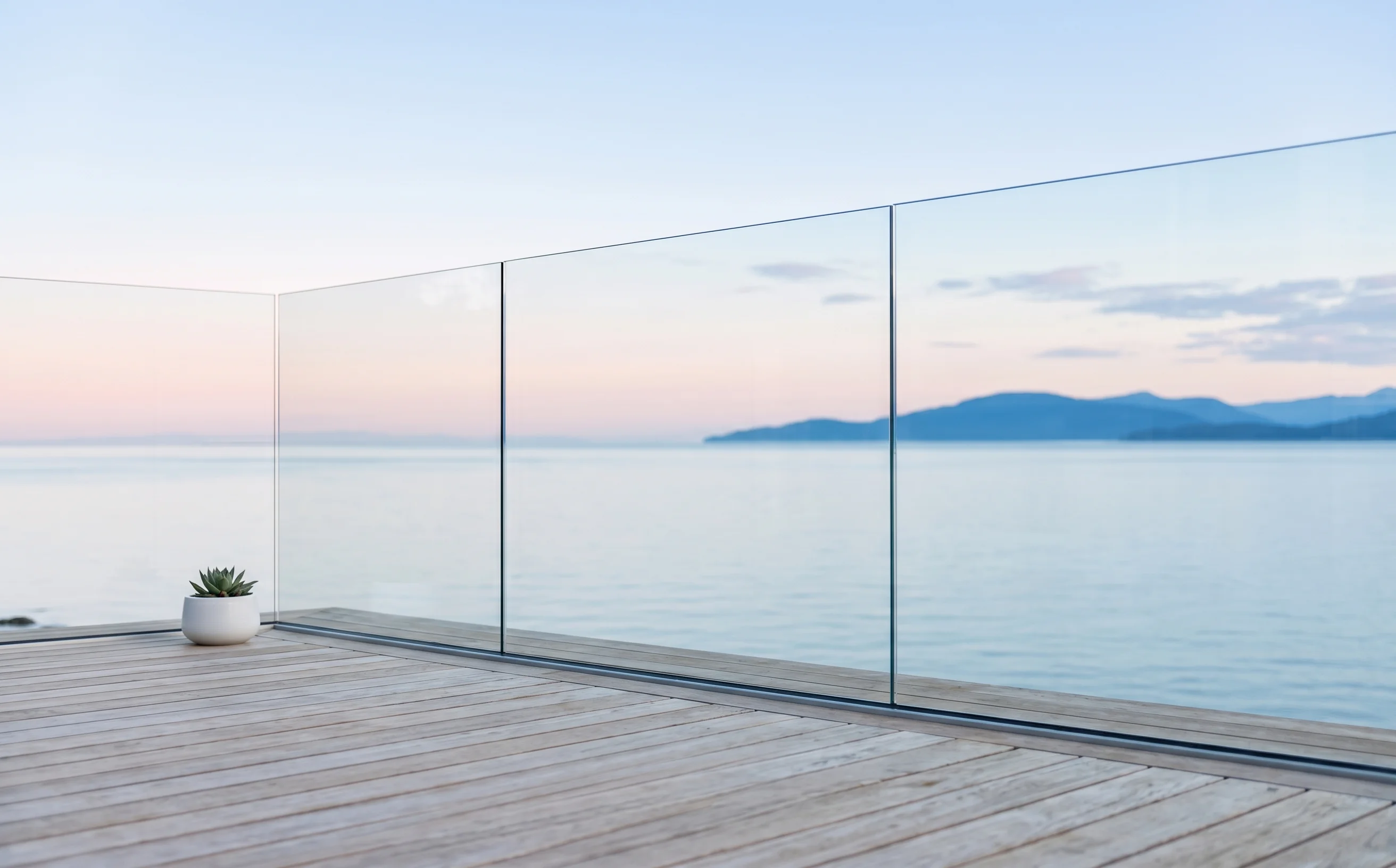
This is the railing most homeowners describe when they say "I want something modern and invisible." It's also the most misunderstood.
Frameless base-shoe glass uses a continuous aluminum U-channel recessed below the deck line so only the glass panel is visible. 12 mm tempered-laminated low-iron glass drops into the channel. No posts, no top rail, no visible hardware. From three metres back on a West Vancouver waterfront deck, the railing disappears entirely into the view.
The technical case: a continuous channel distributes wind loads across every panel rather than concentrating stress at individual mount points. On a south-facing West Van terrace, that matters. The aesthetic case: low-iron glass eliminates the green tint you see at the edges of standard float glass — a tint that ages a railing before it's a year old.
What it's not: a good choice for every site. Glass collects salt spray and fogs under marine condensation — a trade-off we've written about in our piece on why glass railings fog on Sunshine Coast and Gulf Islands properties.
Best for: West Vancouver waterfront homes, Kitsilano penthouse terraces, Point Grey oceanfront — properties where the primary view corridor is uninterrupted and you want the railing to vanish. Full spec on our frameless glass railing systems.
3. Bi-Level Privacy Glass — The Neighbor-Proof View
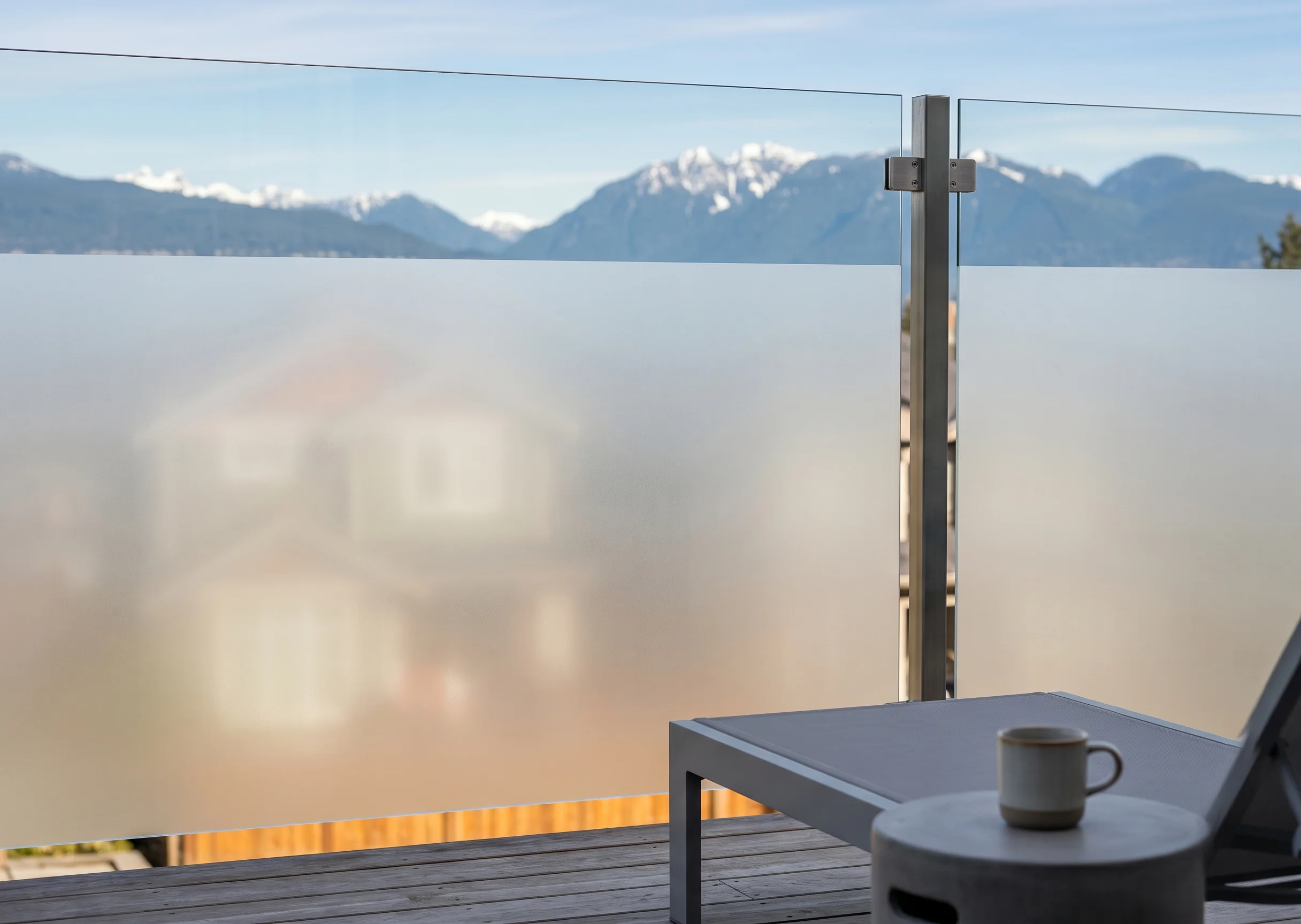
This is the design nobody talks about — and it solves the most common frustration we hear on site visits.
The setup: your deck faces the ocean, mountains, or lake. The view is perfect. But at deck-surface level, your neighbor's living room window stares directly into your outdoor space. Or your lot is nine metres wide with decks on each side, and sitting down on yours means sitting three metres from theirs.
Clear glass gives you the view and the exposure. Frosted glass gives you privacy and kills the view. The answer isn't one or the other — it's both, split horizontally.
Our bi-level privacy glass uses acid-etched frosted panels for the bottom 900 mm — everything below eye level when seated — transitioning to clear tempered-laminated glass above. Standing at the railing, the view is unobstructed. Seated on a lounger, the frosted section blocks direct sightlines from neighboring windows. Acid-etched glass is true structural privacy — unlike cheap frosted stickers that peel and fail within three BC winters.
Have existing clear glass? If you already have a clear glass railing and want to add privacy without replacing the panels, explore our smart PDLC self-adhesive film — an architectural-grade solution that switches from clear to opaque instantly.
Best for: dense lots in Ambleside, Dundarave, Kitsilano, and the West End; strata balconies in Burnaby and New Westminster where visual consistency matters; townhouse decks in Langley and Coquitlam with close-set lot lines. Panel treatment options on our glass railing page.
4. Cable + Wood Top Rail — For the Deck That Faces Trees, Not Towers
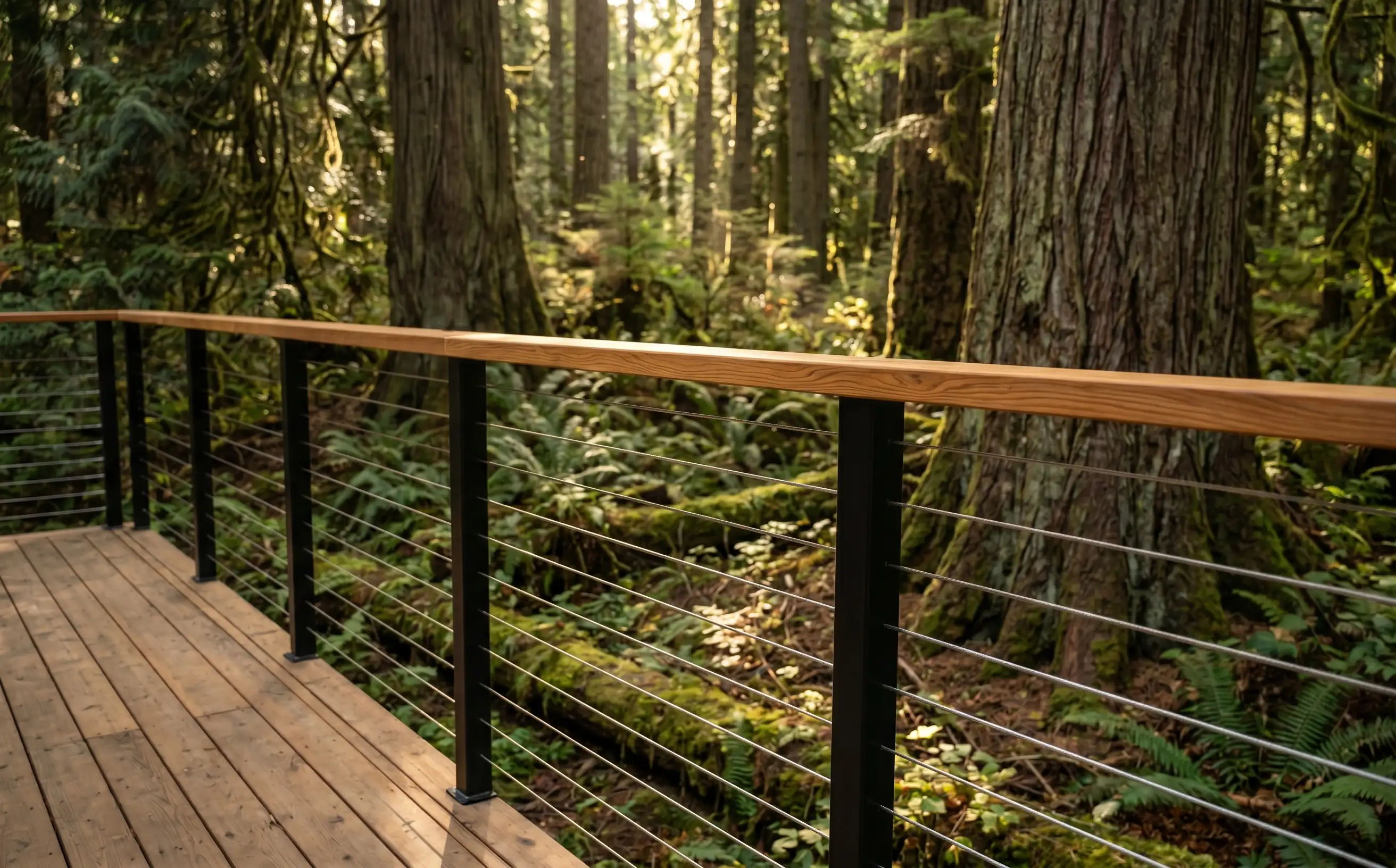
There's a specific kind of BC home that doesn't want modern minimalist. The deck faces Douglas firs in Deep Cove, or overlooks Lynn Valley's cedar canopy, or sits at the edge of a forested lot in Belcarra (where fire-resistant materials are crucial). Cold metal would fight the setting. Full wood would rot within a decade. The answer — what 2026 trend reports call "Soft Industrial" — is the hybrid.
Horizontal stainless cables through matte black powder-coated posts, capped with a warm wood top rail in western red cedar, ipe, or reclaimed Douglas fir. The cable preserves the view through the trees; the wood gives your hand something that feels like the forest, not a shop tool.
The technical challenge is the joint between metal and wood. Cedar and ipe move with humidity; powder-coated steel doesn't. We build the steel frame as a continuous rigid structure, then mount the wood top rail with concealed stainless fasteners that allow seasonal movement without cracking the finish or loosening the cables. Our wood top rails are shop-sealed with marine-grade hardwax oil — refinishing is a light sand every three years, not a strip-to-bare-wood job every eighteen months.
Best for: North Vancouver forest-adjacent properties, Deep Cove, Belcarra, Anmore, Sea-to-Sky homes, and Sunshine Coast cabins. System base is our ClearView™ line. Replacing aging wood railings? See our guide to steel replacements.
5. Standoff Fascia-Mount Glass — For the Balcony Where Every Inch Counts
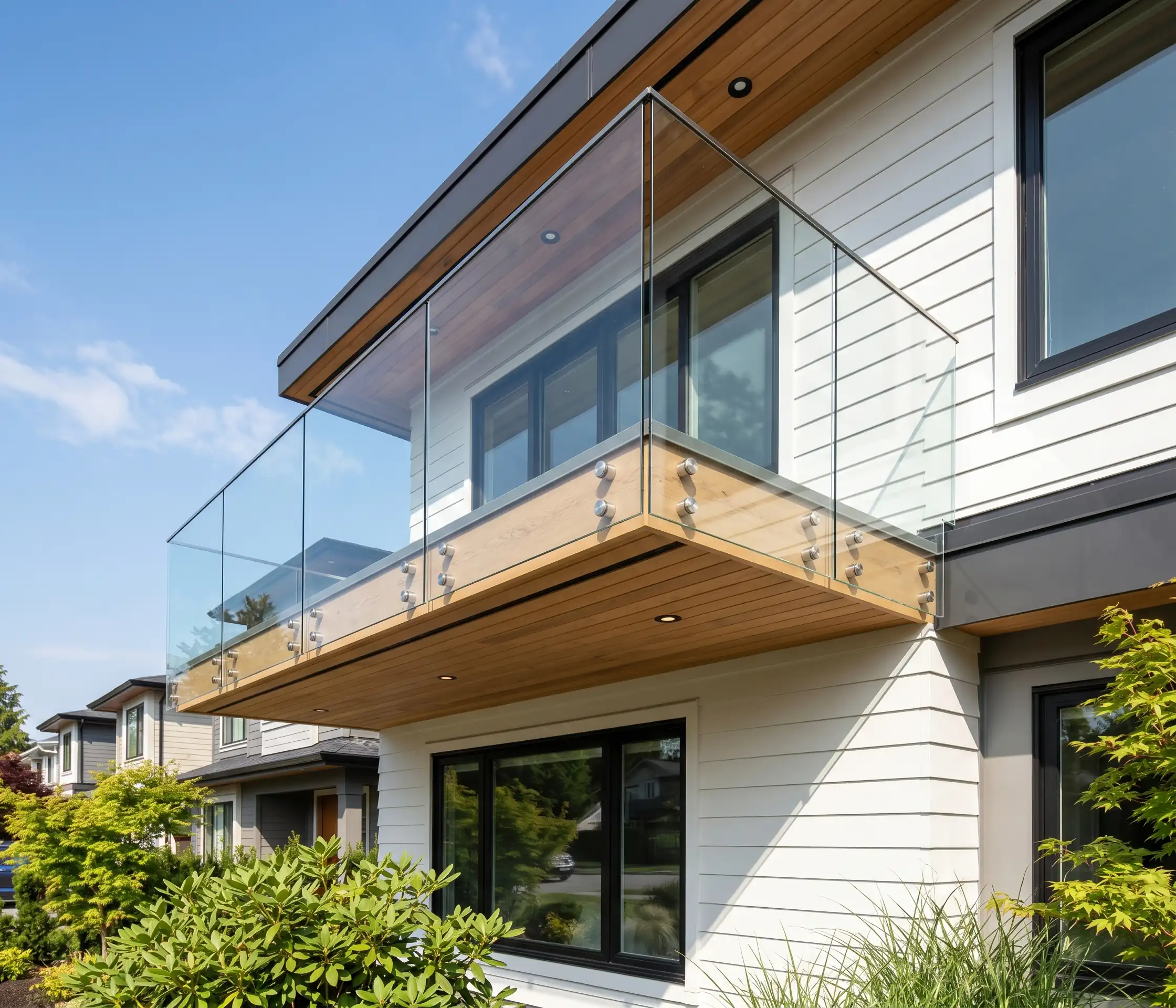
Not every view-property homeowner owns a sprawling waterfront deck. Many of BC's best views are attached to condos, townhouses, and older homes with narrow second-storey balconies — two and a half metres deep, sometimes less. On a deck that tight, every design decision has to pay rent in square footage.
A traditional base-shoe glass railing eats 60 to 80 mm along the full perimeter. Over ten linear metres of frontage, that's most of a chair's worth of floor space. Standoff fascia-mount glass solves this by mounting panels to the outside face of the deck fascia rather than the top surface. The entire deck floor stays clear, edge to edge.
The hardware is round stainless steel standoff posts passing through pre-drilled holes in the glass, clamping each panel against the fascia with a concealed gasket. Four standoffs per panel. No top rail, no post on the deck, no channel on the floor. From inside looking out, only glass stands between you and the view.
Best for: Vancouver condo and penthouse balconies, Kitsilano and Point Grey second-storey decks, Main Street and Mount Pleasant character-home additions, Burnaby strata balcony replacements. Hardware details on our glass railing page.
6. Marine-Grade 316 Stainless Cable — The Railing That Outlasts the Roof
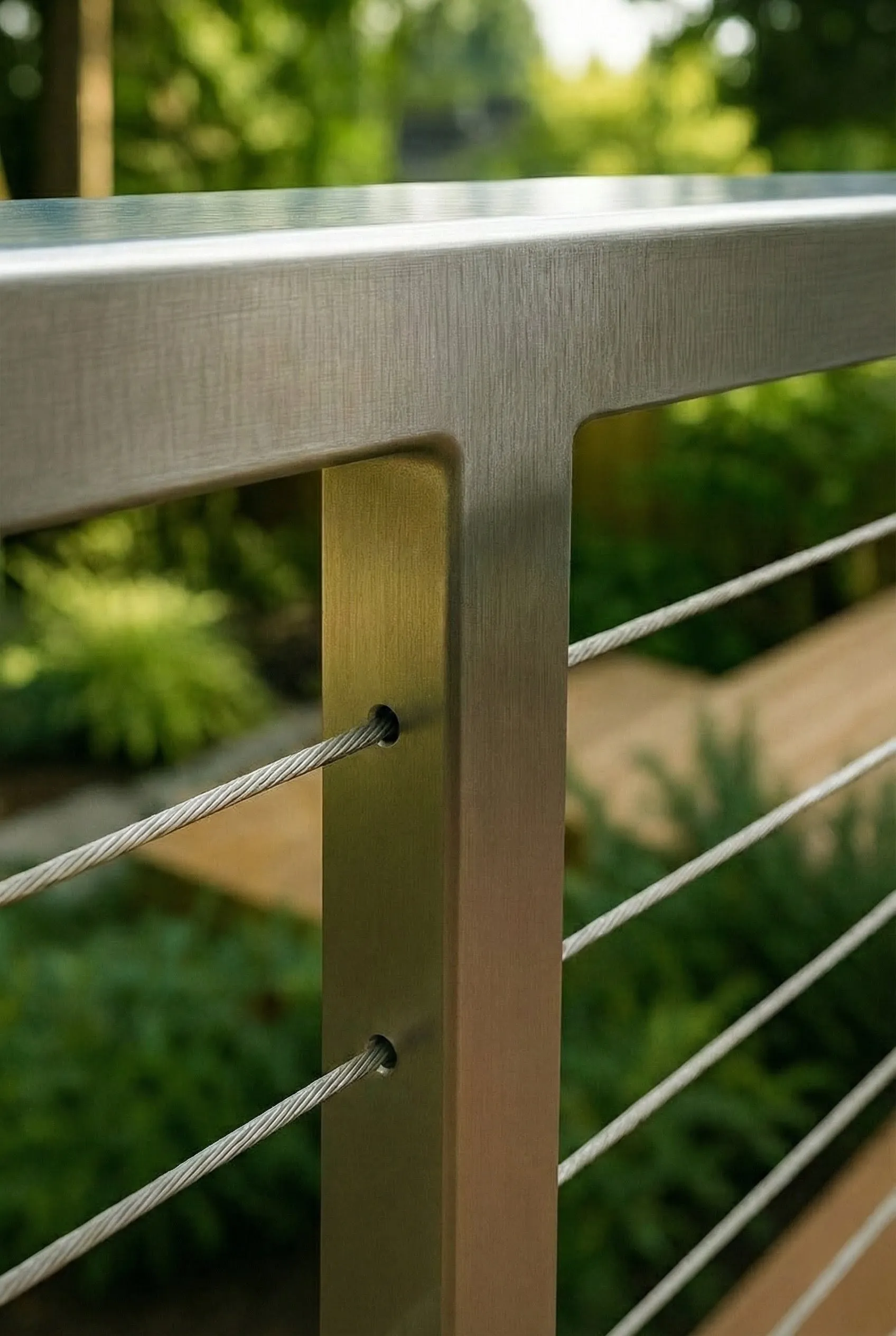
Every railing above this point assumes basic protection from salt. For properties within 100 metres of open salt water, assumptions don't cut it. The wrong specification means tea-staining within eighteen months, pitting within five years, and structural compromise within ten.
316 stainless steel is the baseline for waterfront railings. Not 304 — 304 pits in West Van salt air within three years. Any company installing 304 stainless on a waterfront property is either cutting corners or doesn't know the difference. 316 adds molybdenum, which resists chloride attack. On true marine-exposure sites — Caulfeild foreshore, Horseshoe Bay, Tsawwassen — we sometimes move to Duplex 2205 stainless, which is even more corrosion-resistant but requires specialized welding our shop is set up for, performed by CWB-certified welders.
The system mirrors design #1 in appearance, but every component is full 316: cable strands, turnbuckles, post tubing, base plates, fasteners. No mixed metals, no galvanized, no powder coat over steel. Only brushed satin or mirror-polished 316 finishes.
This costs meaningfully more than powder-coated steel. But a replacement five years into the wrong spec costs more than building it correctly the first time. Our deep-dive on salt air and freeze-thaw failure modes walks through the data.
Best for: West Vancouver waterfront estates, Sunshine Coast oceanfront homes, Gulf Islands, Vancouver Island coastal. System spec on our cable railing page.
7. Bronze/Grey Tinted Glass — The Sunset Filter Nobody Told You About
This is the design ninety-five percent of homeowners never consider — and thirty percent of them should.
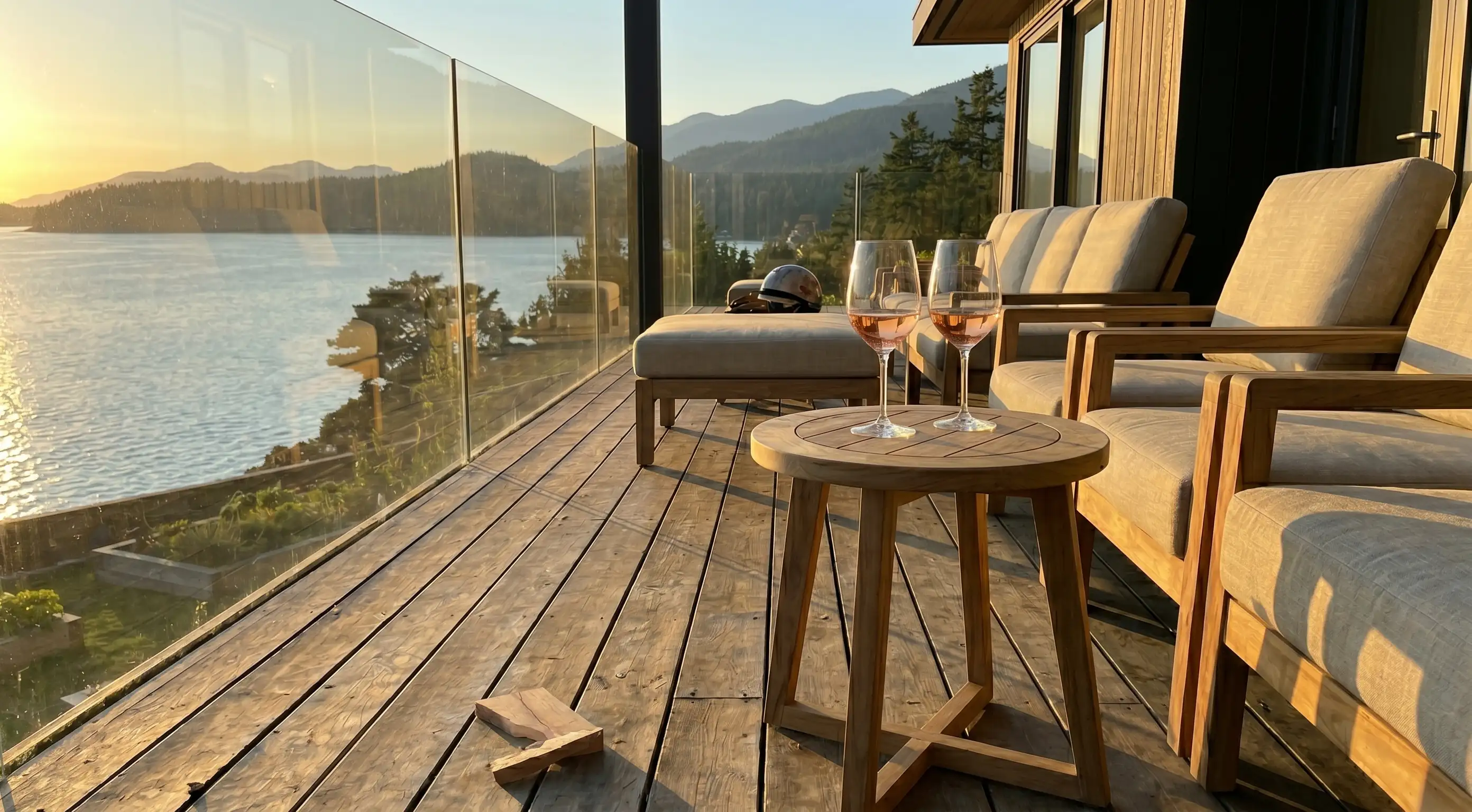
If your best view is west-facing, it comes with a problem: direct sun. Spanish Banks, Kitsilano, West Vancouver waterfront, White Rock, Sunshine Coast — late-afternoon sun floods the deck exactly when you most want to use it. Standard clear glass does nothing to help. You squint, pull the umbrella across the view, or retreat inside.
Tinted tempered-laminated glass — we specify bronze or neutral grey at 15 to 20 percent tint density — cuts glare without blocking the view. On an overcast day, a guest wouldn't notice the tint. On a cloudless summer evening, the railing becomes a polarized lens for the sunset.
Bronze tints warm the light, flattering West Coast timber homes. Neutral grey is more architecturally neutral and works better on monochrome modern homes. Avoid blue-green tints — they date quickly and compete with the ocean.
Structurally, tinted glass is identical to clear: same tempered-laminated safety spec, same 12 mm thickness. For BC's UV conditions, we specify mass-tinted glass (tint in the float line) rather than interlayer tinting.
Best for: west-facing decks on the coast — Vancouver Point Grey and Kitsilano, West Vancouver waterfront, White Rock. Still deciding between cable and glass for BC weather? Our comparison piece helps.
8. Spigot-Mounted Frameless Glass — For the Deck That Ends in Air
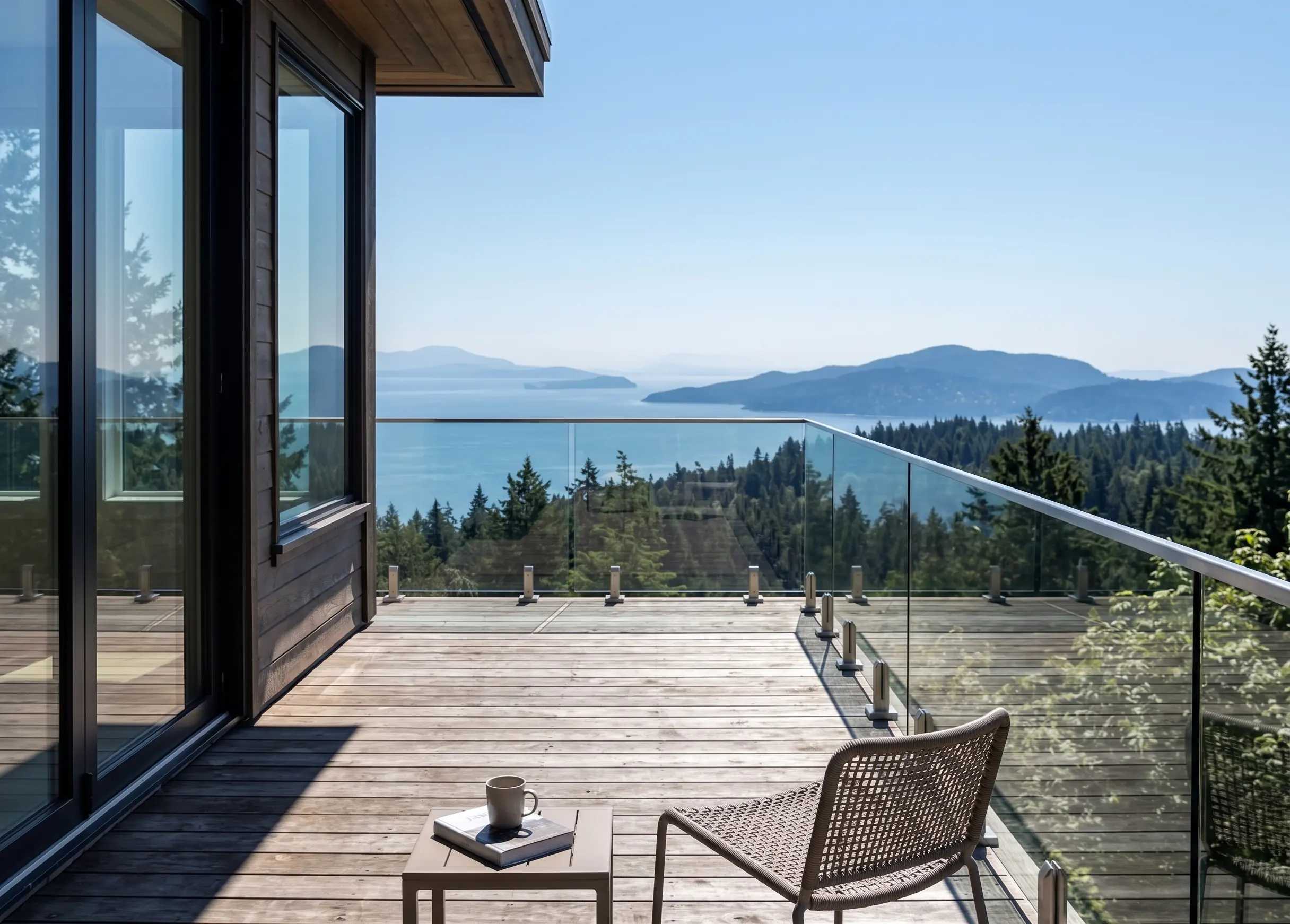
Some decks don't end at a lawn. They end at a fifteen-metre grade drop, a cantilevered edge, a cliff face, an infinity pool lip. On these decks, the railing isn't finishing a space — it's the only thing between you and empty air. It should look the part.
Spigot-mounted frameless glass uses individual mini-posts — stainless steel spigots 200 to 250 mm tall — bolted through the deck substrate to support glass panels from below. Four spigots per panel, hidden at the bottom edge, invisible from more than a few metres back. The glass appears to float above the deck with a small shadow gap beneath it.
The spigot system has one functional advantage over base-shoe for rain-heavy coastal BC: the gap beneath panels allows water to sheet off the deck without pooling. Base-shoe channels can hold standing water during heavy rain. Spigot systems drain themselves.
Structurally, spigots concentrate load at four points per panel rather than distributing it along a continuous channel, so glass is typically 15 mm rather than 12 mm. This is where P.Eng.-sealed structural drawings matter — we include them as standard on cantilevered applications, not as an upsell.
Best for: West Vancouver cantilevered estate decks, British Properties slope homes, infinity-edge pool decks, rooftop terraces. Full glass options on our glass railing page.
9. Cable + Integrated LED Under-Rail — Your View Doesn't End at Sunset
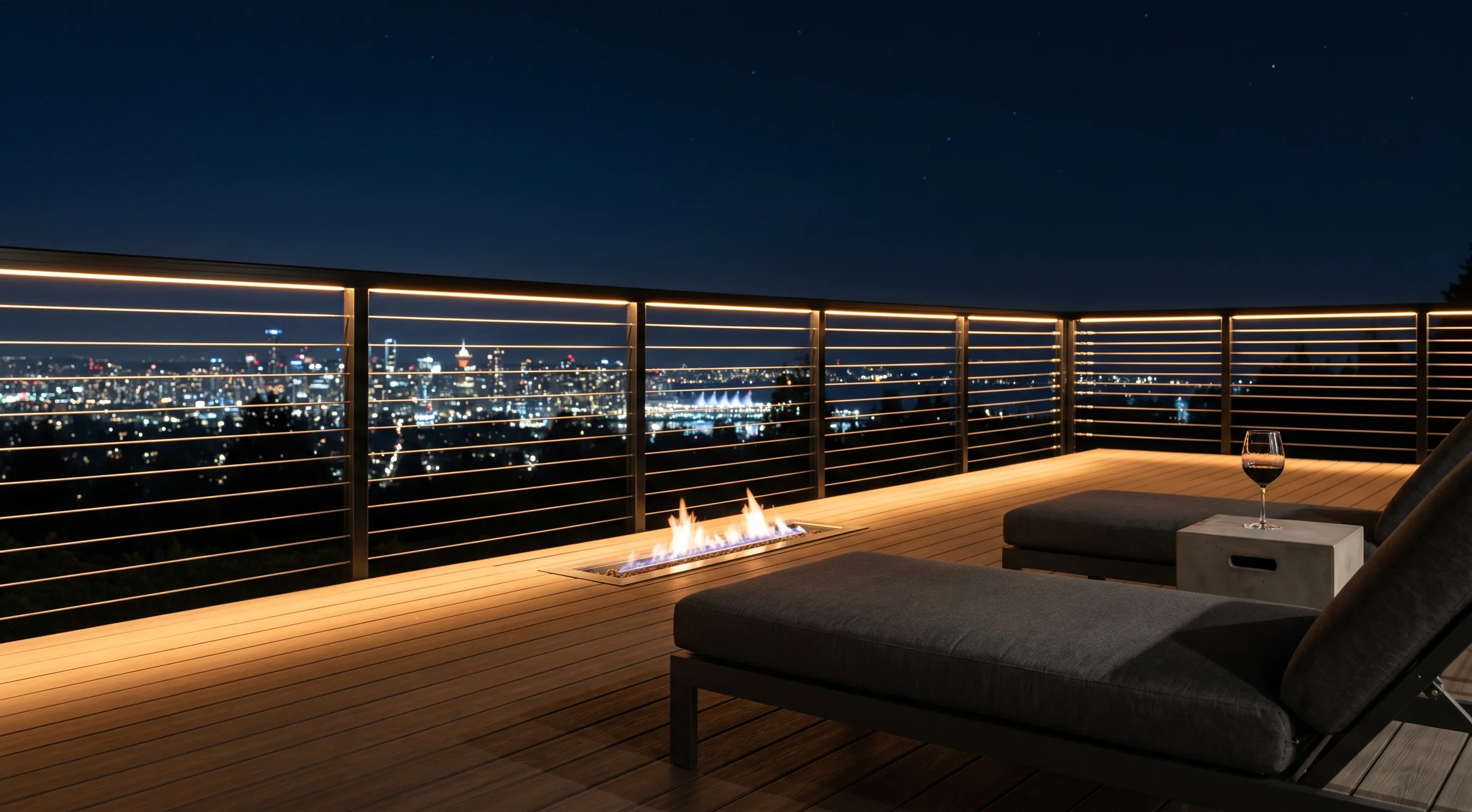
Most railing guides miss the most common complaint we hear six months after install: "It's beautiful during the day, but we don't use the deck at night."
View properties are evening properties. The city lights of downtown Vancouver from a Burnaby Mountain deck. Navigation beacons across the Strait of Georgia from a Sunshine Coast cabin. The Milky Way from a Squamish ridge. Sunset is when the view is most distinctive — and when a poorly lit deck becomes unusable.
Integrated LED under-rail lighting adds a thin low-voltage strip concealed beneath the top rail, aimed downward at the deck surface. It's not landscape lighting — it glows downward, washing the deck with 2700 K warm light that matches the color temperature of a sunset. You see the view. The view doesn't see a flood light in its reflection.
We integrate this at the fabrication stage — the LED driver concealed inside a hollow post, wiring run through the top rail before powder coating, controller hardwired to a transformer or integrated into a smart system. Done as a retrofit, the wiring is surface-run, the color temperature is wrong, and the fixture looks like an Amazon impulse buy.
Best for: entertaining-focused decks, two-storey homes with visually prominent decks, properties with dramatic night views. Base system is our ClearView™ cable line; integration under custom metalwork services.
10. Mixed-System Strategic Zoning — What Architects Specify, and Why Most Homeowners Get It Backwards
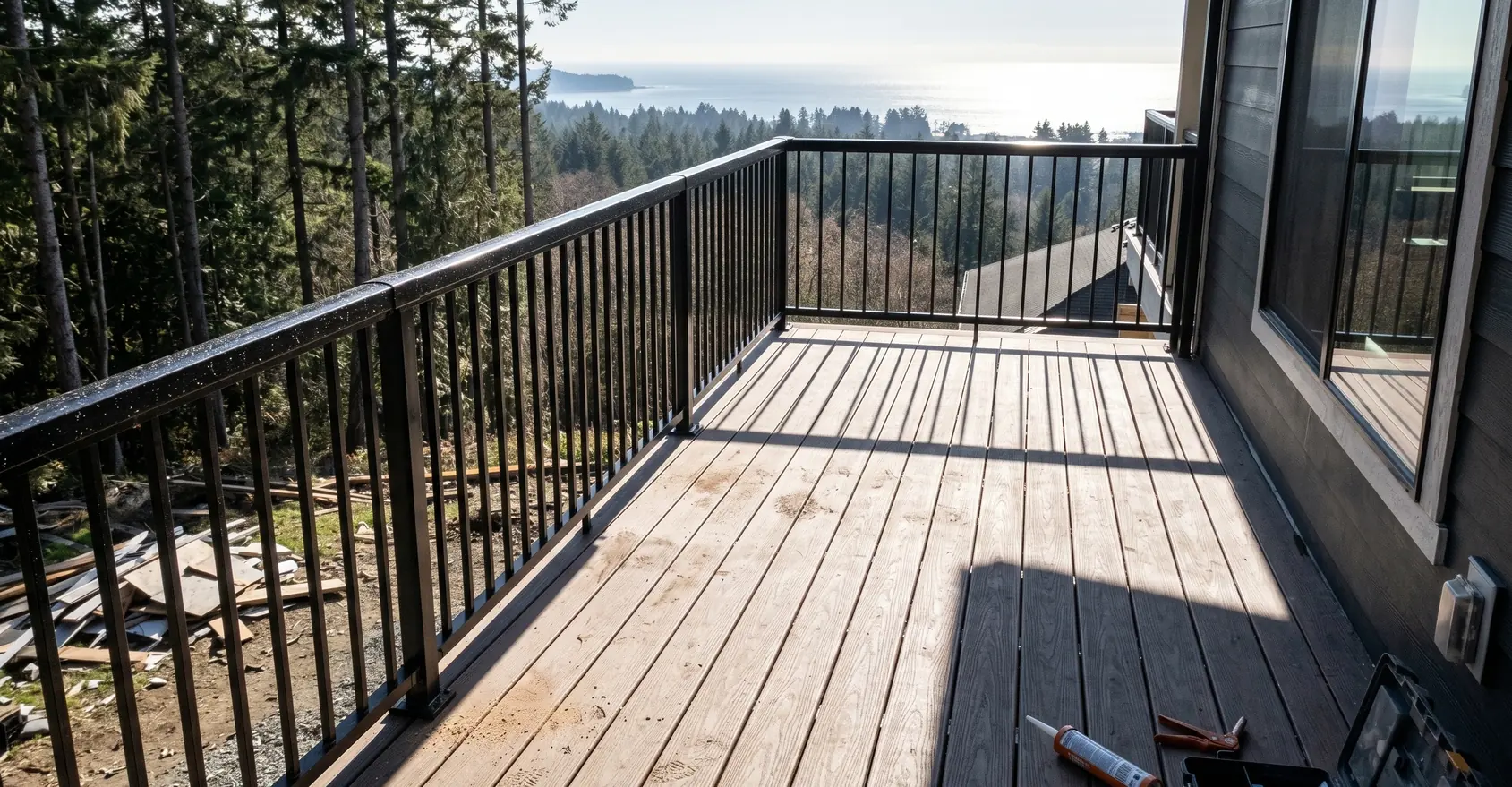
Here's the design most homeowners don't realize is a design: using different railing systems in different zones of the same deck.
A wrap-around deck on a typical BC view home has three distinct sides. The primary view side faces the ocean, mountain, or lake. One side faces the neighbor or driveway. The back often faces the house itself.
Most homeowners — and most commodity railing companies — install the same system on all three sides. It's administratively easy and visually uniform.
Architects working with experienced custom fabricators approach it differently. Frameless glass on the view side where sightline preservation matters most. Horizontal cable on the forest or lawn side. Powder-coated steel picket on the house side, where there's no view and picket is structurally stronger and cheaper.
The result: a deck that allocates budget where it matters. Frameless base-shoe glass costs two to three times what powder-coated picket does per linear foot. Using glass everywhere on a forty-metre wrap-around means spending luxury-tier budget on sections facing blank walls. Strategic zoning can reduce total spend by 25 to 40 percent without sacrificing the view.
We keep one color, one top rail height, and one post profile across all three systems — the infill changes, the frame language stays unified. On approach, the eye reads one railing. Kit suppliers can't execute this because kits come in single-system boxes. Custom fabrication across cable, glass, and picket is what makes it possible. We also fabricate matching handrails for your deck stairs to complete the look.
Best for: any deck with multiple exposures, particularly wrap-around and L-shaped designs.
Safety and BC Building Code Compliance
Every design above meets or exceeds BC Building Code 2024 requirements and Vancouver Building By-law. A railing is a life-safety device first, a design feature second.
The numbers: guard height is 1,070 mm for any exterior deck more than 1,800 mm above grade — the standard for most BC view decks. Interior stair guards are 900 mm. The 100 mm sphere rule applies to every opening, including cable and spigot gaps. Horizontal cable infill is now permitted in the City of Vancouver for fall heights under 4.2 metres (VBBL amendment, September 2025). Structural loads must resist 0.75 kN/m lateral plus a 1.5 kN concentrated load at any point.
For the authoritative source text, see the official BC Building Code 2024 and the Vancouver Building By-law.
LOUEI systems include P.Eng.-sealed structural drawings for permit submission when the project requires engineering (avoiding a costly failed inspection). For complete plain-language code walk-through, see our BC Building Code railing requirements guide. For permit questions, see do you need a permit to replace deck railings in Vancouver.
How to Choose the Right System for Your View
Three questions usually settle the system choice.
First: how exposed is your property to salt air? Within 100 metres of open salt water, cable means 316 stainless and glass means 316 stainless hardware. Anything less fails. Inland or protected inlet, options open up.
Second: what's the dominant problem with your view? "Neighbors can see me" means bi-level privacy (design #3). "Afternoon sun is blinding" means tinted glass (design #7). "The deck feels cold and institutional" means cable with wood top rail (design #4). "Nothing should be visible between me and the view" means frameless base-shoe or spigot glass (designs #2 and #8).
Third: single exposure or multiple? Single-exposure decks work best with one system. Multi-exposure decks almost always benefit from strategic zoning (design #10).
Still uncertain? That's what a site visit is for. We fabricate and install across Metro Vancouver, Sea-to-Sky, Sunshine Coast, Vancouver Island, and the Okanagan — the same crew that welds the frames drives the truck to your property.
Not sure which design is yours? Use our quick 3-step guide.
How close is your property to open salt water?
Explore Our Core Systems
Glass Railings
Frameless base-shoe, spigot, and standoff systems for completely uninterrupted views and maximum wind protection.
Cable Railings
Marine-grade stainless steel cable infill with powder-coated frames. Modern, low-maintenance, and highly transparent.
Picket Railings
Custom-welded aluminum and steel picket designs. The ultimate structural durability with classic or modern styling.
Frequently Asked Questions
Does horizontal cable railing meet the Vancouver Building By-law?
Why do you recommend 316 stainless steel for BC waterfront decks?
Can I add privacy to my existing glass deck railing?
Can I use different railing systems on different sides of the same deck?
How do I reduce sunset glare on a west-facing deck without blocking the view?

About the Author
LOUEI Metal Arts, founded by Arsh Khodamoradi, is a custom metal fabrication shop based in Coquitlam, BC, with CWB-certified welders. Our in-house team designs, welds, finishes, and installs every cable, glass, and picket railing system across British Columbia — with WorkSafeBC coverage, commercial liability insurance, and P.Eng.-sealed structural drawings on every project that requires engineering. No subcontractors, no kit systems. The same crew that fabricates your railing drives the truck to your site.
Start Your Project
Ten designs, ten specific BC scenarios, one crew that builds all of them in-house in Coquitlam. No subcontractors, no kits, no guessing at your site.
The best way to start is the same way our existing clients did — send a few photos of your space, a rough sketch or measurements, and what you're trying to solve. We'll come back within two to three business days with a written quote, material recommendations, and sightline sketches for the systems that fit your site.
Or explore our recent projects to see how these designs look installed across British Columbia.