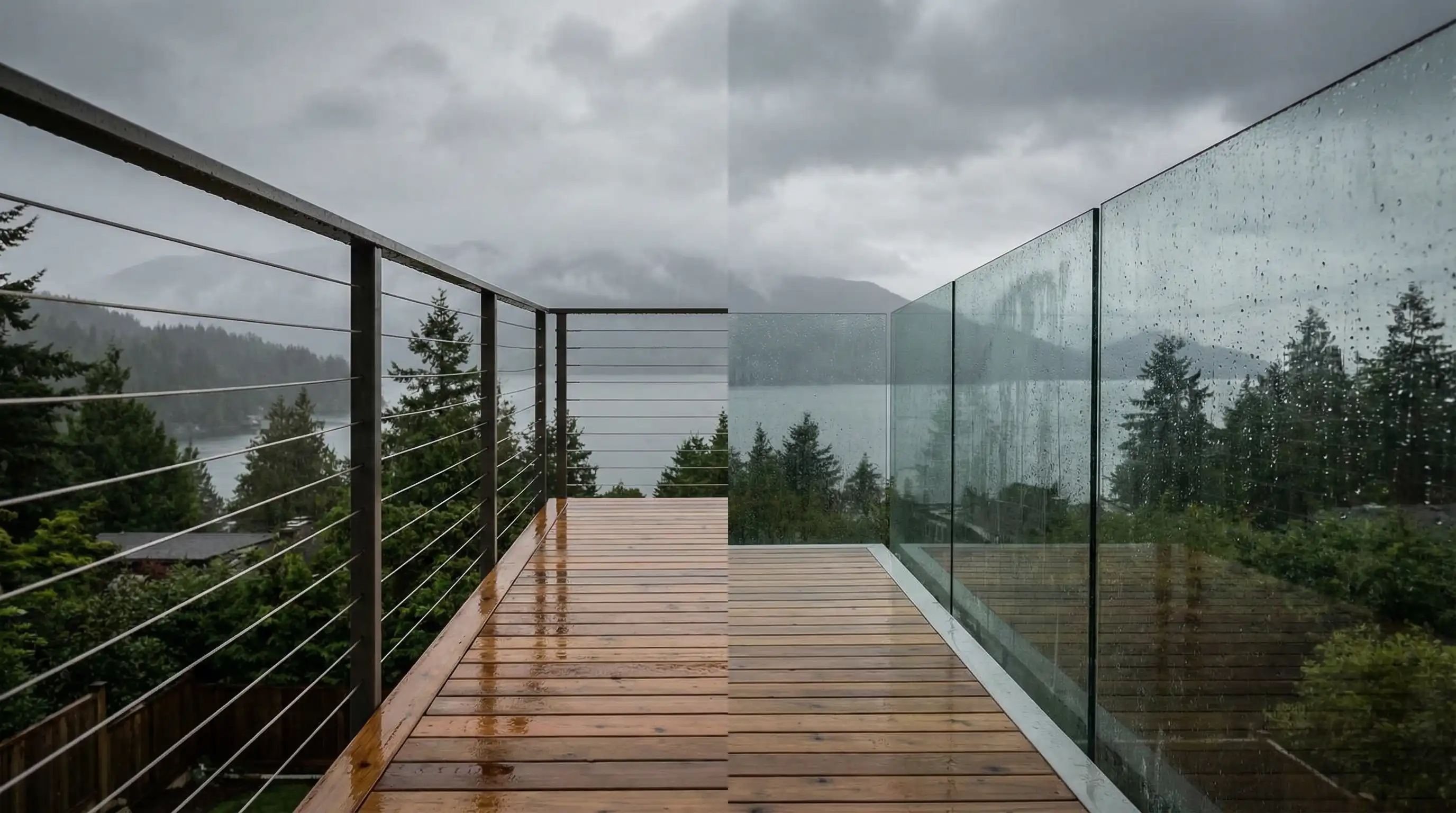
If you're a homeowner in Metro Vancouver, you've probably asked yourself: "Should I get glass railings or cable railings?"
It's the most common question we hear. And most comparison articles online are written for American markets — they completely ignore BC's specific weather, building codes, and regulations.
We're a Coquitlam-based custom fabrication shop that installs both systems. We don't push one over the other. What follows is an honest, source-backed comparison across the six factors that actually matter in our climate.
BC's Climate: Why It Matters
According to Environment Canada, Vancouver International Airport gets ~1,189 mm of rainfall across 164+ days a year. In elevated areas like North Vancouver and Coquitlam, precipitation exceeds 2,000 mm.
- Persistent moisture (rain on 45% of days)
- Coastal salt air from the Burrard Inlet and Strait of Georgia
- Pacific storm gusts exceeding 90 km/h
Source: Environment and Climate Change Canada — Climate Normals 1991–2020
A Note on the Building Code
Both systems can be built fully code-compliant in BC — including horizontal cable in Vancouver, which By-law #14343 re-permitted for most residential guards in September 2025. For the exact guard heights, opening limits, and glass rules that apply to your project, see our guide to BC Building Code glass railing requirements.
The Head-to-Head
Six factors that matter in Metro Vancouver.
Rain Performance
Cable Railing
Rain is a non-issue. Water passes through. No flat surfaces collect mineral deposits. After a storm, the railing looks the same.
Glass Railing
Rain is glass's biggest enemy in Vancouver. Every rainfall leaves water spots that accumulate into mineral deposits. Within weeks, panels look cloudy. Unchecked, these deposits bake in and permanently etch the glass—a process we detail in our climate destruction guide.
Wind Protection
Glass Railing
Solid panels act as a windbreak, creating a sheltered microclimate on your deck. This extends the usable outdoor season—a major advantage on windy coastal evenings.
Cable Railing
Zero wind protection. Great for summer airflow, but no shelter from gusts. However, cable presents minimal wind load during Pacific storms, reducing structural stress.
Coastal Salt Air Resistance
Cable Railing
Excellent — if fabricated from Type 316 (marine-grade) stainless steel. Grade 304 will eventually show "tea staining" in coastal BC. We only use 316 for exterior jobs. For a deeper dive into metals, read our guide to coastal BC railing materials.
Glass Railing
The panels are immune to salt. But the metal hardware (posts, spigots) is the vulnerability. If cheap hardware is used, it corrodes fast.
Maintenance in BC
This is where the difference is most dramatic.
Cable Railing
~1–2 hours per year
Annual tension check, wipe with damp cloth 2-4x per year. Freshwater rinse for coastal properties. That's it. Cable is low-maintenance when the system is built correctly, but weak posts or hardware can lead to sag. See why cable railing sags and how proper tension works.
Glass Railing
~8–20+ hours per year
Monthly cleaning minimum. Professional cleaning recommended for upper-floor balconies.
05. Quality of Views
Glass provides an uninterrupted frameless view — when clean. In Vancouver's climate, a dirty glass panel (or one covered in morning dew) obstructs views more than cables.
Cable (3–4 mm lines) is nearly invisible from a distance and the view stays consistent regardless of rain, spotting, or time of year. This is a key reason why black cable railing has become the top architectural trend for BC homes.
So Which Should You Choose?
Choose Cable If:
- Low maintenance is your top priority.
- Property faces coastal salt & heavy rain.
- Budget matters over the next 10 years.
- You want to utilize the new VBBL rules.
Choose Glass If:
- Wind protection is essential for comfort.
- Location is sheltered (e.g., covered interior stair).
- Complete containment logic (pets/gaps).
- Strata rules require matching glass.
Pro Tip: Consider Both
Many of our Metro Vancouver projects use a hybrid approach: Glass panels on the windward side for weather protection, and cable on the leeward side for crystal-clear views and airflow.
If picket is also on the table for your deck, our broader deck railing options guide compares all three systems against BC code and climate. For upper-floor units where the cable-vs-glass trade-offs shift dramatically, our balcony railing decisions guide walks through what changes above 4.2 m.
Ready to decide?
At LOUEI Metal Arts, we fabricate both. Every project is measured on site, built in Coquitlam, and installed by our crew across the Lower Mainland.

Written by LOUEI Metal Arts
This comparison is drawn directly from our experience fabricating and installing custom metal railing systems in the Lower Mainland. We see first-hand how different materials perform after 5+ years of driving coastal rain, salt air, and heavy winds—and we engineer our systems to outlast those elements.