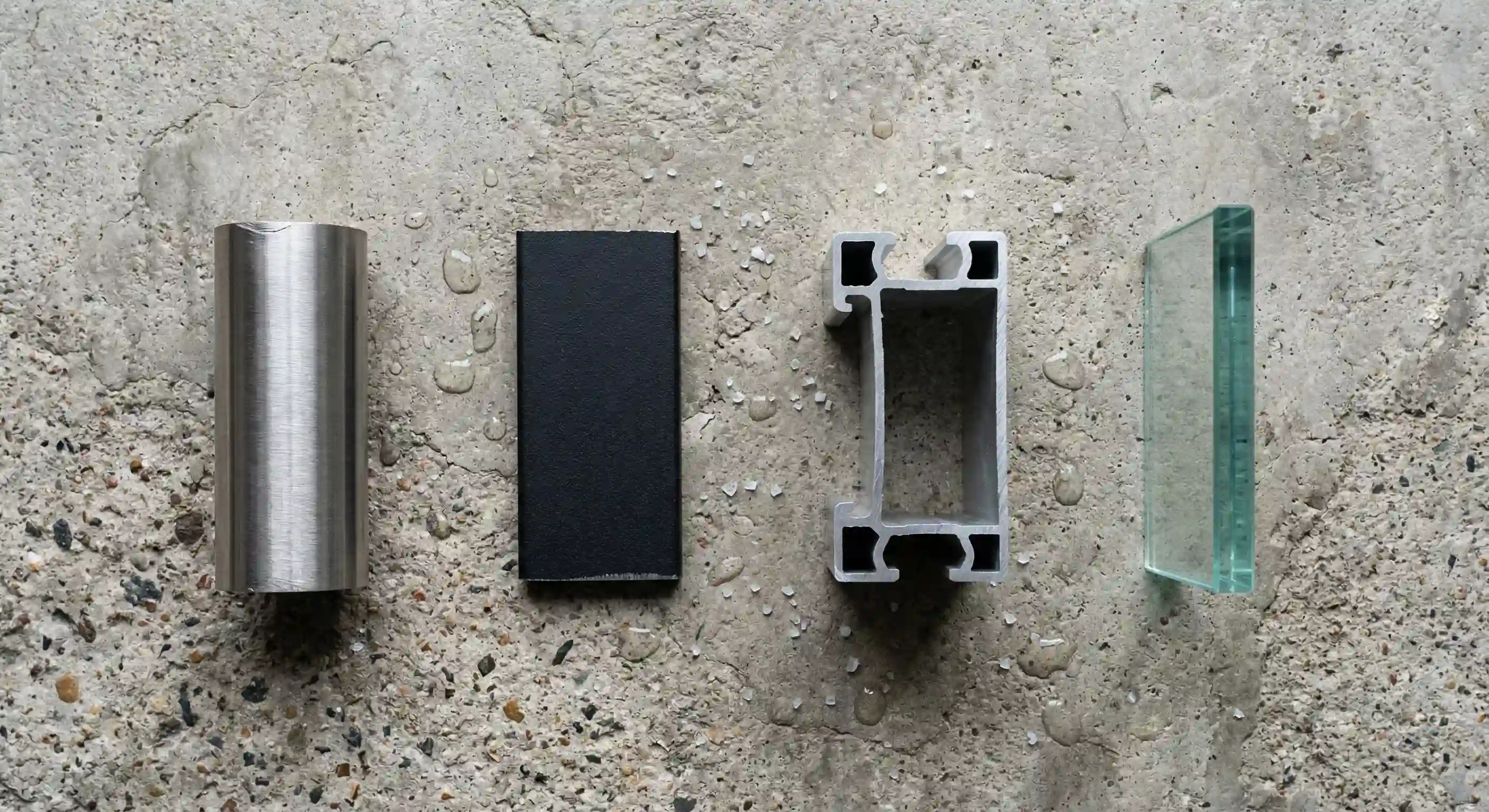
Your neighbour in Kitsilano has cable railing. Your cousin in Kelowna went with glass. Your contractor says "just go aluminum — it's lighter and easier." And that one guy on Reddit swears by Duplex 2205 because his uncle works on oil rigs.
Everyone has an opinion. Nobody is talking about the one factor that actually decides which material survives on your deck: the specific climate attacking your property.
British Columbia is not one climate. A railing that thrives on a sheltered Burnaby patio will pit and stain within three years on a West Vancouver headland facing the open Strait of Georgia. A glass system that stays crystal-clear in Kamloops will be coated in mineral haze after six weeks of Metro Vancouver rain.
We install all of these materials — 316 stainless, powder-coated steel, aluminum, glass, and Duplex 2205 — across BC. We've watched them perform for years. What follows is the material selection guide we wish every homeowner had before signing a quote.
Material × Climate Snapshot
Which material handles which BC threat — at a glance.
(GALV+PC)
Four Climate Zones,
Four Different Enemies
Before you choose a material, you need to know what your property is actually fighting. BC has four distinct railing environments, and each one destroys materials differently.
To understand the specific failure mechanisms behind these recommendations — the chemistry of chloride pitting, the physics of freeze-thaw, and the real-world evidence — see our guide to how BC's climate destroys the wrong railing material.
Metro Vancouver
Vancouver, Burnaby, North Shore, Surrey, Richmond, Coquitlam
~1,200 mm of rain per year. Moderate salt exposure on the western waterfront and North Shore. Mild winters — frost is rare, freeze-thaw is minimal. The dominant threat is persistent moisture sitting in joints, pooling in channels, and wicking into unsealed welds for six straight months. This is exactly why most Metro Vancouver homeowners shopping for an exterior deck railing end up specifying 316 hardware and welded steel frames. The same coastal moisture logic drives material choice for an exterior balcony railing, where standing water in base channels is even harder to drain on a slab.
Sea-to-Sky Corridor
Squamish, Whistler, Pemberton
Heavy rain at valley level, heavy snow and aggressive freeze-thaw at elevation. Water that seeps into a railing base plate in October will freeze, expand, thaw, and refreeze dozens of times before April. Limited salt exposure — corrosion is less of a concern than mechanical fatigue from ice cycling.
Sunshine Coast & Vancouver Island
Nanaimo, Victoria, Gibsons, Sechelt
The most corrosive residential atmosphere in BC. Direct salt spray from open ocean, combined with rain and wind. Properties within 500 metres of tidal water experience chloride levels that can push even marine-grade 316 stainless into surface staining territory.
Okanagan & Interior
Kelowna, Vernon, Penticton, Kamloops
Hot, dry summers with intense UV exposure. Cold, dry winters with sharp freeze-thaw. Minimal salt, minimal rain. The primary threats are UV degradation of coatings and sealants, and wildfire vulnerability — not corrosion.
"The takeaway: A railing company that recommends the same material for a Kamloops lakehouse and a West Vancouver oceanfront property either doesn't understand metallurgy — or doesn't care. The material must match the site."
Five Materials, Tested
by BC Weather
What follows is a material-by-material breakdown. We are not ranking them from best to worst — we are mapping each one to the conditions where it excels and the conditions where it fails. For how each material performs as a system (cable vs. glass vs. picket), see our Cable vs. Glass comparison guide. If you are considering cable and wondering about Vancouver's recent climbability code changes, see our guide to the current horizontal cable code requirements. This article is strictly about the metals and glass themselves.
Material A: 316 Marine-Grade Stainless Steel
The standard for BC's coastal railing hardware. Contains 2–3% molybdenum, which is the element that resists chloride (salt) corrosion. This is why it earns the "marine grade" label.
Cable hardware, turnbuckles, standoffs, glass fittings, and exposed handrails on any property within 1,500 metres of salt water. In Metro Vancouver, the North Shore waterfront, Kitsilano, Point Grey, the Sunshine Coast, and Victoria's inner harbour — 316 is the minimum standard for any exposed metal component. If you are choosing cable for a coastal deck, material grade is only part of the system — tension, post stiffness, and hardware matter too. See why cable railing sags and how to keep it tight.
316 is not invincible. Its Pitting Resistance Equivalency Number (PREN) is 24–26, which sits below the 32 threshold for full chloride immunity. In aggressive marine zones — direct splash, unrinsed salt buildup, warm stagnant conditions — 316 can develop a tan surface discolouration called "tea staining." It is cosmetic, not structural, but it surprises homeowners who assumed "marine-grade" meant "immune."
For pools, spas, and ritual baths, the material question becomes even sharper. See the best materials for pool and wet-area handrails.
Monthly freshwater rinse in coastal zones. Annual stainless-safe protectant for waterfront properties. Interior applications: essentially zero.
Material B: Aluminum (Powder-Coated)
Lightweight, naturally corrosion-resistant, and the dominant material in mass-produced railing kits across North America. Aluminum forms a protective oxide layer on contact with air — it literally self-seals.
Large strata balcony replacement projects where speed and volume drive the decision. Interior BC locations (Kelowna, Kamloops) where salt exposure is non-existent and the primary threat is UV — a quality AAMA 2605 powder coat handles UV well. Also strong for any project where weight matters.
Most aluminum railing systems are bolted kit assemblies — not welded. This is the critical distinction. Bolted joints work loose from thermal expansion, wind vibration, and the simple reality of people leaning against the railing thousands of times. After five to ten years in an exposed BC location, you may hear rattling, feel play in the posts, or see daylight through splice joints. For a timeline of what to expect, read our DIY kit vs custom fabrication timeline. In direct coastal salt air, raw aluminum pits. Low-grade powder coats (below AAMA 2604 standard) can fail within seven years on the coast.
"Aluminum is not a bad material. It is a misapplied material. It is excellent for the right project — and quietly disappointing when used where welded steel or 316 stainless should have been specified."
Rinse twice yearly. Inspect and re-tighten bolted connections annually. Touch up coating chips immediately — exposed aluminum in salt air will pit.
Material C: Mild Steel (Hot-Dip Galvanized + Powder Coat)
Standard structural carbon steel — the same material that frames buildings and bridges. On its own, mild steel rusts aggressively in wet air. The entire performance story comes down to how it is protected.
Custom picket railings, stair guards, and architectural metalwork where design flexibility matters more than anything else. Mild steel can be welded into any profile, curve, or geometry — and the fully welded frame acts as a single rigid structural unit with no bolted joints to loosen. The protection system (media-blasted, hot-dip galvanized, powder coat) gives mild steel a service life that matches or exceeds aluminum in every BC climate zone except direct ocean splash.
If the coating is compromised — a deep gouge that exposes bare steel, a poorly sealed weld bead, or a single-layer powder coat without galvanizing — mild steel will rust. In Metro Vancouver's six-month wet season, an exposed scratch can show orange within weeks. The non-negotiable rule: if anyone quotes you mild steel with "just powder coat" and no galvanizing for an exterior BC installation — walk away. To see how these finishes look in reality, check out our RAL powder coat colour guide.
Seasonal hose rinse. Annual visual inspection of the finish. Immediate touch-up if bare steel is exposed anywhere.
Material D: Duplex 2205 Stainless Steel
The most corrosion-resistant railing material commercially available. A duplex alloy (half austenite, half ferrite) with high chromium, molybdenum, and nitrogen content. Its PREN is 34–35 — well above the 32 threshold where chloride corrosion effectively stops.
Structures in permanent salt spray: dock railings, marina walkways, oceanfront hospitality properties, and bridges over brackish water. This alloy was engineered for offshore oil platforms and seawater piping — environments far more hostile than anything residential in BC. For premium waterfront homes on exposed headlands (Point Grey, Horseshoe Bay, Gibsons waterfront, Tofino), 2205 delivers absolute peace of mind over a fifty-year service life.
A backyard deck in Coquitlam. An interior stair in Surrey. A covered patio in Kelowna. For the vast majority of BC residential projects, 316 stainless provides more than adequate corrosion performance. Duplex 2205 is a specialty alloy — harder to source, harder to fabricate, and unnecessary unless the site genuinely demands it.
"We carry Duplex 2205 and fabricate with it when the site demands it. But we will never upsell it to a homeowner who doesn't need it. If your property is not in a direct, constant salt-spray environment, 316 is the right call."
Virtually none. Periodic rinsing is recommended but rarely necessary.
Material E: Glass (Tempered / Laminated Panels)
Glass is railing infill — it sits between structural posts and rails. The glass itself is impervious to corrosion, salt, UV, and moisture. It will never rust, rot, or degrade from BC weather. The weak link is always the hardware holding the glass.
Any property where the view is the entire point — ocean-facing balconies, mountain-view decks, rooftop terraces. Low-iron glass eliminates the green tint of standard float glass, keeping colours true. In the Okanagan's clear skies, glass stays clean longer and looks spectacular.
- Rain & Coastal zones: Every rainfall deposits minerals. Without regular cleaning, panels develop a cumulative haze. In highly exposed marine areas, morning dew and fog will also temporarily obscure views.
- Freeze-thaw zones (Okanagan, Sea-to-Sky): The critical risk is not the glass — it is the mounting channel. Base-shoe systems must be engineered with drainage so water cannot pool and freeze around glass edges. Poor channel drainage is the number one cause of glass panel failure in cold climates.
- Hardware quality: Low-grade zinc-alloy spigots or grade 304 stainless clamps will fail on the coast long before the glass shows any issue. Every LOUEI glass railing uses 316 stainless or powder-coated steel hardware.
Clean panels every one to three months depending on rainfall exposure. Inspect hardware and drainage channels seasonally.
Climate Zone
Recommendations
Now the practical part: which material to specify for your specific location.
Metro Vancouver
Vancouver, Burnaby, Richmond, Surrey, North Shore, Coquitlam
Mild steel (galv + PC) for picket railings and custom guards — strongest all-round choice, maximum design flexibility, fully welded rigidity.
316 stainless for all cable hardware and glass fittings.
AVOID: Untreated or single-coat mild steel. Grade 304 stainless on any waterfront property. Low-spec aluminum kits.
Sea-to-Sky Corridor
Squamish, Whistler, Pemberton
Sunshine Coast & Vancouver Island
Nanaimo, Victoria, Gibsons, Sechelt
316 stainless for all exposed hardware — minimum standard. For heavily exposed waterfront properties with direct salt spray, Duplex 2205 for posts and fittings.
AVOID: Uncoated aluminum near the waterfront. Grade 304 stainless in any exposed application. Any steel system without hot-dip galvanizing.
Okanagan & Interior
Kelowna, Vernon, Penticton, Kamloops
Mild steel with UV-stable PC — the strongest all-round performer in the interior. Corrosion risk is minimal; the primary enemy is UV. Aluminum is also strong here. Glass works exceptionally well given clear skies.
The Three Questions That
Expose a Bad Fabricator
Before you sign any railing contract in BC, ask these three questions. The answers separate a materials-literate fabricator from a kit reseller.
Question 1: "What coating system do you use on exterior mild steel?"
Correct Answer: Media-blasted → hot-dip galvanized → super-durable polyester powder coat.
Red Flag: "We prime and powder coat it." (No galvanizing = rust within 5–8 years in coastal BC.)
Question 2: "What grade of stainless steel do you use for exterior hardware?"
Correct Answer: 316 (or Duplex 2205 for extreme marine).
Red Flag: "Stainless steel" without specifying grade, or "304." (304 tea-stains in coastal air.)
Question 3: "Are your railing frames welded or bolted?"
Correct Answer: Fully welded in-shop, finished as a single assembly.
Red Flag: "We assemble on site with brackets." (Bolted joints loosen. Kit systems rattle.)
How We Specify
Materials For Your Site
We do not apply a default material to every project. Every consultation begins with an assessment of your specific conditions:
- Distance to salt water — drives stainless grade selection.
- Elevation and exposure direction — determines wind load and UV intensity.
- Structural substrate — concrete, wood framing, steel ledger — affects anchoring method.
- Maintenance tolerance — some homeowners want zero upkeep; others are fine with an annual inspection.
A second-storey East Vancouver deck gets a different material spec than a waterfront balcony in West Vancouver — even if the railing style looks identical.
Frequently Asked Questions
Straight answers about materials and BC weather.
Does stainless steel rust in Vancouver rain?
Grade 316 stainless is formulated to resist corrosion in wet, chloride-rich environments. In Metro Vancouver, 316 will not develop rust under normal conditions. However, properties within 500 metres of tidal water should rinse exposed stainless monthly to prevent long-term surface discolouration. Grade 304 is not recommended for exterior coastal use.
Is aluminum railing better than steel for Vancouver's rain?
Aluminum is naturally rust-proof and lightweight, making it a common choice for large strata projects. But most aluminum systems are bolted kits that loosen over time. Welded mild steel with hot-dip galvanizing plus powder coat delivers superior structural rigidity, a seamless appearance, and a comparable or longer lifespan — with far less long-term maintenance.
What is the best railing material for a BC waterfront property?
For properties within 500 metres of tidal water, 316 stainless is the minimum standard for all exposed hardware. Glass infill paired with 316 fittings maximizes views. For extreme exposure — dock railings, piers, direct splash zones — Duplex 2205 provides the highest corrosion resistance commercially available.
How long does powder-coated steel last in Vancouver?
A properly specified system (media-blasted, hot-dip galvanized, super-durable powder coat) delivers 30+ years in Metro Vancouver with minimal maintenance. A single-layer powder coat without galvanizing may fail within 8–12 years in a rain-heavy environment.
Can I use glass railing where it freezes (Okanagan, Whistler)?
Yes — but the mounting system must be engineered for freeze-thaw. Base-shoe channels need integrated drainage to prevent water from pooling and freezing around glass edges. Spigot and standoff mounts are generally more freeze-thaw tolerant than channels. We design every Kelowna and Whistler glass installation with climate-specific drainage detailing.
For aging-in-place homeowners, accessibility-driven railing upgrades may qualify for BC RAHA and federal tax credits totaling over $24,000 when fabricated to BC Building Code Article 9.8.7 graspability standards.

LOUEI Metal Arts
Specialists in custom architectural metalwork, serving Greater Vancouver and British Columbia. We fabricate in steel, stainless, and aluminum, building code-compliant systems designed for the specific demands of the Pacific Northwest climate.