Back to Blog

    Why Horizontal Cable Railing Is Now Legal in Vancouver And what changed on September 15, 2025.

    LOUEI Metal ArtsMarch 202610 min read
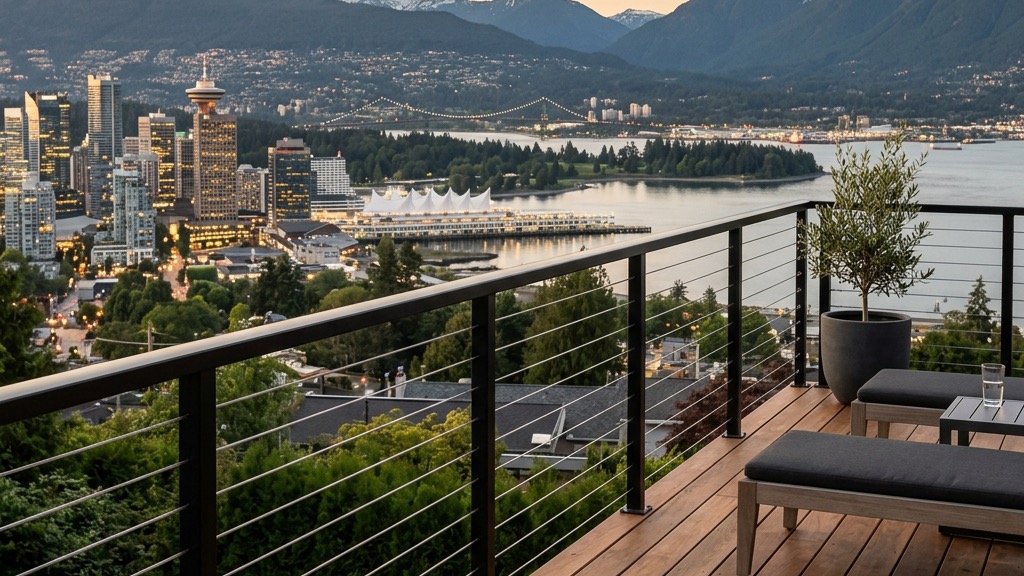
    Horizontal cable railing on a Vancouver residential deck — now legal under VBBL 2025

    If you asked a Vancouver contractor about horizontal cable railing any time before September 2025, you probably heard one of two things: "It's not allowed" or "It's a grey area — I wouldn't risk it."

    Both answers were understandable. For fifty years, Vancouver's building code restricted horizontal elements in guards because of a theoretical concern about children climbing them. The result was a city full of vertical picket railings and glass panels — while homeowners in Burnaby, Surrey, and every other BC municipality were free to install the sleek, modern cable systems they saw in American and European architecture magazines.

    That changed on September 15, 2025.

    Vancouver Building By-law #14343 harmonized the city's guard requirements with the National Building Code, officially removing the blanket anti-climbing restrictions that had blocked horizontal cable railing for decades. If you have been waiting for this change — or if you had no idea it happened — this guide explains exactly what the code says now, what it means for your property, and what rules still apply.

    QUICK REFERENCE

    What Changed at a Glance

    The September 15, 2025 update in plain language.

    FEATUREBEFORE SEPT 15, 2025AFTER SEPT 15, 2025
    Horizontal cable infillRestricted (climbability rules applied to ALL heights)Permitted for falls ≤ 4.2 m
    Horizontal bar / rod infillRestrictedPermitted for falls ≤ 4.2 m
    Vertical picket infillPermitted at all heightsStill permitted at all heights
    Glass infillPermitted at all heightsStill permitted at all heights
    Guards above 4.2 mAnti-climbing requiredAnti-climbing still required
    100 mm sphere ruleRequiredStill required — unchanged
    Guard height (1,070 mm)RequiredStill required — unchanged
    By-law referenceVBBL 2019VBBL 2025 (By-law #14343, Article 9.8.8.6.)
    01

    The 50-Year Misconception

    How a 1975 regulation without evidence locked out an entire category of railing design.

    The restriction on horizontal guard elements in Canada traces back to a single provision introduced in the 1975 National Building Code (NBC). The original rule was narrow — it applied only to guards around balconies in Part 3 residential buildings — and it was based on a theoretical concern that horizontal members could serve as "toe-holds" for children climbing over railings.

    There was one significant problem: the provision was never supported by documented injury data. No coroner reports. No hospital statistics. No recorded incidents of children falling as a result of climbing horizontal guard infill — in Canada or in the United States, where horizontal cable and bar railing remained legal throughout this entire period.

    Despite the lack of evidence, subsequent editions of the NBC expanded the scope of the restriction to cover more building types and more locations. By the time BC adopted its provincial code, and Vancouver built its own Building By-law on top of that, the anti-climbing restriction had become a blanket rule that applied to all guards at all heights.

    The practical effect was simple: in Vancouver, if you wanted a modern railing with any horizontal element — cable, flat bar, rod — you were out of luck. Vertical pickets or glass. Those were your options.

    "For fifty years, a regulation introduced without injury evidence restricted an entire category of railing design in Vancouver. Meanwhile, homeowners across the border in Washington State — and even in Burnaby, fifteen minutes away — installed horizontal cable railings without incident."
    02

    The Timeline

    From NBC 1975 to VBBL 2025 — a fifty-year arc.

    1975 — NBC introduces anti-climbing provision

    The National Building Code adds a requirement restricting horizontal guard elements. Applied only to Part 3 residential balconies. No supporting injury data.

    1975–2007 — Scope expands without evidence

    Successive NBC editions expand the anti-climbing restriction to more building types and locations. Still no documented injuries related to horizontal guard infill. The U.S. maintains no such restriction throughout this period.

    2007–2014 — Industry pushes back

    Bezdan Railing Solutions and industry proponents begin an eight-year research and advocacy effort to challenge the restriction. The National Research Council (NRC) conducts research that confirms the widely held belief: there is no evidence linking horizontal guard design to child injuries.

    March 2015 — NBC 2015 removes the blanket restriction

    Articles 3.3.1.18., 3.4.6.6., and 9.8.8.6. are updated. Anti-climbing requirements now apply only to guards protecting a fall of more than 4.2 metres. Below that threshold, horizontal infill — including cable — is explicitly permitted.

    2015–2024 — Provinces adopt the change (except Vancouver)

    BC adopts the change through the BCBC. Alberta, Saskatchewan, Nova Scotia, Yukon, and eventually Quebec follow. Municipalities governed by BCBC — Burnaby, Surrey, Coquitlam, North Vancouver, Richmond, and others — begin permitting horizontal cable railing. But the City of Vancouver operates under its own Building By-law (VBBL), which had not yet adopted the NBC 2015 guard articles.

    September 15, 2025 — Vancouver finally harmonizes

    Vancouver Building By-law #14343 takes effect. Article 9.8.8.6. ("Design of Guards to Not Facilitate Climbing") is updated to apply only to guards protecting a fall of more than 4.2 metres. Horizontal cable railing is now fully permitted in Vancouver for the first time in fifty years.

    "For nearly a decade after the National Code changed, Vancouver remained the last major holdout in BC. A homeowner in Burnaby could legally install cable railing while their neighbour across Boundary Road in Vancouver could not. That inconsistency ended on September 15, 2025."
    03

    What the Code Actually Says Now

    Article 9.8.8.6. in plain language.

    The updated VBBL 2025 (By-law #14343) states:

    "Except for guards in industrial occupancies, guards required by Article 9.8.8.1. that protect a level located more than 4.2 m above the adjacent level shall be designed so that no member, attachment or opening located between 140 mm and 900 mm above the level protected by the guard facilitates climbing."

    In plain English, this means:

    ✓ PERMITTED (fall ≤ 4.2 m):

    Horizontal cable railing, horizontal bar or rod infill, ornamental designs with horizontal elements — on residential decks, most balconies, stairs, porches, and any guard where the drop to the surface below is 4.2 metres or less.

    ✗ STILL RESTRICTED (fall > 4.2 m):

    Guards protecting a fall of more than 4.2 metres — typically third-storey balconies and above — must still be designed so that no element between 140 mm and 900 mm above the protected level facilitates climbing. This effectively requires vertical pickets or glass at these heights.

    How tall is 4.2 metres in practice?

    4.2 metres is approximately 13.7 feet — roughly the height of a standard second-storey balcony above grade. Most single-family homes, townhouses, and low-rise developments in Metro Vancouver fall well within this threshold.

    "If your deck is on the first or second storey — which covers the overwhelming majority of residential projects in Metro Vancouver — horizontal cable railing is now fully code-compliant."
    04

    What Did NOT Change

    The climbability update was one rule. These others still apply exactly as before.

    This is where homeowners and even some contractors get confused. The September 2025 update changed one specific provision — climbability. Every other guard requirement remains fully in force.

    100 mm Sphere Rule — Still Required

    A 100 mm (4-inch) sphere must not be able to pass through any opening in the guard. For cable railing, this means cables must be spaced close enough — and tensioned tightly enough — that even under lateral pressure, the gap between cables does not exceed 100 mm.

    ⚠ COMMON INSPECTION FAIL:

    Cable deflection. Cables may look tight at installation, but if a child pushes against them laterally and the gap opens beyond 100 mm, the guard fails inspection. Proper cable gauge, post spacing, and tensioning hardware are critical.

    Guard Height — Still 1,070 mm

    The minimum guard height for most exterior decks and balconies remains 1,070 mm (42 inches). The 900 mm (36-inch) exception still applies only to interior guards within a dwelling unit or exterior guards serving a single dwelling unit with a drop of less than 1.8 m.

    For the full breakdown of guard height rules, see our BC Building Code railing guide.

    Structural Loads — Still Required

    Guards must resist a horizontal load of 0.75 kN/m applied at the top of the guard. Cable railing end posts and corner posts bear significant tensioning forces and must be properly anchored to structural framing — not just screwed into deck boards.

    Handrail Graspability — Still Required

    If the guard is along a staircase, it must include a continuously graspable handrail. A wide flat cap rail does not qualify. A secondary offset rail or a shaped top rail that meets graspability requirements is typically required.

    Permits — Still Situation-Dependent

    Switching from a vertical picket system to horizontal cable is a system change. Even though cable is now permitted, switching systems often triggers a permit requirement because the structural loading changes. See our permit guide for details.

    Considering cable railing for your Vancouver deck or balcony?

    We fabricate and install code-compliant horizontal cable systems across Metro Vancouver — now fully permitted under the updated VBBL.

    05

    Five Myths That Still Circulate

    Even after the code changed, bad information persists.

    Myth 1: "Cable railing is illegal in Vancouver."

    FACT: Not since September 15, 2025. Horizontal cable is permitted for any guard protecting a fall of 4.2 m or less. This was the law in the rest of BC for years — Vancouver was the last major city to catch up.

    Myth 2: "Horizontal cables are dangerous for children."

    FACT: The National Research Council conducted research that found no evidence linking horizontal guard infill to child injuries — in Canada or in the United States, where horizontal cable has been legal for decades. The original 1975 restriction was introduced without supporting data and was removed after the evidence was reviewed.

    Myth 3: "Cable railing is only for modern or West Coast homes."

    FACT: Cable infill works with virtually any architectural style. The slim profile of 316 stainless cables (typically 3–4 mm diameter) virtually disappears against the background. It pairs naturally with wood posts, black powder-coated steel frames, and brushed stainless systems. Browse examples on our cable railing page.

    Myth 4: "Cables will sag and loosen over time."

    FACT: A properly engineered cable system with marine-grade hardware and correct post spacing will hold tension for decades. Turnbuckle systems allow for periodic re-tensioning if needed — a five-minute adjustment, not a structural concern. The key is the quality of the hardware, not the concept of cable infill.

    Myth 5: "The rest of BC still bans horizontal cable."

    FACT: The opposite. The BC Building Code adopted the NBC 2015 guard changes years before Vancouver did. Every municipality in BC governed by BCBC — Burnaby, Surrey, North Vancouver, West Vancouver, Coquitlam, Richmond, Squamish, Kelowna, Victoria, and all others — has permitted horizontal cable railing for guards under 4.2 m since the BCBC 2018 adoption. Vancouver was the exception, not the rule.

    06

    Where Cable Railing Works Best in Vancouver

    Now that the code allows it — where does it actually make sense?

    Cable railing is not the right system for every project, but the code change opens it up for the applications where it excels:

    Residential decks and elevated patios

    Why cable works: Unobstructed views of mountains, ocean, or garden. Slim cables virtually disappear compared to pickets or glass panels. Rain passes through — no cleaning required after every storm. See our cable railing systems.

    Second-storey balconies (under 4.2 m)

    Why cable works: Maximum transparency without the maintenance burden of glass. No mineral spotting from Vancouver rain. Strata-friendly when specified with uniform black or stainless posts.

    Exterior stairs

    Why cable works: Horizontal cables paired with a graspable offset handrail create an open, airy staircase. Especially effective on hillside properties in North Vancouver and West Vancouver where the stair descends through a landscape.

    Pool and hot tub enclosures

    Why cable works: Code-compliant barrier with minimal visual weight. Water spray and splash do not accumulate on cables the way they spot glass panels.

    ⚠ WHERE CABLE IS NOT PERMITTED:

    Guards protecting a fall of more than 4.2 m (typically third-storey balconies and above). For these applications, see our glass railing or picket railing systems.

    For a detailed head-to-head comparison of cable vs. glass across all six performance factors, see our Cable vs. Glass guide.

    07

    What You Need to Know Before Installing

    Cable is now legal. Here is how to make sure your installation is code-compliant.

    Use 316 stainless steel — minimum

    Grade 304 stainless will develop surface staining (tea staining) in Metro Vancouver's coastal atmosphere. For all exterior cable railing, 316 marine-grade stainless is the minimum recommendation for cables, fittings, turnbuckles, and standoffs. For a deeper material breakdown by climate zone, see our railing material guide.

    Post spacing matters

    Maximum post spacing for cable railing is determined by cable deflection — not just aesthetics. Wider post spacing means cables can flex further apart under pressure, risking a 100 mm sphere failure. Typical residential post spacing for cable systems is 1,200–1,800 mm depending on cable gauge and tensioning system.

    End posts take the most stress

    Every cable run terminates at an end post. The cumulative tension from multiple cables creates significant lateral force on those posts. End posts must be anchored directly to structural framing — joists, beams, or concrete — not surface-mounted to deck boards.

    Pre-swaged vs. field-swaged cables

    Pre-swaged cable assemblies (factory-crimped) deliver more consistent tension and cleaner terminations than field-swaged (on-site crimped) cables. At LOUEI Metal Arts, every cable panel is pre-swaged, labelled for post-to-post spacing, and installs with a single hex key — reducing site labour significantly.

    Get it inspected

    Even though cable is now permitted, the installation must still pass municipal inspection. Inspectors check cable tension, sphere spacing, post anchoring, guard height, and handrail graspability. A properly engineered and fabricated system passes on the first visit.

    Build it once. Build it to code.

    Horizontal cable railing is no longer a grey area in Vancouver. It is code-approved, backed by decades of evidence, and installed by the same crew that fabricates it.

    FAQ

    Common questions about horizontal cable railing in Vancouver.

    Are horizontal cable railings legal in Vancouver?
    Yes. Since September 15, 2025, Vancouver Building By-law #14343 permits horizontal cable railing for guards protecting a fall of 4.2 metres or less. This covers the vast majority of residential decks, balconies, and stairs.
    Are cable railings legal in the rest of BC?
    Yes. The BC Building Code adopted the National Building Code changes years before Vancouver did. Municipalities outside Vancouver — including Burnaby, Surrey, North Vancouver, Coquitlam, and others governed by BCBC — have permitted horizontal cable railing for guards under 4.2 m since the BCBC 2018 adoption.
    What is the 4.2 metre rule for cable railing?
    Anti-climbing restrictions only apply to guards protecting a fall of more than 4.2 metres (approximately 13.7 feet). Below that threshold, horizontal elements like cables, flat bars, and rod infill are permitted. Above it, vertical pickets or glass are required.
    Do cable railings still need to pass the 100 mm sphere test?
    Yes. The climbability change did not affect the 100 mm sphere rule. A 100 mm sphere must not be able to pass through any opening in the guard, including between cables. Cables must be spaced close enough — and tensioned properly — to prevent sphere passage even under deflection.
    Can I install cable railing on a high-rise condo balcony?
    It depends on the fall height. If your balcony is more than 4.2 m above grade (roughly above the second storey), anti-climbing restrictions still apply and horizontal cable would not be permitted. Glass or vertical picket systems are required for those heights. Additionally, strata approval is typically needed for any balcony railing change.
    What grade of stainless steel should cable railing use in Vancouver?
    Type 316 marine-grade stainless steel is the minimum recommendation for exterior cable railing in Metro Vancouver. Grade 304 can develop surface staining (tea staining) in coastal salt air. LOUEI Metal Arts uses 316 stainless exclusively for all exterior cable hardware.
    LOUEI Metal Arts Logo

    Written by LOUEI Metal Arts

    We have been installing cable railing systems across Metro Vancouver and BC since before the Vancouver code change — and we closely tracked the regulatory process as it moved through City Council in 2025. This guide reflects both the current code and our hands-on experience fabricating and installing horizontal cable systems that pass inspection on the first visit.

    About LOUEI Metal Arts: We are a premier custom metal fabricator serving Vancouver, Burnaby, Coquitlam, and the Lower Mainland. We specialize in high-end, code-compliant architectural systems.