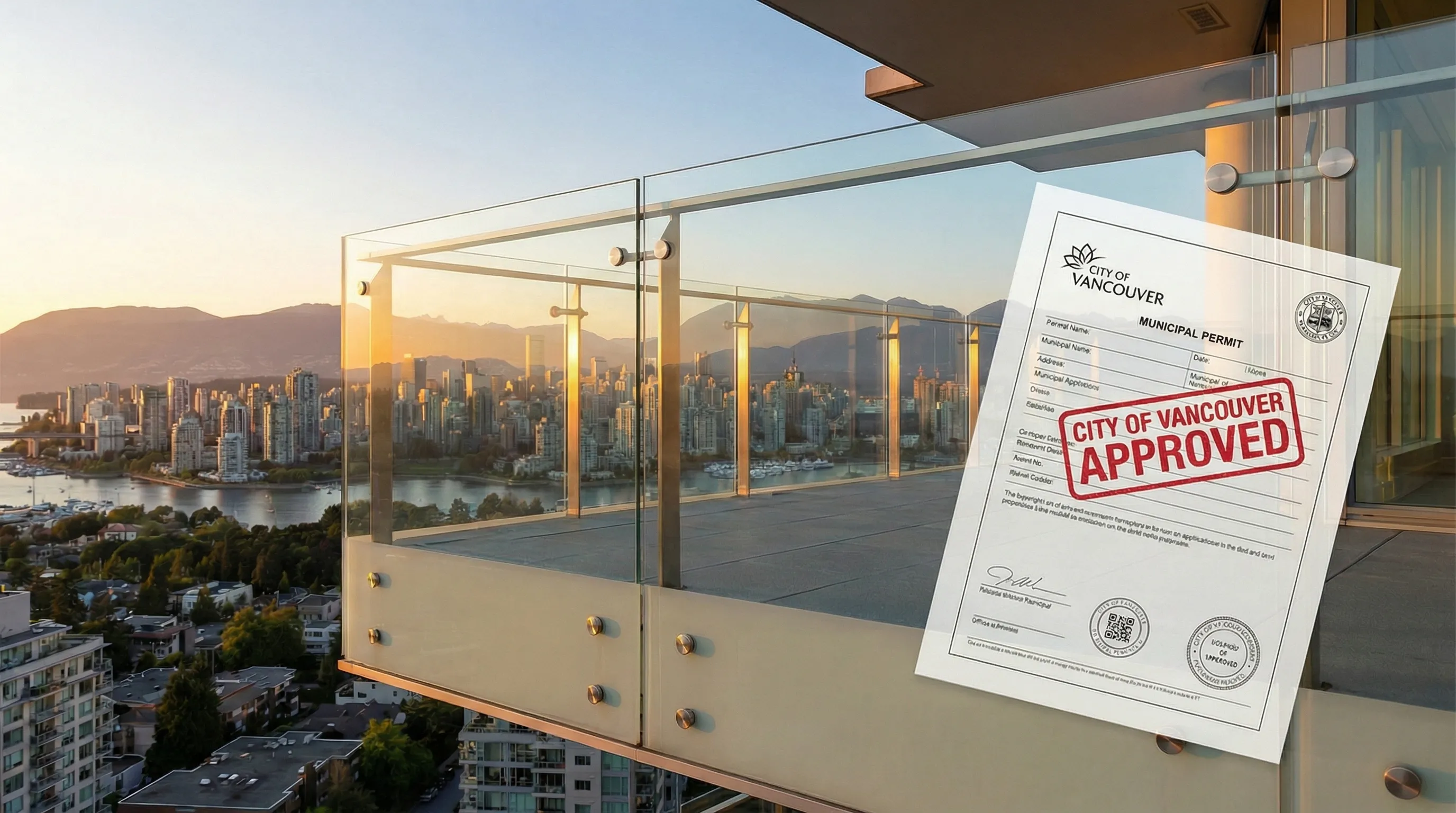
You have a railing that needs to go. Maybe the wood pickets are rotting after fifteen Vancouver winters. Maybe the old aluminum system looks dated and you want glass or cable instead. Maybe your strata council has mandated a building-wide railing replacement. Whatever the reason, one question comes up early:
Do I actually need a building permit to replace my deck or balcony railing?
The answer isn’t a simple yes or no. It depends on what you’re changing, where it’s installed, and which municipality you’re in. Metro Vancouver spans multiple jurisdictions—Vancouver, Burnaby, North Vancouver (City and District), West Vancouver, Surrey, Coquitlam, Richmond, and others—and each building department has its own enforcement approach and review expectations.
This guide covers the most common railing replacement scenarios in plain language, explains where the permit lines typically fall, and flags the risks of getting it wrong. This is general guidance based on our experience installing railings across Metro Vancouver. For your specific project, always confirm requirements with your local building department before starting work. If you already know you need a full deck railing service, our Vancouver hub walks through system selection, code, and quoting.
Quick Summary (Cheat Sheet)
Often NOT Required
- Like-for-like replacement on a previously permitted deck (same type, same footprint, same mounting).
Often Required
- Changing railing type(picket → glass/cable)
- Adding a new guard(adding where none existed)
- Structural modificationsto framing/posts
- Strata / Condo buildings(almost always)
- Commercial properties
Rule of Thumb: Swapping same-for-same is usually maintenance. Changing systems or structure triggers permits.
Permit Decision Flow
Use this quick flow before you call the city—this is the fastest way to self-classify your project:
Was the deck/balcony originally permitted and inspected?
If no / not sure → assume you’ll need guidance (and possibly a permit).
Are you changing the railing system type? (picket → glass/cable, etc.)
If yes → you’re likely in permit/engineering territory.
Are you adding a guard where none existed? (or drop > 600 mm)
If yes → permits are commonly required.
Are you touching structural framing or waterproofing?
If yes → expect permits and/or engineered details.
Is this a strata condo/townhouse balcony?
If yes → strata approval is usually mandatory; permitting is common.
Scenario 1:
Like-for-Like Replacement
This is the simplest scenario. Your deck was originally built with a permit, it has an existing railing, and you want to replace that railing with a new one of the same general type—wood picket for wood picket, aluminum for aluminum, glass for glass—on the same footprint, at the same height, using the same mounting locations.
In many Metro Vancouver municipalities, a like-for-like railing replacement on a previously permitted deck is often treated as maintenance and may not require a new building permit, provided you are:
- not altering the deck structure,
- not changing the railing type,
- not expanding the guard to new areas, and
- not changing the fundamental connection approach.
A scope that begins as like-for-like can change when waterproofing or supporting layers are opened. See how membrane replacement affects railing reuse and reinstallation.
Where people get surprisedSome municipalities (or inspectors) expect replacement work to meet current code—not the code from the year your home was built. That means an older, “grandfathered” railing may have been acceptable in the past, but once replaced, the new guard may be expected to comply with today’s requirements (height, openings, loads, etc.).
Recommendation: Call your local building department and describe the scope in one sentence. It’s a five-minute check that can prevent rework later.
Scenario 2:
Changing Railing Type
This is where permits come up most often—especially for homeowners searching “permit replace deck railing Vancouver” or “building permit railing BC.”
Changing the railing type is more than cosmetic. Different systems load your deck differently:
- Glass guards can be heavy and can introduce higher lateral demands through posts and base channels.
- Cable railings create significant tension forces at end posts and corners.
- Horizontal bar systems can behave similarly to cable in how they load end conditions.
Why Departments Care
When you switch systems, the building department wants to verify:
- New guard meets current code
- Connections to deck framing are adequate
- Post blocking/joist reinforcement is sufficient
- Waterproofing isn't compromised
Vancouver Note (Sept 2025)
Homeowners in Vancouver who previously avoided cable may now revisit cable railing options. Even if permitted, switching from picket to cable is still a system change requiring structural verification.
Scenario 3:
Adding New Guard
If your deck currently has no railing and the drop exceeds 600 mm (24 inches), a guard is legally required. Adding a guard where none exists is new construction of a life-safety element and often requires a building permit.
A permit for new guard installation typically requires documentation showing:
- guard height and layout,
- materials and system type,
- connection details to structure,
- compliance with current code.
For glass guard installations, engineer-sealed details are commonly requested.
Scenario 4:
Strata (Condos)
Strata projects add approvals that go beyond municipal permitting—this is one of the most common sources of confusion in “deck railing permit Metro Vancouver” searches.
1) Strata council approval (usually mandatory)
Under the BC Strata Property Act, changes to exterior/common property typically require written approval. Balcony railings are often common property. The strata may impose requirements for uniform appearance: style, color, material, and system. If your replacement is for an upper-floor unit, our balcony railing service page outlines what we handle from strata submission through inspection sign-off.
2) Permits depend on scope
- Building-wide balcony railing replacement projects often involve permits, engineering, and inspection sign-off.
- Individual unit replacements may be allowed only if the strata has a standardized system or an approved master scope.
3) Engineering expectations
For multi-storey condos, building departments and insurers often prefer engineer-sealed documentation and clear inspection records.
Scenario 5:
Commercial Properties
Commercial railing projects—retail, office, restaurant patios, institutional buildings—almost always require building permits. Commercial occupancies can have:
- higher guard load requirements,
- accessibility considerations,
- fire and egress implications.
Engineer-sealed drawings are standard in commercial guard installations.
Municipal Differences
Permit requirements are not uniform across Metro Vancouver. The notes below reflect common patterns, but always check your specific address.
- City of Vancouver Generally thorough review; railing type changes and new guards are likely permit-worthy. For how the city's review plays out on real jobs, see our page on railing work in the City of Vancouver.
- Burnaby Often practical on like-for-like; structural mods trigger permits.
- North Vancouver (City & District) Diligent enforcement, especially on hillside properties with high fall hazards.
- West Vancouver Expects strong documentation for hillside/waterfront work; engineering often requested.
- Surrey High volume; like-for-like can be simple; system changes enter standard permit path.
- Coquitlam / Tri-Cities Generally efficient; glass often brings engineering documentation.
- Richmond Corrosion resistance focus near water; similar to BCBC enforcement.
What Happens If You Skip the Permit?
- Stop-work orders / retroactive permits: Can be more expensive and scrutinized.
- Penalty fees: Severe penalties for non-compliance.
- Forced removal: If non-compliant, you may have to rebuild.
- Liability risk: Insurance coverage could be challenged if an injury occurs on unpermitted work.
- Resale complications: Buyers may flag unpermitted work.
If you do get caught or fail an inspection, the consequences can cascade quickly. Learn exactly what happens when your railing fails a building inspection and how to navigate it.
One important exception: adding a graspable accessibility handrail to an existing guard often qualifies for BC senior accessibility funding — BC RAHA, federal HATC, and the BC Senior's Refundable Credit can stack to more than $24,000 in 2026.
Not sure if your project triggers a permit?
Send us a photo and your municipality, and we’ll give you a quick direction on what typically applies.
Send a photo for assessmentWhat LOUEI Metal Arts Handles for You
Permits, code compliance, strata approvals, and engineering coordination are part of what we handle on real projects. When you work with us, we can:
- Assess typical permit triggers
- Coordinate engineer-sealed drawings
- Advise on strata approvals
- Build to current code expectations

Written by LOUEI Metal Arts
We navigate the municipal permit process daily. From dealing with the City of Vancouver's stringent documentation requirements to managing complex strata approvals across Burnaby and the North Shore, our fabrication team knows exactly what inspectors look for when signing off on structural railing replacements.