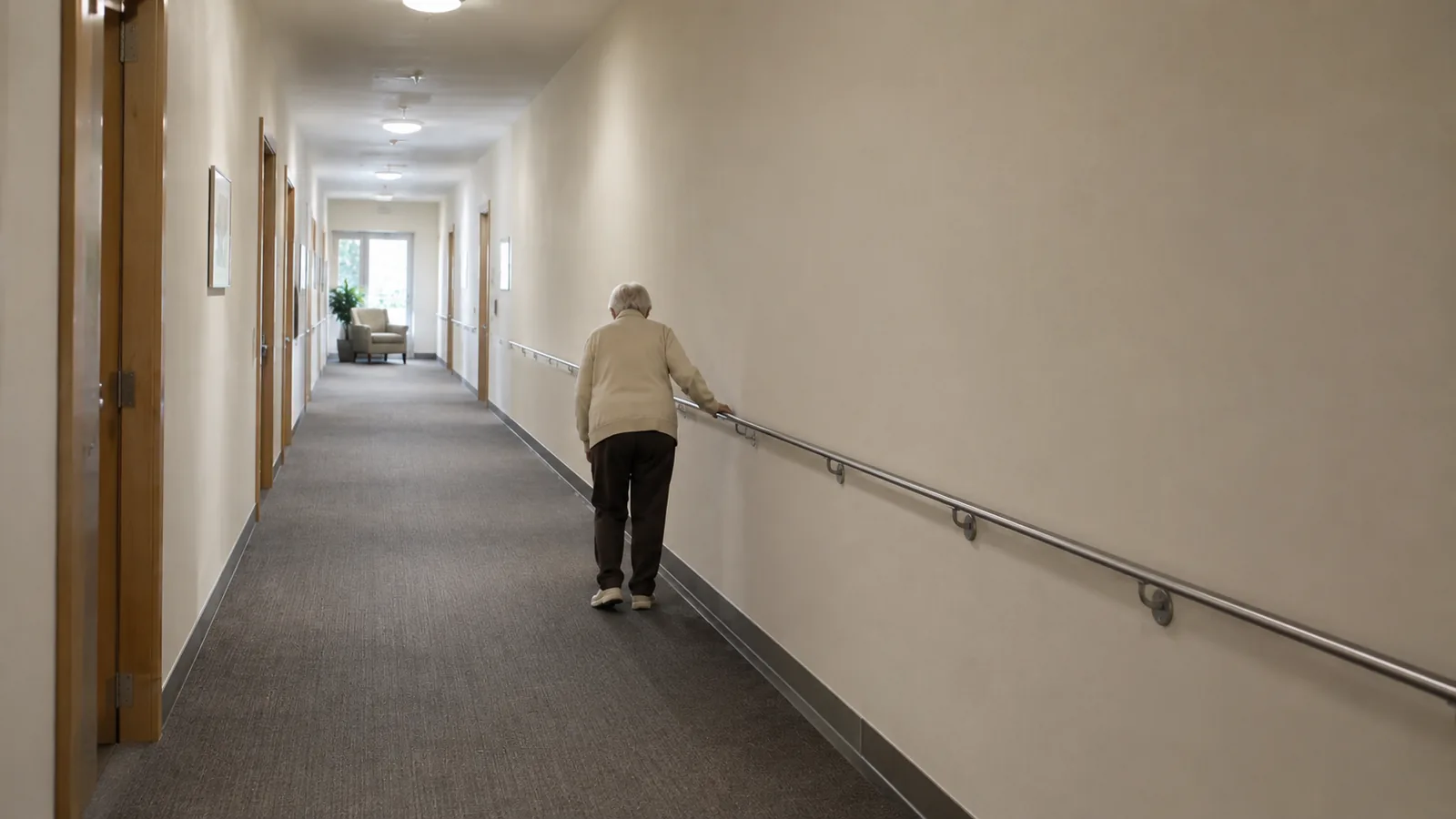
In 2024, BC Emergency Health Services responded to more than 55,600 fall-related calls involving adults aged 66 and older. On an average day in British Columbia, 42 people aged 65 and over are hospitalized due to fall-related injuries, with stays typically lasting more than two weeks.
Falls are the leading cause of injury-related hospitalizations, long-term disabilities, and deaths among BC seniors, costing the province $1.41 billion in 2025 alone. Most are preventable. The BC Injury Research and Prevention Unit and the Office of the Provincial Health Officer consistently name the same short list of interventions: strength and balance exercise, annual medication review, eye exams — and home safety modifications, with graspable handrails and grab bars at the top.
This guide explains the four 2026 government programs that pay for those modifications: BC Housing's Rebate for Accessible Home Adaptations, the federal Home Accessibility Tax Credit (the rate changed in 2025 and again in 2026, and stacking rules with the Medical Expense Tax Credit changed too), the BC Home Renovation Tax Credit for Seniors and Persons with Disabilities, and the Veterans Affairs Canada Veterans Independence Program. It also covers the specific BC Building Code provisions that determine which fabricated metalwork qualifies as a handrail and which doesn't.
A note up front.This article explains current public program rules with citations to official sources at the bottom. It is not legal, financial, or tax advice — LOUEI Metal Arts is a custom metal fabricator, not a professional advisor. For binding decisions, work with BC Housing, the CRA, Veterans Affairs Canada, and a licensed accountant.
The 4-Program Stack at a Glance
None of these programs auto-trigger the others. A successful project means working through three in parallel.
| Program | 2026 Maximum | Type | Administered By |
|---|---|---|---|
| BC RAHA | $20,000 lifetime | Rebate, paid after work completed | BC Housing |
| Federal HATC | $2,800 credit (14% × $20,000) | Non-refundable tax credit | CRA, Line 31285 |
| BC Senior's Credit | $1,000 credit (10% × $10,000) | Refundable tax credit | gov.bc.ca via T1 |
| VAC VIP | Needs-assessed | Direct contribution | Veterans Affairs Canada |
Quick Answers
How much is the BC senior accessibility rebate in 2026?
Up to $20,000 lifetime per household through BC Housing's Rebate for Accessible Home Adaptations (BC RAHA), plus up to $2,800 from the federal Home Accessibility Tax Credit at 2026's 14% rate, plus $1,000 refundable from BC's Home Renovation Tax Credit for Seniors. Combined benefits commonly exceed $24,000.
Who qualifies for BC RAHA in 2026?
BC residents who own or rent their primary home, have a permanent disability or loss of ability (including age-related diminished abilities for seniors 65+), have household assets under $100,000 (excluding equity in the home being adapted), and a home below the BC Housing-published Home Value Limit for their assessment area. For 2026 homeowner applications, BC Housing lists the gross household income limit as $146,270 — verify the current limits directly with BC Housing before applying.
Can BC RAHA stack with the federal HATC?
Yes. RAHA and HATC are separate programs administered by different governments. Crucially, a RAHA rebate does NOT reduce the HATC base — per CRA Line 31285, HATC is calculated on the full pre-rebate eligible expense up to $20,000 of expense per dwelling per year.
What is the HATC rate in 2026?
14% of eligible expenses up to $20,000, for a maximum credit of $2,800 per dwelling per year. The rate was reduced from 15% to 14.5% for 2025 (blended) and to 14% for 2026 and subsequent years per Bill C-4 (Making Life More Affordable for Canadians Act).
Do TFSAs count toward the BC RAHA $100,000 asset limit?
Yes. BC Housing's RAHA program counts TFSAs, GICs, savings, non-registered stocks and bonds, and any property other than the primary residence as liquid assets. Only RRSPs, RESPs, RIFs, vehicles, and the principal residence itself are excluded. This is the most common cause of rejection.
Can a tenant apply for BC RAHA?
Yes, jointly with the landlord using the Landlord and Tenant application. Both parties must meet eligibility criteria; the landlord must consent to the adaptations and may be responsible for ongoing maintenance.
BC RAHA:
The $20,000 Anchor
BC Housing's Rebate for Accessible Home Adaptations is the largest single program — a $20,000 lifetime maximum per household, cumulative across all applications. Funded jointly by the province and Ottawa, it rebates permanent home adaptations tied to a permanent disability or loss of ability.
Income, Asset, and Residency Tests
To qualify as a homeowner in 2026, the household must meet all of these:
- Gross household income below the published limit (Line 15000 of your Notice of Assessment, plus non-taxable income) — province-wide, no regional variation. For 2026 homeowner applications, BC Housing lists the gross household income limit as $146,270. Applicants should verify the current limit directly with BC Housing before applying.
- Household assets under $100,000 across all household members 19+, excluding equity in the home being adapted. Counts: cash, savings, TFSAs, GICs, non-registered stocks and bonds, and any property other than the home being adapted. Excluded: RRSPs, RESPs, RIFs, vehicles, and the primary residence itself.
- Canadian citizenship, permanent residence, refugee status, or an accepted refugee application.
- The home is the primary residence of both the homeowner and the person needing the adaptations.
- The BC Assessment value is below the regional Home Value Limit set by BC Housing (table below), or below the area's average assessed value.
The TFSA rule is the single most common disqualifier. Many applicants assume their full registered-asset balance is excluded because RRSPs are. TFSAs are not — they count.
2026/27 Home Value Limits for LOUEI's Service Areas
BC Housing's 2026/27 Home Value Limits are effective April 1, 2026 and update annually. For the assessment areas we serve (verify current values directly with the BC Housing 2026/27 Home Value Limits publication before applying):
| Assessment Area | Includes | Home Value Limit |
|---|---|---|
| Vancouver | City of Vancouver, University Endowment Lands | $1,599,999 |
| North Shore–Squamish Valley | North & West Vancouver, Bowen Island, Squamish, Whistler, Pemberton, Gibsons, Sechelt, Lions Bay | $1,774,999 |
| North Fraser | New Westminster, Burnaby, Coquitlam, Port Coquitlam, Port Moody, Anmore, Belcarra | $1,224,999 |
| Richmond–Delta | Richmond, Delta, Tsawwassen First Nation | $1,324,999 |
| Surrey–White Rock | Surrey, White Rock | $1,324,999 |
| Fraser Valley | Langley, Chilliwack, Maple Ridge, Mission, Pitt Meadows, Abbotsford, Hope, Harrison Hot Springs | $1,049,999 |
Source: BC Housing — 2026/27 Home Value Limits (effective April 1, 2026).
Use your BC Assessment Notice value — not market price. BC Housing's 2026/27 Home Value Limits are effective April 1, 2026 and update annually. Confirm current values with BC Housing before applying.
What RAHA Pays For (and Doesn't)
The Maximum Rebate Schedule explicitly lists handrails, ramps, grab bars, walk-in tubs, barrier-free showers, raised toilets, lever handles, widened doorways, accessible cabinets, lowered counters, stair lifts, ceiling tracks, and improved lighting. The program excludes: appliances, ordinary repairs or maintenance, luxury materials (granite, marble, hardwood, jetted tubs), and items not directly tied to the disability. If you choose a luxury material, BC Housing may request a second contractor estimate with modest materials and rebate only that amount.
The Critical Sequence
Any work begun before BC Housing's written approval is not eligible. This is the single most common rejection reason. The only exception: emergency adaptations required prior to hospital release. In emergency cases, adaptations must be installed within four months of release, the application must be received within six months, and documentation of the hospital stay and supporting OT/PT assessment must be included.
Once approved, the homeowner has 180 days from the approval letter to complete the work. After completion and submission of receipts, payment is typically mailed within three weeks.
Practical Takeaway"BC Housing prioritizes complete applications. An incomplete file doesn't move forward until corrected — which can push a 4-week timeline past the April 1 annual budget reset."
Federal HATC:
What Changed in 2025 & 2026
The federal Home Accessibility Tax Credit (HATC), claimed on Line 31285, allows eligible renovation expenses up to $20,000 per year. The credit is calculated using the lowest federal personal income tax rate. For 2026, that rate is 14%, so the maximum potential federal HATC value for 2026 is up to $2,800. For 2026 and later tax years, the same expense cannot be claimed under both the Medical Expense Tax Credit (METC) and the HATC.
This is general information, not tax advice. Confirm eligibility and the amount you can actually claim with the CRA or a qualified tax professional.
The 2025–2026 Rate Reduction (Most Calculators Miss This)
The federal government reduced the lowest marginal personal income tax rate — which is the rate applied to most non-refundable credits, including HATC — from 15% to 14.5% for 2025, and to 14% for 2026 and subsequent years. This is part of Bill C-4, the "middle-class tax cut."
| Tax Year | Rate | Max HATC Credit |
|---|---|---|
| 2024 and earlier | 15% | $3,000 |
| 2025 (blended) | 14.5% | $2,900 |
| 2026 and onward | 14% | $2,800 |
Calculators across the internet still quote $3,000. For 2026 returns, the correct number is $2,800.
For taxpayers whose total non-refundable credits exceed the first income bracket threshold ($57,375 in 2025, indexed), Budget 2025 introduced a Top-Up Tax Credit for 2025 through 2030 that effectively restores the 15% rate on amounts above that threshold. For most seniors below the threshold, 14% applies; for higher-income claimants, the Top-Up restores the previous value.
Who Qualifies
A qualifying individual is someone who is 65+ at year-end OR eligible for the Disability Tax Credit at any time in the year. An eligible individual is the spouse, common-law partner, parent, grandparent, child, grandchild, sibling, aunt, uncle, nephew, or niece — as long as the qualifying individual is their dependant. Per CRA's eligibility rules, an adult child renovating their own home to accommodate an aging parent who lives with them may qualify to claim HATC.
The Calculation Detail Most Homeowners Miss
HATC is calculated on the full pre-rebate eligible expense, capped at $20,000 of expense per year. A grant from another government program — including BC RAHA — does not reduce the HATC base. This is per CRA Line 31285 guidance.
On a $25,000 eligible project that received the maximum $20,000 RAHA rebate, HATC is still calculated on the full $20,000 cap — producing up to a $2,800 maximum potential federal credit for that taxpayer in 2026. If a calculator or contractor applies HATC to your out-of-pocket cost only — after subtracting RAHA — the credit base is incorrectly reduced.
Practical Takeaway"Ask your contractor for a year-end summary that itemizes total eligible expense (pre-rebate), the RAHA rebate received, and materials versus labour. Your accountant claims HATC on the pre-rebate eligible expense — not on what you actually paid."
BC Senior's Home Renovation Tax Credit:
The Refundable Layer
Administered by the Province of BC, claimed via Schedule BC(S12) on your T1.
Maximum credit: $1,000 per tax year — calculated as 10% on up to $10,000 of eligible expenses. Refundable — if it exceeds tax owed, the difference is paid out. This refundability is what makes it useful for seniors with low fixed income.
You qualify if you are a BC resident on December 31 of the tax year, and either 65+ (or a family member living with a senior), or eligible for the Disability Tax Credit (or a family member living with such a person). No income limit, no asset limit. The BC credit can be claimed on the same expenses also claimed under federal HATC and the federal METC.
Veterans Affairs Canada:
Veterans Independence Program
For eligible veterans, civilian pensioners, certain Reserve members, qualifying Allied Veterans, and primary caregivers and survivors, VIP funds home adaptations as part of a broader package that includes housekeeping, grounds maintenance, personal care, and ambulatory health services.
Unlike RAHA's published lifetime cap, VAC's VIP home adaptations funding is needs-assessed by a VAC case manager based on a qualified professional's assessment (typically an occupational therapist) and calculated using the going rate in the geographic area. Eligible adaptations explicitly include handrails on stairways, grab bars, ramps, widened doorways, anti-scald valves, and slip-resistant flooring at stairs and entries.
When eligibility exists under both VAC's Treatment Benefits Program and VIP, Treatment Benefits is considered first. Where provincial programs (like RAHA) can address the same need, VAC coordinates rather than duplicates — often RAHA handles the primary structural adaptation while VAC supplements with additional handrails, grab bars, and ongoing maintenance items. VAC frequently pays the contractor directly, bypassing the reimbursement-after-the-fact cash-flow gap of the RAHA model.
The 2026
HATC + METC Change
For renovations completed in 2026 and beyond, per Budget 2025, the Income Tax Act will be amended such that an expense claimed under the Medical Expense Tax Credit cannot also be claimed under the Home Accessibility Tax Credit.
Before 2026, the same dollar could be claimed under both, producing a partial double-credit. From 2026 onward, the same expense must be claimed under one or the other.
For most senior accessibility projects, HATC produces the larger benefit because METC has an income-based threshold (the lesser of $2,834 in 2025 or 3% of net income). However, METC may produce a better outcome when the renovation expense is small and combines with significant other medical expenses in the same year. Your accountant runs both calculations at filing time and selects the winner.
The BC Home Renovation Tax Credit is unaffected by this federal change and continues to stack with both.
Handrails, Railings, and
BC Building Code Article 9.8.7
BC RAHA's Maximum Rebate Schedule explicitly lists handrails as eligible. Generic decorative railings are not. The distinction comes from the BC Building Code itself.
The 2024 BC Building Code, Section 9.8, draws a sharp line between two elements:
- A guard is a barrier preventing falls from an edge. Heights per Article 9.8.8: typically 1,070 mm, with a 900 mm exception inside dwelling units or on exterior decks serving one unit where the drop is under 1.8 m. The 100 mm sphere rule applies to openings. (Full coverage in our BC Building Code 2025–2026 guide.)
- A handrail is a graspable support along a stair, ramp, or path of travel. Its purpose is mobility support — not fall prevention.
Article 9.8.7 governs handrails specifically:
- 9.8.7.4 (Height): Top of the handrail between 865 mm and 1,070 mm, measured vertically from the nosing of the stair tread or ramp surface.
- 9.8.7.5 (Graspability): Handrails must be continuously graspable along their entire length with no obstruction on or above them. The graspable portion must allow a person's fingers and thumb to curl under part of the handrail. Wall clearance: 50 mm minimum (60 mm if rough or abrasive).
- 9.8.7.6 (Projection): Handrails cannot project more than 100 mm into the required stair or ramp width.
- 9.8.7.7 (Loads): Must withstand a concentrated load of 0.9 kN in any direction. Non-residential handrails additionally support a uniform load of 0.7 kN/m.
Standard graspable diameters fall between 30 mm and 43 mm circular cross-section. BC Housing's accessibility design guidelines call for a minimum 38 mm round handrail or equivalent graspable design.
Why This Matters for RAHA Eligibility
For a fabricated railing system to qualify as a RAHA-eligible handrail rather than as an ineligible decorative railing, its design must satisfy Article 9.8.7 — particularly the graspability requirement of 9.8.7.5. A flat top-rail wider than approximately 50 mm typically fails this test (confirmed in BC Building Code Appeal Board decisions BCAB #1301 and BCAB #1937). Returns at the ends, continuous runs through landings, and adequate wall clearance also matter.
Where an existing guard is code-compliant for fall protection but its top rail isn't graspable, a homeowner can add a continuous secondary handrail along the inside or outside of the guard. The added handrail qualifies for RAHA when supported by an OT assessment. The original guard doesn't need to be replaced.
Practical Takeaway"For accessibility renovations, the right question isn't 'does this railing look nice?' It is 'is this handrail graspable along its full length per Article 9.8.7.5?' If yes, and an OT supports the recommendation, RAHA applies."
The Hospital
Discharge Window
Among all RAHA rules, the hospital discharge exception is the most operationally important — and the most poorly known.
The general rule is no work before written approval. The exception: when adaptations are required for hospital discharge, work may begin pre-approval if all three are met:
- Adaptations are installed within four months of hospital release
- The RAHA application is received by BC Housing within six months of release
- The application includes documentation of the hospital stay and an OT/PT assessment supporting the need
This carve-out is what makes RAHA usable on a hip-replacement timeline. A hospital discharge planner can recommend an accessibility install the same week, and a fabricator who understands the emergency-exception invoicing format can begin work without forfeiting the rebate.
The OT
Assessment Threshold
The Maximum Rebate Schedule marks specific adaptations as requiring an Occupational Therapist, Physical Therapist, or other medical professional assessment. These include walk-in tubs, stair lifts, ceiling tracks, and major bathroom or kitchen remodels. For projects approaching the $20,000 lifetime cap, an OT/PT assessment is functionally required regardless of which adaptation is selected.
The assessment must include direct observation (in-person or virtual), disability details, expected duration (12+ months), specific recommendations, and the assessor's credentials. RAHA rebates the assessment cost up to $300 — even if you ultimately don't proceed with the work.
Two routes:
- Public: Through your regional health authority's Home Health intake (Island Health, Vancouver Coastal Health, Fraser Health, Interior Health, Northern Health, First Nations Health Authority). Wait times can be long.
- Private: Through licensed private-practice OTs. The Canadian Association of Occupational Therapists at caot.ca and the Physiotherapy Association of BC at bcphysio.org maintain national directories. Private assessments typically turn around in 2 to 4 weeks.
Common Mistakes
That Void Rebates
After working with families across the Lower Mainland on accessibility installs, the recurring errors are predictable. In rough order of frequency:
1. Starting work before BC Housing's written approval
The single most common rejection reason. Only the four-month hospital-discharge window allows pre-approval work.
2. Treating TFSAs as excluded from the $100,000 liquid-asset ceiling
They count. So do non-registered investments and any property other than the principal residence. Only RRSPs, RESPs, RIFs, vehicles, and the home itself are excluded.
3. Submitting a one-line estimate instead of an itemized quote
BC RAHA requires date, contractor identification, line-itemed materials and labour, applicable taxes (PST/GST), and detailed scope. Bare contractor emails are returned for revision.
4. Allowing the project to drift past 180 days from approval
Approvals expire. Extensions may be granted, but only if requested before the deadline expires.
5. Applying HATC to the out-of-pocket residual
RAHA grants do not reduce the HATC base per CRA Line 31285. This is the single most common contractor and homeowner accounting error.
6. Selecting luxury materials without a 'standard alternative' quote
When granite is selected where laminate would have served the accessibility function, BC Housing pays only the standard-equivalent amount.
7. Forgetting HATC and METC can no longer stack in 2026
Your accountant must run both calculations and choose which credit goes on which expense.
8. Overlooking the home-warranty consideration
Homes under 10 years old may still be under home warranty insurance. Adaptations that void the warranty are a separate problem BC Housing flags but doesn't enforce. Check with your warranty provider before signing.
How LOUEI documents
an accessibility project
Every accessibility quote we send — handrail, integrated railing, ramp rail, or grab-bar — is formatted to BC RAHA submission standards: itemized materials and labour, taxes separated, dated, with our business ID and GST/HST number. Our accessibility handrail and railing work is designed and documented against applicable BC Building Code 2024 Section 9.8 requirements, and Vancouver Building By-law requirements where applicable.
Final anchoring, fastening, blocking, guard/handrail configuration, and permit or engineering requirements depend on the existing structure and site conditions.
We don't issue the application to BC Housing on your behalf — the application is in your name — but we provide what your application requires and what your OT/PT needs to support their assessment.
Port Coquitlam workshop. Serving Vancouver, Burnaby, the North Shore, Richmond, Surrey, the Tri-Cities, the Fraser Valley, Sea-to-Sky, and the Sunshine Coast.
FAQ
Common questions about BC senior accessibility funding.
How long does the full BC RAHA process take?
+
For a non-emergency project: typically 12 to 16 weeks total. Initial contractor quote within several business days. OT/PT assessment in 2 to 4 weeks privately, longer through the public system. BC Housing approval in 4 to 8 weeks after a complete application. Fabrication and installation in 2 to 4 weeks after approval. Reimbursement within roughly 3 weeks after final receipts are submitted. Emergency hospital-discharge cases compress significantly.
Can a tenant apply for BC RAHA?
+
Yes, jointly with the landlord. The Landlord and Tenant application form requires both parties to qualify under income and asset criteria. The landlord must consent to the adaptations and may be responsible for ongoing maintenance.
Our home is above the BC RAHA value limit. Is there anything left to claim?
+
Yes. The federal HATC (up to $2,800 at 2026's 14% rate, calculated on eligible expenses up to $20,000) and the BC Senior's Home Renovation Tax Credit (up to $1,000 refundable) have no income or asset limit. A fully utilized accessibility project may produce up to roughly $3,800 in combined tax credits even without RAHA. For veterans, VAC's VIP funding has no household value test. Confirm eligibility with CRA, BC, and VAC.
Are condo modifications eligible?
+
Yes, including modifications to common areas where the cost is allocated to your unit. For common-area work, you can claim only the portion of the cost allocated to your unit, supported by documentation from the strata corporation.
Where does the graspable requirement come from?
+
BC Building Code Article 9.8.7.5 Sentence 2 states all handrails shall be constructed so as to be continually graspable along their entire length with no obstruction on or above them to break a handhold. BC Building Code Appeal Board decisions BCAB #1301 and #1937 interpret this to mean a flat top rail wide enough to prevent a person's fingers and thumb from curling under it is not graspable. For RAHA eligibility, a fabricated railing system can qualify as a handrail only when its design satisfies this requirement — typically a round or oval profile around 30 to 43 mm in cross-section, or a non-circular profile with equivalent grip characteristics.
My contractor doesn't know how to format a RAHA-compliant invoice. Does that matter?
+
It matters considerably. RAHA's review queue prioritizes complete applications; an improperly formatted invoice pushes you to the back, sometimes past the April 1 annual budget reset. Ask before signing anything: can you provide a RAHA-formatted itemized quote and a final invoice that documents pre-rebate eligible expense, materials, labour, and taxes separately? The answer should be immediate.
How much can BC seniors get for accessibility renovations in 2026?
+
Up to $20,000 lifetime from BC RAHA, up to $2,800 from the federal Home Accessibility Tax Credit (at 2026's 14% rate on eligible expenses up to $20,000), up to $1,000 refundable from BC's Home Renovation Tax Credit for Seniors and Persons with Disabilities, and additional needs-assessed support from Veterans Affairs Canada for eligible veterans. Combined benefits may exceed $24,000 when fully utilized — confirm eligibility with BC Housing and CRA.
Can BC RAHA stack with the federal HATC?
+
Yes. RAHA and HATC are separate programs administered by different governments. A RAHA rebate does NOT reduce the HATC base — per CRA Line 31285, HATC is calculated on the full pre-rebate eligible expense up to $20,000 of expense per dwelling per year.
Do TFSAs count toward the BC RAHA $100,000 asset limit?
+
Yes. BC Housing's RAHA program counts TFSAs, GICs, savings, non-registered stocks and bonds, and any property other than the primary residence as liquid assets. Only RRSPs, RESPs, RIFs, vehicles, and the principal residence itself are excluded. This is the most common cause of rejection.

Written by LOUEI Metal Arts
This guide is drawn from work fabricating and installing custom handrails and accessibility railings across Metro Vancouver and the Fraser Valley. As architectural metal fabricators with CWB-certified welders, we build to BC Building Code 2024 Section 9.8 standards and provide BC RAHA-compliant project documentation to every customer pursuing the rebate. Learn more about our team.
About LOUEI Metal Arts
LOUEI Metal Arts is a custom metal fabrication shop in Port Coquitlam, BC. We build and install code-compliant cable railing, glass railing, picket railing, handrails, and accessibility metalwork for decks, balconies, stairs, ramps, and aging-in-place installations across Vancouver, Burnaby, Richmond, Surrey, and the North Shore. Fully insured and WorkSafeBC-covered, with CWB-certified welders.
Related Reading from the LOUEI Blog
- BC Building Code Railing Requirements 2025–2026: The Vancouver Homeowner's Complete GuideArticle 9.8.7 (handrails) and 9.8.8 (guards) in plain language
- How to Choose the Right Railing Material for Coastal British ColumbiaMaterial selection by climate zone for exterior accessibility work
- Cable vs. Glass Railings: Which Is Better for BC Weather?Comparison for integrated handrail systems
- Do You Need a Permit to Replace Deck Railings in Vancouver?Permits for system changes, including handrail additions
- The Ultimate Guide to Replacing Wood Deck Railings in VancouverWhen replacing degraded railings is the right time to add accessibility features
Sources
All figures and program rules are drawn from the following official government sources, current as of May 2026. Program rules revise annually; verify current details before making decisions.
BC Housing — Rebate for Accessible Home Adaptations (BC RAHA)
- Program overview
- Homeowner Eligibility & Application
- Eligible Adaptations List
- 2026/27 Home Value Limits (PDF)
- Homeowner Application Form (PDF)
- FAQ
- BC RAHA Inquiry Line: 604-433-2218 (Lower Mainland) · 1-800-257-7756 (toll-free)
Canada Revenue Agency — Home Accessibility Tax Credit
Department of Finance Canada — Budget 2025 Tax Measures
Province of British Columbia — Home Renovation Tax Credit for Seniors and Persons with Disabilities
Veterans Affairs Canada
- Veterans Independence Program overview
- VIP Benefits at Home Policy
- Treatment Benefits Program POC 13
- VAC general line: 1-866-522-2122