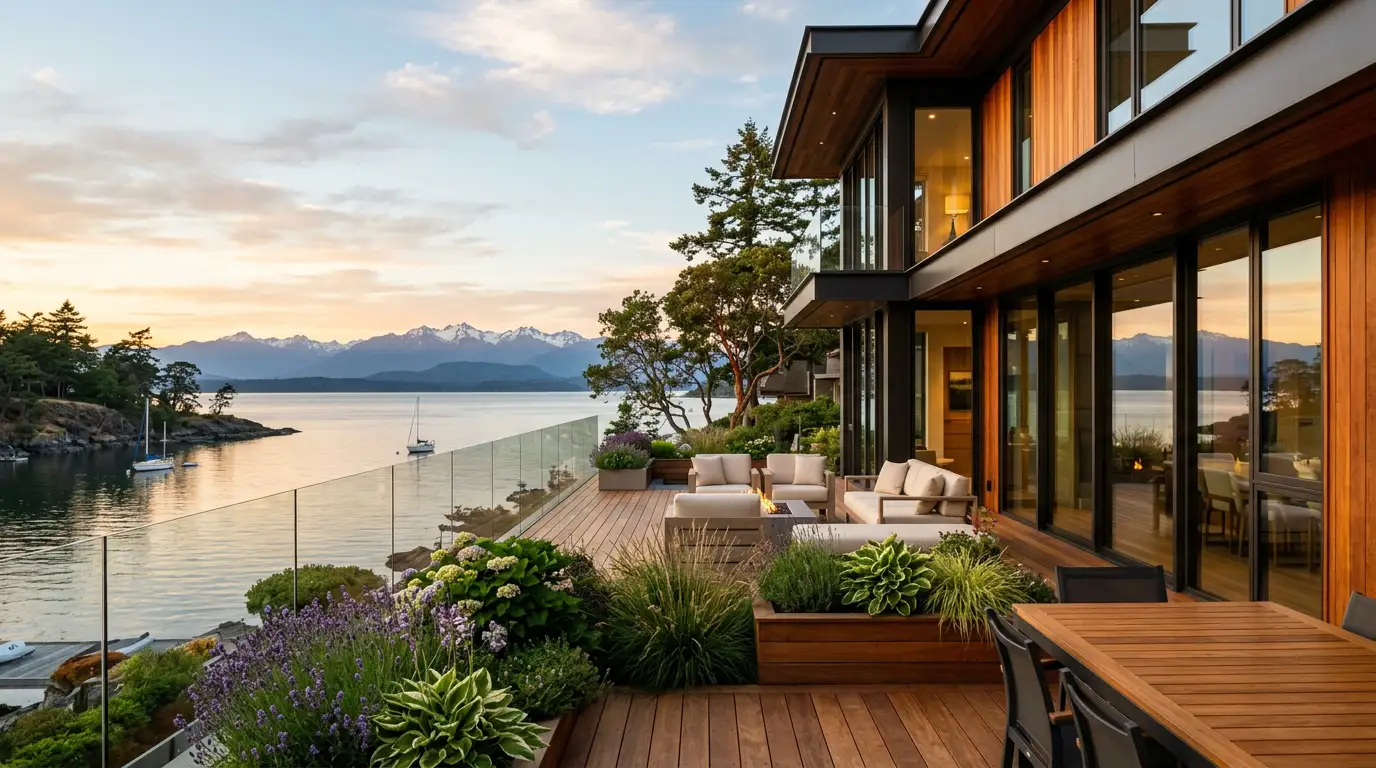
British Columbia Services
Custom Glass Railings in Victoria, BC
Heritage Homes Deserve Better Than Aluminum
Where Heritage Meets Modern: Why Victoria’s Railing Market Demands More Than Aluminum Kits
Pre-1980 Housing
64%
Senior Population
23.2%
Wind Pressure
220 Pa
Victoria is not a typical BC railing market. The architectural DNA runs from Victorian-era heritage homes in James Bay to mid-century apartments in Fairfield to contemporary infill townhomes in Fernwood. Strata balconies outnumber suburban decks. Replacement guards outnumber new installations. Nearly every project involves a conversation about what the building looked like before and what it should look like after.
The railing companies serving this market work almost exclusively in aluminum.
Aluminum kit systems are competent for straightforward installations, but they cannot address the custom angles, heritage-sensitive detailing, mixed-material combinations, or P.Eng.-stamped strata documentation that Victoria’s more complex projects require.
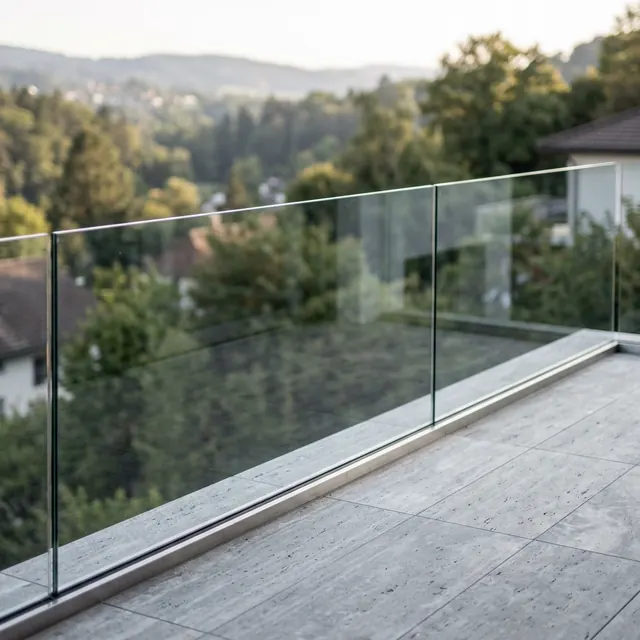
Architectural intent matched with custom fabrication respecting heritage details.
Custom Fabrication:LOUEI Metal Arts is a custom steel and glass fabricator. We design, weld, powder coat, and install glass railings that match architectural intent — whether that's a frameless glass guard on a waterfront Gonzales terrace, a heritage-compatible stair rail for a James Bay restoration, or a strata-wide balcony railing replacement with sealed engineering drawings and Letters of Assurance. Below: how each system serves Victoria's specific project types, what the BC Building Code requires, and what "custom fabrication" actually means for the capital's coastal conditions. For Victoria-specific building permit requirements and Heritage Conservation Area regulations, visit the City of Victoria Building Permits page. Properties in designated Heritage Conservation Areas may require a Heritage Alteration Permit.
Glass Railings for Victoria’s Light-Hungry, View-Conscious Architecture
Victoria receives more overcast winter days than most BC cities. The psychological impact is measurable: architects and homeowners prioritize maximum natural light penetration in every design decision.
A glass railing passes light through — aluminum pickets and steel cables do not. On a Victoria balcony or stairway where winter daylight is precious, the difference between transparent glass and opaque pickets directly affects how the space feels from November through March.
This light-transmission advantage is why glass railings dominate Victoria’s premium residential and multi-family markets. The emerging “Midimalism” design trend in Victoria — blending mid-century warmth with Scandinavian restraint — calls for materials that feel refined without visual weight. Glass delivers exactly that: clean sight-lines, warm-toned hardware (brass-effect, matte black, or brushed stainless), and an open feel that makes compact urban spaces read larger.
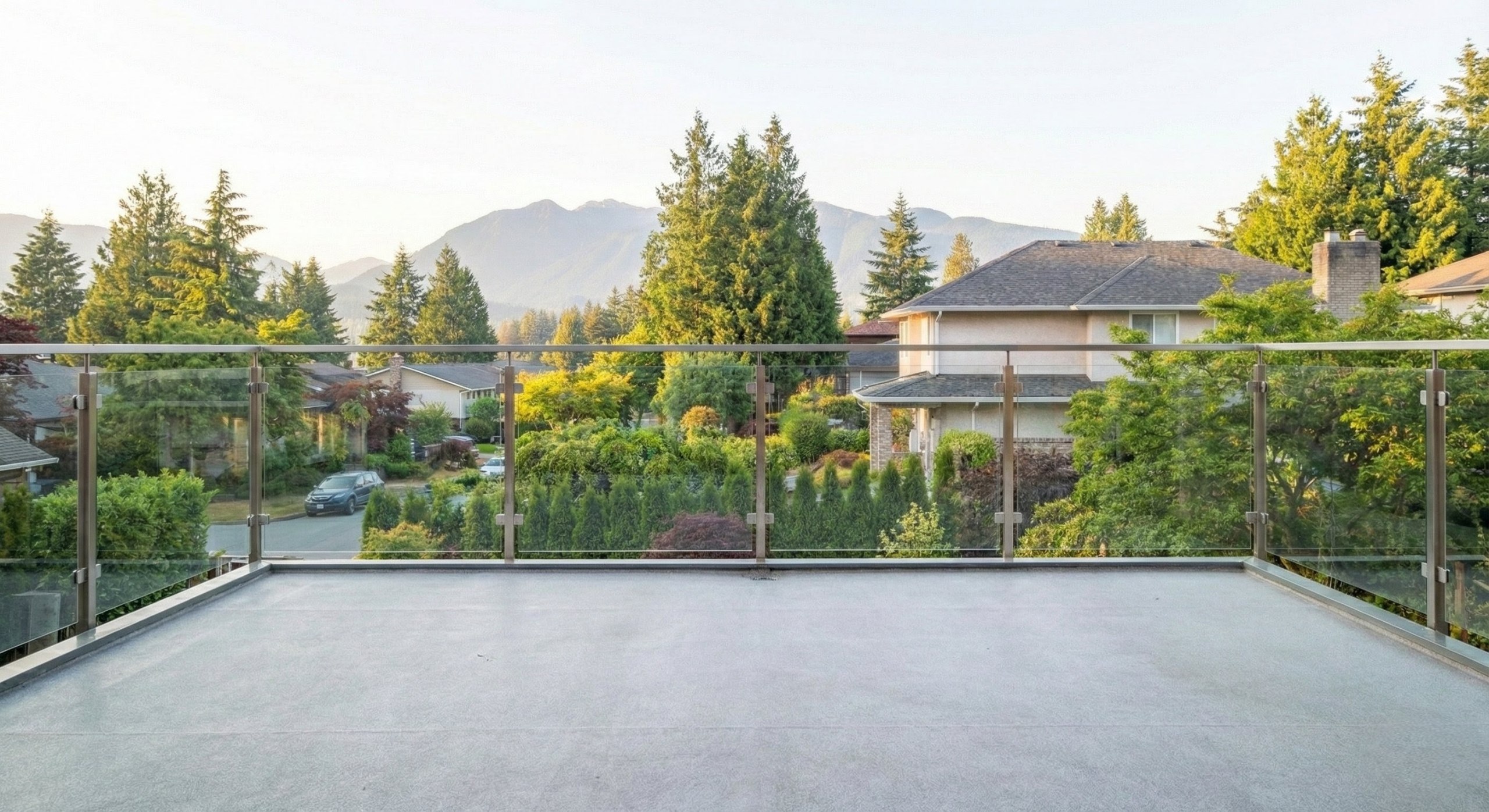
Two Glass Systems for Victoria's Dominant Project Types
Post-and-Clamp — Strata Replacement Standard
Victoria has more apartment units (34,500+) than single-detached homes, and many 40–60-year-old buildings have aluminum or painted steel balcony railings reaching end-of-life. Post-and-clamp glass delivers consistent quality across 32-unit balcony replacement runs at pricing that strata depreciation budgets approve. Steel-framed posts provide the structural rigidity that aging concrete balcony slabs demand — aluminum post systems flex under load on deteriorating substrates. Every strata project ships with P.Eng.-sealed drawings, wind-load calculations calibrated to Victoria's 220 Pa exposure, and Letters of Assurance.
Spigot — Heritage-Compatible Minimal Hardware
For heritage-adjacent projects in James Bay, Rockland, and Fairfield where architectural character must be preserved, spigot-mounted glass uses minimal stainless steel hardware that does not compete with period details. The glass itself is style-neutral — transparent panels let the building's original character remain the visual focus. Available in warm heritage-compatible powder-coat tones (deep green, charcoal, heritage black) rather than the bright aluminum finishes that local competitors default to.
We also fabricate Base-Shoe frameless and Standoff glass systems for waterfront and contemporary applications — see our complete glass railing page for all four options.
Heritage-Compatible Railing Design for Victoria's Character Homes
Victoria has the highest concentration of heritage-designated and character buildings in British Columbia. James Bay alone contains over 300 heritage-listed structures. Rockland, Fernwood, and the Old Town district add hundreds more. When these buildings need railing work — whether upgrading a non-compliant stair guard, adding a new deck railing on a heritage addition, or replacing deteriorated wrought iron — the design must satisfy both modern BC Building Code safety requirements AND the architectural character that heritage designation protects.
This is where pre-fab aluminum kits fail Victoria's heritage market. Standard aluminum railings come in bright silver, black, or white — finishes that look wrong against century-old brick, stone, and painted wood. Standard post profiles and connection details are contemporary industrial, not heritage residential.
Heritage Powder Coating
Custom colours in heritage-appropriate tones — deep greens (RAL 6005, 6009), charcoals (RAL 7016), heritage blacks (RAL 9005 matte), and warm bronzes that complement period building palettes. We match to existing trim colours, not a 3-colour catalogue.
Low-Profile Hardware
Spigot and standoff mounting systems designed to be visually subordinate to the building's existing architectural details. The glass becomes invisible; the hardware becomes a subtle accent, not a visual competitor to century-old craftsmanship.
HAP Coordination
Properties in Victoria's designated Heritage Conservation Areas may require a Heritage Alteration Permit. We work with heritage consultants when HAP review is triggered and design railing systems that satisfy both the Heritage Advisory Panel and modern code. Check the City of Victoria Heritage Register.
Strata Balcony Replacements
(Victoria’s Hidden Market)
Victoria has more apartment units (34,500+) than single-detached homes. Many 40–60-year-old buildings have aluminum or painted steel balcony railings failing code or reaching end-of-life.
| Strata Requirements | Standard Vendor | LOUEI Metal Arts Standard |
|---|---|---|
| Engineering | Required / 3rd party | Sealed P.Eng. Included |
| Wind Load Docs | Generic manufacturer data | Site-specific calculation for Victoria's 220 Pa DRWP per BCBC Appendix C |
| Assurance (Schedules) | Client responsible | Full documentation package |
Coastal Durability
Without Visual Weight
Victoria’s climate data reads: 825mm annual precipitation, moisture index 0.98, 220 Pa driving rain wind pressure. Salt air from the Strait of Juan de Fuca reaches properties across the city.
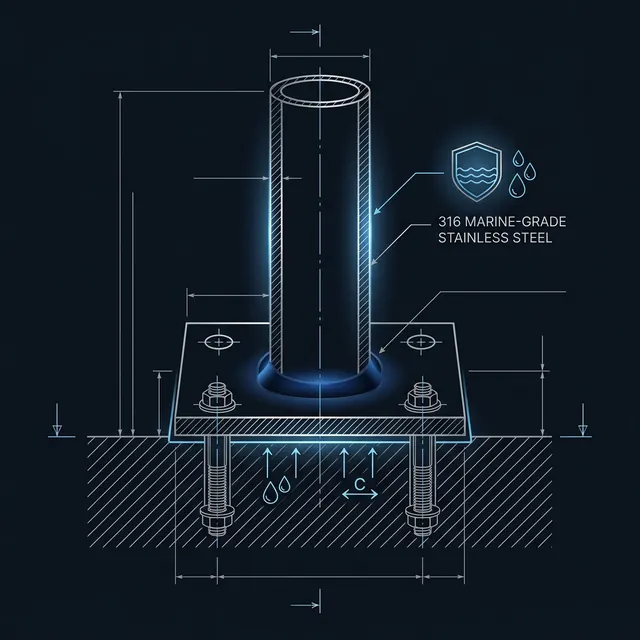
LOUEI Metal Arts specifies 316 marine-grade stainless steel hardware for all Victoria installations. Powder-coated steel frames use factory-applied AAMA 2605-rated finishes. Glass panels are 12mm tempered with edge polishing that prevents micro-chip corrosion initiation.
When strata councils inspect aging balcony railings, surface degradation on 304 SS hardware is the first visible failure indicator. Depreciation reports flag the symptoms: corroded fasteners, stained glass-to-metal connections, pitting at base plates where moisture pools. These are all consequences of specifying 304 instead of 316 in Victoria's coastal environment. LOUEI Metal Arts' 316 SS specification prevents these failure modes entirely.
Handrails for Victoria’s Aging Housing Stock and Senior Population
23.2% of Victoria’s population is 65 or older. 64% of the city’s housing was built before 1980 — before modern accessibility standards existed. The combination creates Victoria’s largest retrofit category: stair handrails and accessible graspable rails for existing homes, apartment common areas, and commercial buildings where current code now requires continuous graspability through landings.
With 64% of Victoria’s housing built before 1980, retrofitting handrails onto century-old James Bay or Rockland stairways means adapting to non-standard tread depths, irregular riser heights, and wall clearances that don’t match modern assumptions. BC Building Code requirements still apply: Part 9 generally specifies graspable handrails at 865–1,070 mm and clearance of 50 mm, or 60 mm at rough surfaces. The exemption for up to three exterior risers is limited to qualifying dwelling/house conditions. Landings, accessible routes and existing-building provisions need separate assessment.
For heritage homes in James Bay and Rockland where the existing stair geometry can’t change, our custom-fabricated stainless steel and powder-coated handrails adapt to the building — not the other way around.
See our accessibility-compliant handrail options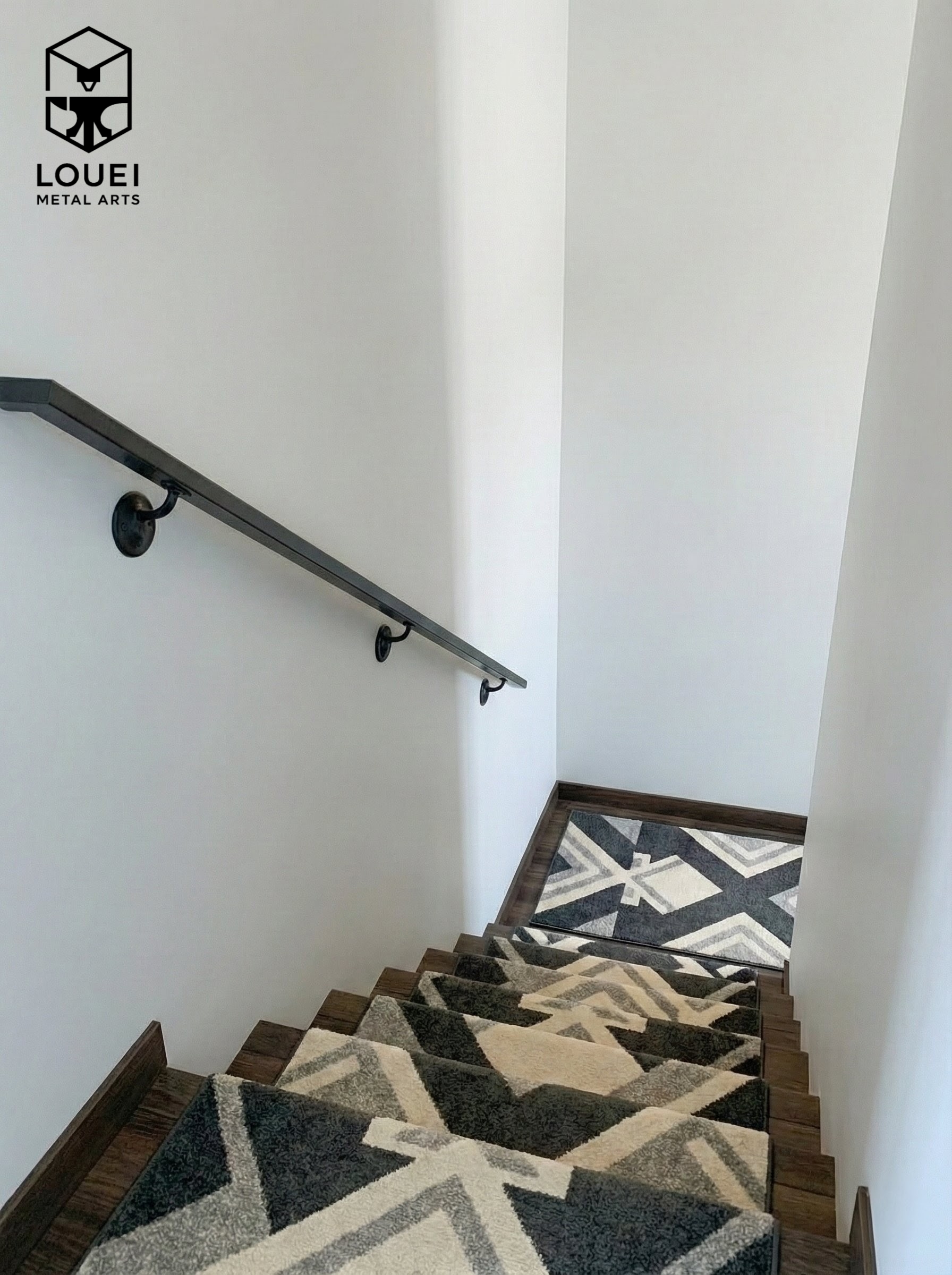
Picket Railings for Heritage-Compatible Projects
Not every Victoria project calls for glass. Heritage renovation work in the Old Town district, family homes in Saanich, and rental property upgrades throughout the city often need a railing system that delivers code compliance, clean lines, and value without the premium of glass.
Our powder-coated steel picket railings are welded to CWB standards in any RAL colour — including the warm heritage tones (deep greens, charcoals, matte blacks) that Victoria’s heritage advisory process favours over bright aluminum finishes.
View our powder-coated picket railing designs →Cable Railings for Contemporary Waterfront
Along Dallas Road, Cadboro Bay, and the Songhees waterfront, the architectural language is industrial-modern — not heritage. Our ClearView Stainless 316 cable railing system is the style choice for these properties — a contemporary option that matches the intent, not just a cheaper-than-glass fallback.
When replacing old balcony railings on Victoria’s aging building stock, cable systems meet current 2024 code — not the original construction-era code. This makes cable a viable modern upgrade for strata buildings seeking both aesthetic improvement and code compliance in a single project. The marine-grade 316 SS specification handles Victoria’s salt-air exposure without surface degradation.
Learn about our ClearView cable railing systems →A Typical Victoria Railing Installation
The following is a representative scenario. It is not a completed case study.
Property
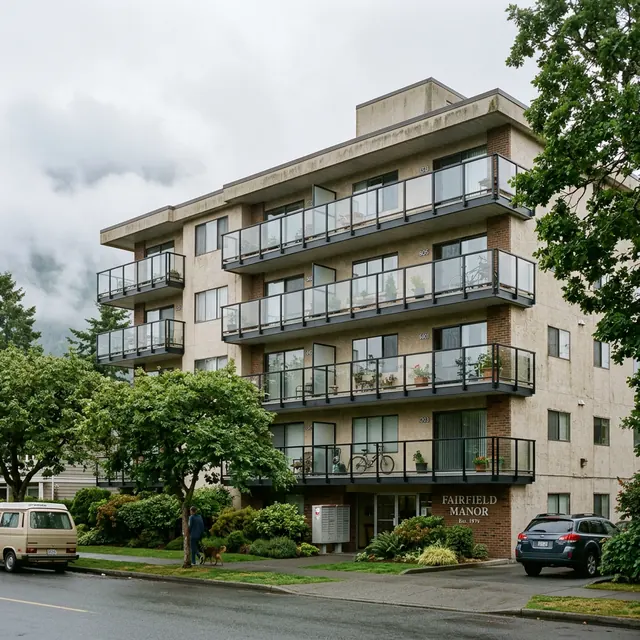
1970s-era strata apartment building in Fairfield, 4 storeys, 32 units. Original painted steel balcony railings showing corrosion and code non-compliance (heights below current 1,070mm standard).
Scope
Full balcony railing replacement across all 32 units. Post-and-clamp glass system selected for consistency, value, and view preservation of ocean views toward the Strait of Juan de Fuca.
Documentation
P.Eng.-sealed structural drawings with wind-load calculations for 220 Pa exposure. Letters of Assurance. Strata council approval package including product specs, colour samples, installation schedule, and noise/disruption plan.
Core Challenges
- ✓ 32-unit consistency requires precision shop fabrication — field-adjusted kit parts create unit-to-unit variation.
- ✓ Original balcony slab conditions require structural assessment before mounting.
- ✓ Resident disruption must be minimized with phased installation over several weeks.
- ✓ Ferry logistics and staging coordination from mainland fabrication studio.
Railing Permit and Code Requirements in Victoria
BC Building Code 2024 applies: Victoria explicitly confirms the BCBC 2024 is in effect for all new permit applications. The city enforces code rigorously, particularly for strata and multi-family work.
BC Building Code & Strata Upgrade Rules
Victoria explicitly confirms BCBC 2024 is in effect. When replacing balcony railings on older Victoria buildings, the new system must meet 2024 code. Many pre-1980 balcony guards were installed at heights that no longer comply. For strata replacements, this often triggers a full-building upgrade from original heights to the current 1,070mm standard. P.Eng. documentation is essential for council approval.
Heritage Conservation & 220 Pa Wind Engineering
Properties in Victoria's designated Heritage Conservation Areas may require a Heritage Alteration Permit (HAP). We design railing systems that satisfy both HAP expectations and building codes. Additionally, Victoria's climatic data specifies 220 Pa driving rain wind pressure due to Pacific exposure. Glass guards must be engineered for this specific wind load, included in our P.Eng.-sealed structural drawings.
Victoria Neighbourhoods We Serve
Victoria's railing market is defined by its diversity — heritage restoration, strata replacement, waterfront premium, and suburban new-build all coexist within a 20-minute drive. Each neighbourhood demands a different approach.
James Bay
Heritage restorations and walk-up apartments.
Fairfield
1970s strata balcony mass replacements.
Oak Bay
Ocean views needing frameless glass.
Gonzales
Marine-grade 316 SS for Pacific exposure.
Rockland
Mansion-scale custom heritage steelwork.
Fernwood
Infill townhomes using cable systems.
Vic West
Contemporary waterfront condos.
Langford
Suburban growth ring family decks.
Colwood
New-build modern estates.
Sidney
Retirement community retrofits.
Frequently Asked Questions
Railings in Victoria
Can LOUEI Metal Arts service Victoria from the mainland?
+
Yes. We fabricate in Coquitlam and transport via BC Ferries. On-site installation ranges from 1 to 5+ days.
Does LOUEI provide strata approval documentation?
+
Yes. Every Victoria strata project includes P.Eng.-sealed structural drawings, wind-load calculations, and Letters of Assurance.
What materials resist Victoria's coastal salt air?
+
We specify 316 marine-grade stainless steel hardware with 2–4% molybdenum for chloride resistance and AAMA 2605 UV-rated powder coating.
How do I get an estimate for a Victoria installation?
+
Detailed quotes include measurement, custom fabrication, ferry transport, and phased installation scheduling.
Can glass railings match heritage homes?
+
Yes, using visually subordinate hardware and heritage-appropriate powder-coat colours.
Do you install accessible handrails?
+
Yes, our handrails meet BC Building Code graspability requirements and fit existing stair geometry.
Do you handle Heritage Alteration Permits?
+
We coordinate with heritage consultants to design systems that satisfy both HAP expectations and building codes.
Are cable railings compliant in Victoria?
+
Horizontal cable is not excluded by the Part 9 anti-climb clause at or below 4.2 m; confirm height, openings, loading, connections and any exit or pool conditions for the project.
Get a Free Consultation for Your Victoria Project
From heritage restorations and strata balcony upgrades to modern waterfront frameless glass — LOUEI Metal Arts delivers custom railing fabrication with the documentation, marine-grade materials, and design sensitivity that Victoria's unique market demands. Call 778-848-1149 (Direct) or 604-388-6086 (Office).
Primary-source code reference · checked September 24, 2026
Code references for this page
These links go to governments, regulators and the original professional or certification bodies—not other railing businesses. Code text, older local bulletins and advisory guidance are labelled separately. This is an editorial source check, not a professional sign-off, product certification or approval of your project.
Which code applies?
BC province versus the City of Vancouver
Use BCBC 2024 with its published amendments outside the City of Vancouver, and VBBL 2025 inside the city. Vancouver is not the same jurisdiction as North Vancouver or West Vancouver. Permit dates and transition rules matter. A newer national model code does not automatically replace the locally adopted edition.
- Province of BC — BC Building Code 2024Government code register
- Province of BC — BCBC amendments, revisions 1–6Government amendment register
- City of Vancouver — current Building By-law and transition informationMunicipal code register
- NRC — National Building Code of Canada 2025National model code; local adoption must be checked
Guard height and openings
Ordinary Part 9 guards; exceptions must be read with the clause
Articles 9.8.8.1, 9.8.8.3 and 9.8.8.5 cover when a guard is required, its height and openings. The usual trigger is a drop over 600 mm within 1.2 m of the walking surface. Default height is 1,070 mm; qualifying residential guards can use 900 mm, including certain exterior guards at no more than 1,800 mm above finished ground. The ordinary required-guard opening rule prevents a 100 mm sphere passing. Exactly 4 inches is 101.6 mm: metric limits control.
- Province of BC — BCBC 2024, base text (read with amendments)Reference: 9.8.8.1–9.8.8.5 · PDF page 979Building code
- City of Vancouver — VBBL 2025, Volume 2 v3.00Reference: 9.8.8.1–9.8.8.5 · PDF page 30Municipal consolidated code, May 5, 2026
Horizontal cable: the 4.2 m rule and its limits
Separate Part 9, Part 3, exit and pool conditions
For ordinary Part 9 guards, 9.8.8.6.(1) applies the anti-climb requirement above 4.2 m. At or below 4.2 m, horizontal cable is not prohibited by that clause merely because it is climbable; height, openings, loads and connections still apply. Part 3 clause 3.3.1.18.(4) also says more than one storey. Vancouver exit clause 3.4.6.6.(7) has no 4.2 m exception. Pool fencing is separate. 4.2 m is about 13 ft 9.35 in, not 14 ft.
- City of Vancouver — VBBL 2025, Volume 2 v3.00Reference: 9.8.8.6.(1) · PDF page 32Municipal consolidated code, May 5, 2026
- City of Vancouver — VBBL 2025, Volume 1 v4.00Reference: 3.3.1.18.(4); 3.3.1.14; 3.3.4.7; 3.4.6.6.(7) · PDF page 308Municipal consolidated code, May 5, 2026
- Province of BC — BCBC 2024, base text (read with amendments)Reference: 3.3.1.18.(4); 3.4.6.6.(7); 9.8.8.6.(1) · PDF page 983Building code
- City of Vancouver — 2025 code seminar, guard design (page 20)Municipal explanatory presentation, not legislation
- BC Code Interpretation Committee — 24-0010, objects near guards (2024)Advisory interpretation; local authority decides
Loads, anchors and structural materials
The whole assembly and its supporting structure
Use the applicable row of Table 9.8.8.2 or Article 4.1.5.14, not one load for every railing. The Part 9 residential top-load row is 0.5 kN/m OR 1.0 kN concentrated, whichever is critical, with 1.5 kN/m vertical and separate infill loading. Handrail loads under 9.8.7.7 differ. Article 9.8.8.2.(2) refers to adjacent vertical elements; it is not a universal horizontal-cable tension test. Cable diameter, post spacing and pretension need system-specific design. Structural steel, aluminium and glass have separate design references in Part 4.
- City of Vancouver — VBBL 2025, Volume 2 v3.00Reference: 9.8.8.2 and Table 9.8.8.2; 9.8.7.7 · PDF page 31Municipal consolidated code, May 5, 2026
- Province of BC — BCBC 2024, base text (read with amendments)Reference: 4.1.5.14; 4.3.4; 4.3.5; 4.3.6; Table 1.3.1.2 · PDF page 524Building code
- Engineers and Geoscientists BC — Designing Guards for Building Projects v2.0 (2018)Professional practice guidance, not a new code edition
Read the applicable clause and its exceptions, referenced standards and amendments together. The municipal consolidated PDFs are convenience copies; enacted text controls. Proprietary standards are linked through their issuing authorities—we do not claim access to, or reproduce, paywalled standards. Explore the complete topic-by-topic official-source register.