
British Columbia Services
Picket Railings in Nanaimo, BC
Salt Air Eats Cheap Metal in Two Winters
110,000 Residents, Zero Custom Steel Railing Fabricators
New Units (Multi-family)
254
Building Permits (2025)
$386M
New Mandate by 2029
4,703
Nanaimo is Vancouver Island’s second-largest city and one of BC’s fastest-growing. New strata complexes are rising along the waterfront. Retirement communities are expanding in north Nanaimo and Lantzville. And yet: every railing company serving this city works in aluminum.
No custom steel fabrication company serves Nanaimo. Every local competitor uses pre-fab aluminum systems.
Aluminum is fine for basic applications. But Nanaimo’s salt-air coastline along the Strait of Georgia degrades standard aluminum connections and 304 stainless hardware faster than inland installations. Harbour-view properties in Departure Bay and Protection Island demand railing systems that won’t pit, stain, or loosen within five years of coastal exposure.
Multi-family developers need consistent, custom-fabricated railing runs that match across dozens of units — not pieced together from pre-fab catalogue parts.
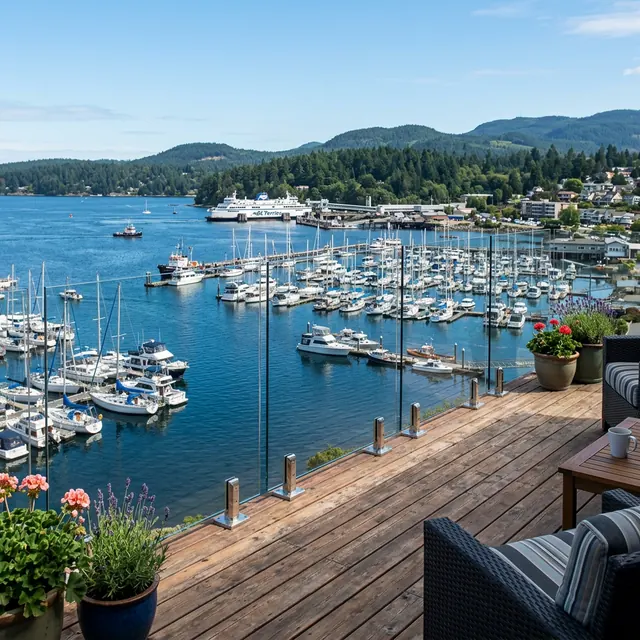
Marine-grade 316 stainless steel stands up to coastal conditions while maximizing views.
The Custom Solution:LOUEI Metal Arts fills that gap. We are a custom steel railing fabricator with CWB-certified welders serving Nanaimo — every local competitor works in aluminum. We fabricate custom steel and stainless steel railing systems in our Coquitlam studio and install across Vancouver Island by appointment. Our specification of 316 marine-grade stainless steel — the same alloy used in marine rigging — addresses Nanaimo's coastal corrosion challenge at the hardware level, not just the finish level. Below: which railing systems work for Nanaimo's specific conditions, what the City requires, and how precision shop fabrication via BC Ferries produces better results than field-assembled aluminum kits. For Nanaimo building permit requirements, visit the City of Nanaimo Building Permits page.
Glass Railings as Wind Barriers for Nanaimo’s Breezy Harbour Properties
Nanaimo’s geography puts it directly in the path of Strait of Georgia winds. Departure Bay, the Newcastle Island viewshed, and the waterfront corridor along the Harbourfront Walkway experience steady onshore breezes that make open decks uncomfortable for much of the shoulder season — exactly when Nanaimo’s mild 3–8°C winters should be making outdoor living possible.
Glass railing panels solve this. Unlike cable or picket systems that let wind pass through, tempered glass acts as a transparent windbreak.
A properly installed glass railing along a harbour-facing deck can reduce perceived wind speed by 50–70%, extending your usable outdoor season by six to eight weeks on either end — without blocking the view of the harbour, Protection Island, or the mainland mountains beyond.
This is the core reason glass railings earn the primary position for Nanaimo. The function isn’t just aesthetic — it’s thermal. In a city where outdoor spaces are usable twelve months a year if you block the wind, glass delivers a return that no other railing material can match.
Two Glass Systems for Nanaimo's Core Markets
Post-and-Clamp — Multi-Family Workhorse
The system built for Nanaimo's strata construction pipeline. Consistent glass-railing quality across 12-unit balcony runs at pricing that development budgets approve. With 254 multi-unit dwellings permitted in 2025, Nanaimo's builders need railing systems that ship with council-ready documentation packages — not field-adjusted aluminum kits that produce visible unit-to-unit variation. CWB-welded steel posts with 316 SS hardware handle the Strait of Georgia salt air that standard aluminum connections cannot.
Base-Shoe Frameless — Departure Bay Premium
For Departure Bay and Protection Island waterfront properties where harbour views command top dollar. Zero hardware above deck level means nothing between your living space and the ocean. The premium choice for properties where every millimetre of visual obstruction impacts value — and where glass panels double as transparent wind barriers that extend outdoor living through Nanaimo's mild shoulder seasons.
We also fabricate Spigot and Standoff glass systems for specific applications — see our complete glass railing page for all four options.
Salt Air Demands Marine-Grade Hardware — Not Standard Aluminum
Nanaimo’s climate data (BC Building Code Appendix C, Table C-2) shows 1,050mm annual precipitation, a moisture index of 1.13, and 200 Pa driving rain wind pressure. But the number that matters most for railing durability isn’t rainfall — it’s salt.
Nanaimo’s direct exposure to the open Strait of Georgia means airborne chloride levels run higher than sheltered coastal cities. Within one kilometre of the waterfront, homeowners see the damage first-hand: brown streaks running below fastener points, white crystalline deposits forming on connections, pitting at base plates where moisture pools, and loosening at gasket contact points where salt infiltrates the seal. Standard 304 stainless steel shows these symptoms within 12–18 months. Aluminum-to-steel connections fail into galvanic corrosion even faster.
LOUEI Metal Arts specifies 316 marine-grade stainless steel for all coastal Nanaimo hardware — tensioners, standoffs, spigots, and fasteners. The 2–4% molybdenum content in 316 SS provides chloride resistance that standard aluminum and 304 stainless cannot match. Every powder-coated steel component uses factory-applied finishes rated for 2,000+ hours of salt-spray testing. This isn’t an upgrade — it’s the baseline specification for any railing system that needs to last on Vancouver Island’s coast.
How Mainland-to-Island Fabrication Produces Better Railings
Every Nanaimo railing company field-assembles aluminum kit parts on your property. LOUEI Metal Arts does the opposite: we precision-fabricate every component in our Coquitlam studio — CWB-certified welding, factory powder coating in a controlled environment, pre-drilling to site-specific measurements — then transport finished assemblies via BC Ferries to Nanaimo.
Shop vs. Field Welding
Welding in a controlled studio produces cleaner, stronger joints than portable welding on a deck in Nanaimo's coastal moisture. Powder coating applied in a factory oven bonds at the molecular level — field-applied paint cannot match this adhesion or corrosion resistance. The result: joints that hold longer and finishes that resist salt-air degradation for years, not seasons.
Pre-Drilled Precision
Every post, bracket, and mounting plate arrives drilled to your site's exact measurements. On-site installation becomes assembly, not fabrication. This reduces installation time to 1–3 days and eliminates the metal shavings, grinding dust, and noise of field fabrication on your property.
Ferry Logistics
We transport from Horseshoe Bay to Departure Bay (1 hour 40 minutes) or via Duke Point. Railing sections are crated for ferry transport and arrive ready to mount. We schedule Nanaimo installations in multi-day blocks to optimize the crossing — your project cost includes all ferry coordination and transport.
The Bottom Line
Higher precision, better finish quality, and shorter on-site disruption than field-assembled systems. This is the same build-in-shop, install-in-field model used by marine and aerospace fabricators. Your neighbours see a 1–3 day installation — not a week-long construction site.
Picket Railings for Nanaimo’s Multi-Family Boom
Nanaimo’s building market is shifting hard toward multi-family: 254 multi-unit dwellings were permitted in 2025. Strata developers need railing systems that are code-compliant, visually consistent across entire buildings, and deliverable on tight schedules.
1.5m
Bylaw 4500 Trigger Height
1.07m
Req. Guardrail Height
The Hidden Market
Nanaimo’s hilly topography means most construction projects require retaining walls. Under Nanaimo Zoning Bylaw 4500, any retaining wall 1.5 metres or higher legally requires a guardrail. This generates massive demand for metal guardrails that has nothing to do with decks or balconies.
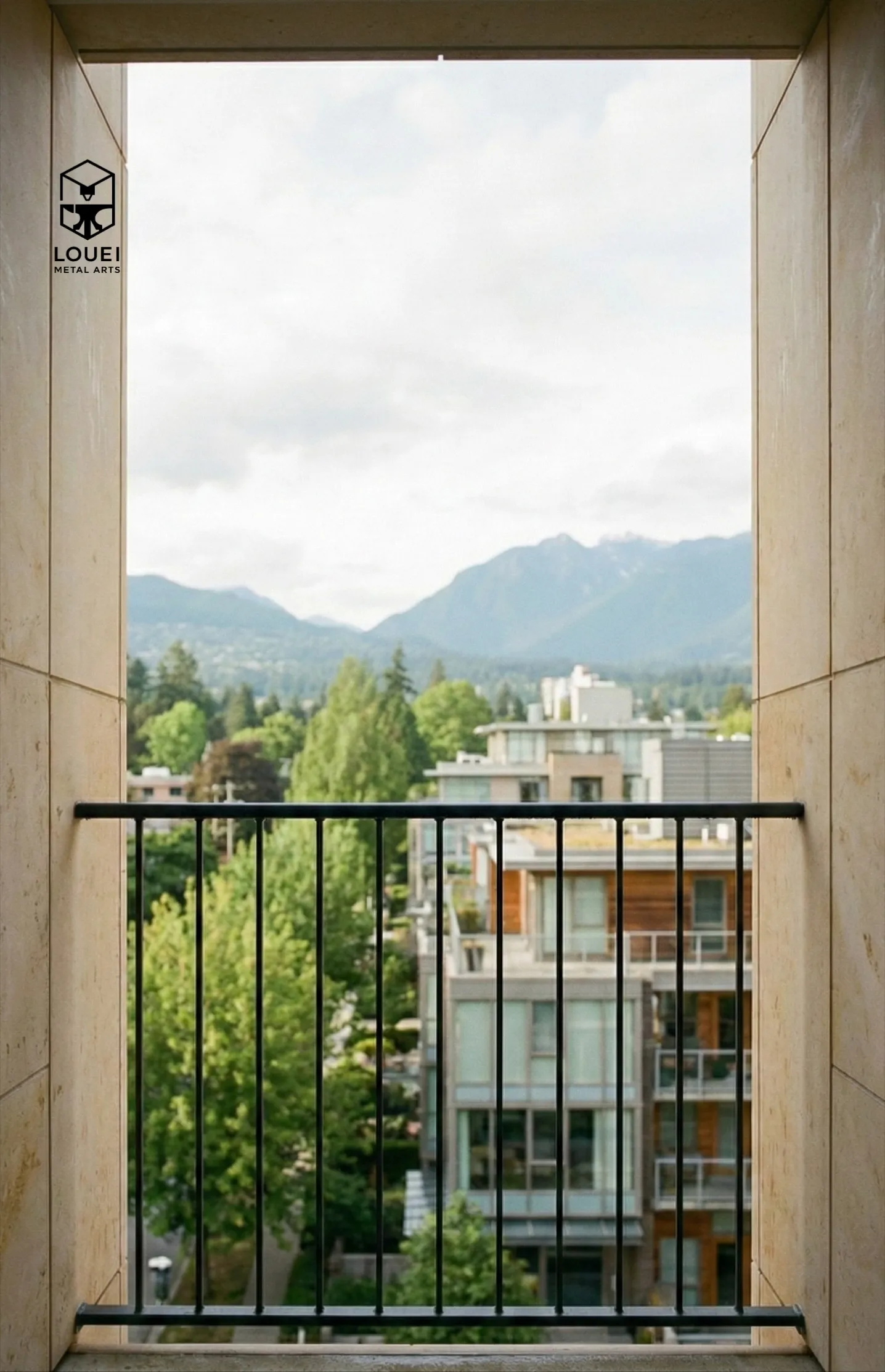
Accessible Handrails for Nanaimo’s Growing Senior Population
24.6% of Nanaimo’s population is 65 or older — projected to reach 25% by 2029. This creates specific demand for code-compliant handrails with proper graspability (graspable profile, 865–1,070mm height per BC Building Code) on exterior stairs, multi-level entries, and walkways.
For aging-in-place retrofits and the accessibility requirements now mandatory in new multi-family construction, our stainless steel and powder-coated handrails provide both compliance and durability in Nanaimo’s coastal conditions.
View our accessible handrail designs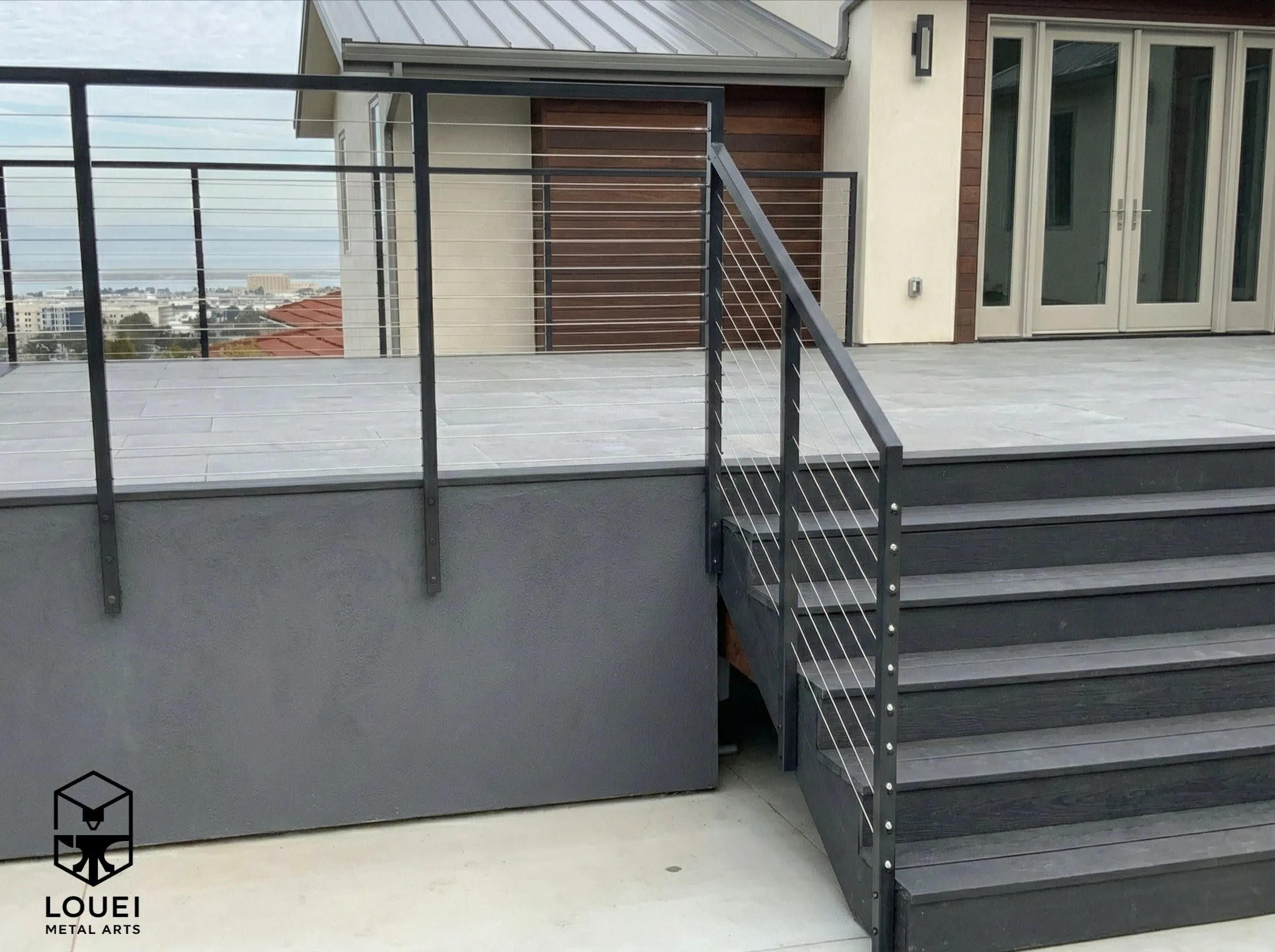
Cable Railings for Modern Waterfront Builds
For budget-conscious harbour-view homeowners who want transparency without the glass cleaning burden, our ClearView Stainless 316 cable railing system is the marine-grade alternative. The 316 SS hardware handles Strait of Georgia chloride without the tea staining that cheaper cable kits develop within a season — and cables never need the periodic cleaning that glass demands in salt-air conditions.
Cable systems meet code for the townhome and strata projects dominating Nanaimo's construction pipeline. The P.Eng. certification LOUEI provides with every cable installation satisfies the City's Guard Railing requirements — requirements that go beyond the base BC Building Code and eliminate DIY cable kits from multi-family work.
Learn about our ClearView cable railing systemsA Typical Nanaimo Railing Installation
The following is a representative scenario based on common Nanaimo property types. It is not a completed case study.
Property
New strata townhome complex in north Nanaimo, 12 units, three storeys. Harbour views from upper balconies. Retaining wall along the rear property line at 2.1 metres height.
Scope
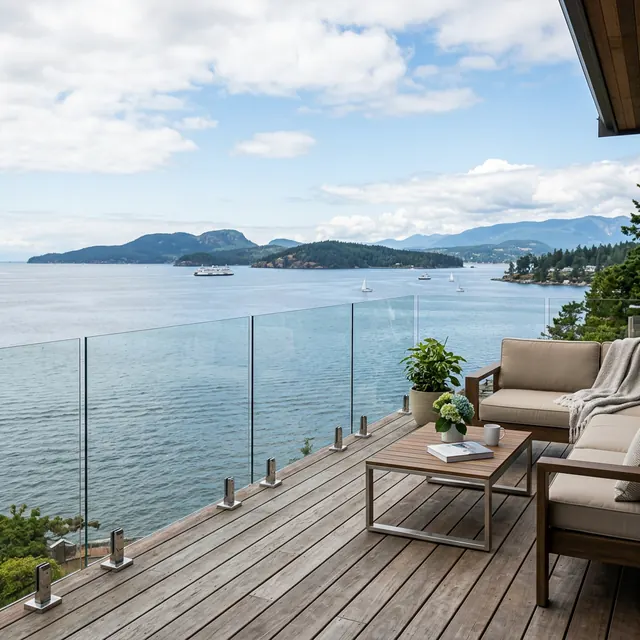
(1) 180 linear feet of post-and-clamp glass railing across 12 upper balconies (consistent design across all units). (2) 45 linear feet of steel picket guardrail along the retaining wall per Bylaw 4500. (3) Continuous handrails on all three stairwells (accessibility compliance).
Products
Post-and-clamp glass system for balconies (budget-optimized for volume). Powder-coated steel picket for retaining wall (RAL 7016 anthracite, matched to building trim). Stainless steel handrails with 35mm graspable profile.
Core Challenges
- ✓ Salt air from Strait of Georgia requires 316 SS hardware on all exterior installations.
- ✓ Retaining wall guardrail must meet 1.07m height and BC Building Code load requirements.
- ✓ 12-unit consistency demands precision fabrication, not field-adjusted kit parts.
- ✓ Ferry-coordinated logistics for delivery from mainland studio.
Timeline: 6–8 weeks including fabrication, ferry transport, and multi-day installation.
Railing Permit and Code Requirements in Nanaimo
Building inspection: City of Nanaimo, 250-755-4429. Permit processing target: 3 weeks for complete applications (6–10 weeks during peak periods).
Railing Replacement Exemption
Replacing deck railings on a previously permitted structure does not require a new building permit provided the original deck was approved under a building permit. However, all replacement railings must meet current BC Building Code 2024 requirements.
Bylaw 4500 Retaining Wall Guardrails
Nanaimo Zoning Bylaw 4500 imposes a requirement most other BC cities do not have: any retaining wall 1.5 metres or higher legally requires a guardrail of at least 1.07 metres.
Permit Processing Times
The City of Nanaimo targets 3-week permit processing for complete applications, but peak-period wait times can extend to 6–10 weeks. Early permit submission is critical.
Multi-Family Engineering Standard
On 12-unit strata projects where Nanaimo building inspectors review engineering documentation for every balcony, LOUEI Metal Arts delivers permit-ready P.Eng.-sealed structural drawing packages that cover all units in a single coordinated submission.
Heritage Overlay Districts
Certain sections of the Old City Quarter fall under Heritage Alteration Permit (HAP) guidelines. Railing designs in these districts must be reviewed for compatibility with neighbourhood character prior to building permit submission.
Nanaimo Neighbourhoods We Serve
Nanaimo's railing needs vary dramatically by neighbourhood — salt exposure, housing age, topography, and project type change from waterfront to hillside to urban core. Here is how we address each area.
Departure Bay
Highest salt-air exposure; 316 stainless mandatory.
North Nanaimo
Handrail retrofits and accessible ADA-compliant ramps.
Hammond Bay
Cable railing systems for oceanfront contemporary builds.
Old City Quarter
Strata block development using volume picket systems.
Protection Island
Foot-passenger ferry logistics handled by our HQ.
Parksville
Oceanfront deck railings and accessible handrails.
Qualicum Beach
Retirement community retrofits and coastal estates.
Ladysmith
Steep hillside lots requiring structural retaining wall guards.
Frequently Asked Questions — Railings in Nanaimo
Can LOUEI Metal Arts install railings in Nanaimo from the mainland?
+
We precision-fabricate every component in our Coquitlam studio under controlled conditions: CWB-certified welding, factory powder coating, pre-drilling to site-specific measurements. Finished assemblies ship via BC Ferries to Departure Bay or Duke Point. On-site installation typically takes 1–3 days.
Do I need a building permit to replace deck railings in Nanaimo?
+
Not if the deck was previously approved under a building permit. All replacement railings must meet current BC Building Code 2024.
What railing materials resist Nanaimo’s salt air?
+
Within one kilometre of the Strait of Georgia, 316 marine-grade stainless steel with 2–4% molybdenum content is the minimum specification. LOUEI Metal Arts specifies 316 SS hardware on all Nanaimo coastal installations.
Does my Nanaimo retaining wall need a guardrail?
+
Under Nanaimo Zoning Bylaw 4500, any retaining wall 1.5 metres or higher requires a guardrail of at least 1.07 metres.
Tell me about glass railing options for Nanaimo.
+
Post-and-clamp is our most accessible option—ideal for strata balcony runs. Base-shoe frameless is for luxury waterfront applications.
Are cable railings an option for Nanaimo harbour-view decks?
+
Yes. Horizontal cable can be considered for ordinary Part 9 guards at or below 4.2 m, provided the full guard design meets the other applicable requirements. Our ClearView Stainless 316 system uses full marine-grade hardware.
How long does fabrication take?
+
Typically 6-8 weeks, inclusive of ferry coordination and powder coating lead times.
Do you service Ladysmith and Cedar?
+
Yes, our Vancouver Island installation footprint covers everything from Qualicum Beach down through Ladysmith, coordinating all transport logistics.
Get a Free Estimate for Your Nanaimo Project
From waterfront homeowners to multi-family developers — LOUEI Metal Arts is a steel railing fabricator with CWB-certified welders serving Vancouver Island. We deliver marine-grade materials, permit-ready documentation, and precision shop fabrication directly to Nanaimo via BC Ferries.
Primary-source code reference · checked September 24, 2026
Code references for this page
These links go to governments, regulators and the original professional or certification bodies—not other railing businesses. Code text, older local bulletins and advisory guidance are labelled separately. This is an editorial source check, not a professional sign-off, product certification or approval of your project.
Which code applies?
BC province versus the City of Vancouver
Use BCBC 2024 with its published amendments outside the City of Vancouver, and VBBL 2025 inside the city. Vancouver is not the same jurisdiction as North Vancouver or West Vancouver. Permit dates and transition rules matter. A newer national model code does not automatically replace the locally adopted edition.
- Province of BC — BC Building Code 2024Government code register
- Province of BC — BCBC amendments, revisions 1–6Government amendment register
- City of Vancouver — current Building By-law and transition informationMunicipal code register
- NRC — National Building Code of Canada 2025National model code; local adoption must be checked
Guard height and openings
Ordinary Part 9 guards; exceptions must be read with the clause
Articles 9.8.8.1, 9.8.8.3 and 9.8.8.5 cover when a guard is required, its height and openings. The usual trigger is a drop over 600 mm within 1.2 m of the walking surface. Default height is 1,070 mm; qualifying residential guards can use 900 mm, including certain exterior guards at no more than 1,800 mm above finished ground. The ordinary required-guard opening rule prevents a 100 mm sphere passing. Exactly 4 inches is 101.6 mm: metric limits control.
- Province of BC — BCBC 2024, base text (read with amendments)Reference: 9.8.8.1–9.8.8.5 · PDF page 979Building code
- City of Vancouver — VBBL 2025, Volume 2 v3.00Reference: 9.8.8.1–9.8.8.5 · PDF page 30Municipal consolidated code, May 5, 2026
Horizontal cable: the 4.2 m rule and its limits
Separate Part 9, Part 3, exit and pool conditions
For ordinary Part 9 guards, 9.8.8.6.(1) applies the anti-climb requirement above 4.2 m. At or below 4.2 m, horizontal cable is not prohibited by that clause merely because it is climbable; height, openings, loads and connections still apply. Part 3 clause 3.3.1.18.(4) also says more than one storey. Vancouver exit clause 3.4.6.6.(7) has no 4.2 m exception. Pool fencing is separate. 4.2 m is about 13 ft 9.35 in, not 14 ft.
- City of Vancouver — VBBL 2025, Volume 2 v3.00Reference: 9.8.8.6.(1) · PDF page 32Municipal consolidated code, May 5, 2026
- City of Vancouver — VBBL 2025, Volume 1 v4.00Reference: 3.3.1.18.(4); 3.3.1.14; 3.3.4.7; 3.4.6.6.(7) · PDF page 308Municipal consolidated code, May 5, 2026
- Province of BC — BCBC 2024, base text (read with amendments)Reference: 3.3.1.18.(4); 3.4.6.6.(7); 9.8.8.6.(1) · PDF page 983Building code
- City of Vancouver — 2025 code seminar, guard design (page 20)Municipal explanatory presentation, not legislation
- BC Code Interpretation Committee — 24-0010, objects near guards (2024)Advisory interpretation; local authority decides
Loads, anchors and structural materials
The whole assembly and its supporting structure
Use the applicable row of Table 9.8.8.2 or Article 4.1.5.14, not one load for every railing. The Part 9 residential top-load row is 0.5 kN/m OR 1.0 kN concentrated, whichever is critical, with 1.5 kN/m vertical and separate infill loading. Handrail loads under 9.8.7.7 differ. Article 9.8.8.2.(2) refers to adjacent vertical elements; it is not a universal horizontal-cable tension test. Cable diameter, post spacing and pretension need system-specific design. Structural steel, aluminium and glass have separate design references in Part 4.
- City of Vancouver — VBBL 2025, Volume 2 v3.00Reference: 9.8.8.2 and Table 9.8.8.2; 9.8.7.7 · PDF page 31Municipal consolidated code, May 5, 2026
- Province of BC — BCBC 2024, base text (read with amendments)Reference: 4.1.5.14; 4.3.4; 4.3.5; 4.3.6; Table 1.3.1.2 · PDF page 524Building code
- Engineers and Geoscientists BC — Designing Guards for Building Projects v2.0 (2018)Professional practice guidance, not a new code edition
Read the applicable clause and its exceptions, referenced standards and amendments together. The municipal consolidated PDFs are convenience copies; enacted text controls. Proprietary standards are linked through their issuing authorities—we do not claim access to, or reproduce, paywalled standards. Explore the complete topic-by-topic official-source register.