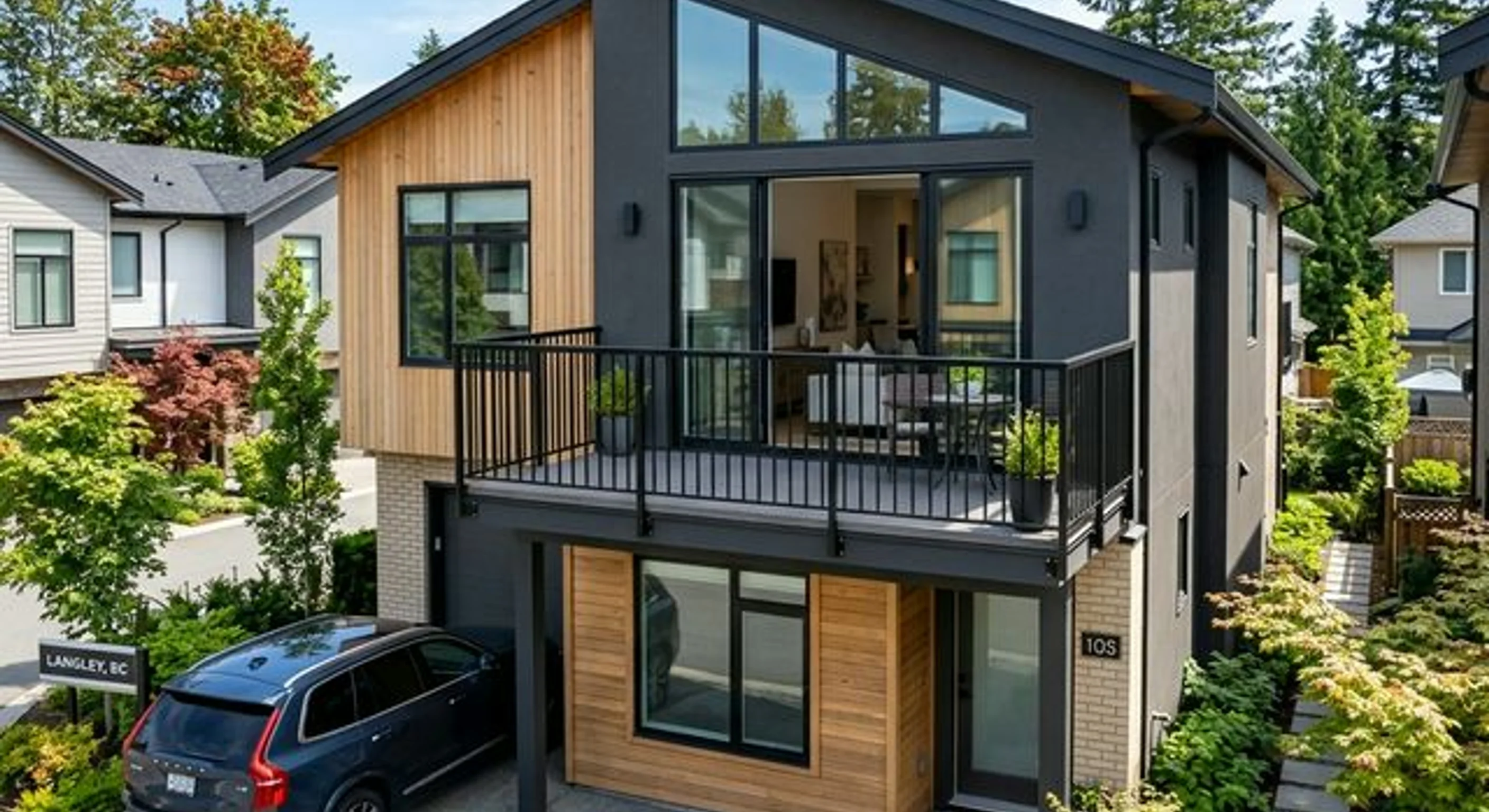
Custom Railings · Welded Aluminum
Custom Aluminum Railings for Metro Vancouver
Site-measured guards and pickets, welded and powder-coated in our Coquitlam shop — not stock extrusions field-bolted together on your deck.
LOUEI Metal Arts fabricates and installs custom aluminum railings — welded pickets and guards for decks, balconies, and townhomes — from our Coquitlam shop for homes and strata properties across Metro Vancouver and the Fraser Valley.
Fabrication
Site-measured and welded — no field-cut splice joints, no surface-bolted plates that loosen
Finish
In-house powder coat in 200+ RAL colours — kit extrusions usually offer three factory colours
Where it wins
Naturally rust-proof, light on the wallet and the structure, repeatable across strata and townhome runs
Most aluminum railings in Metro Vancouver are bolted kits — competent for straightforward installations, but chosen by developers for speed and cost. This page is about the other kind: aluminum fabricated like our steel work, for projects from Langley townhome developments to Vancouver strata balconies.
RAL Colours In-House
200+
Typical Kit Colour Range
3
Fraser Valley Annual Rain
~1,500 mm
Custom Welded Aluminum vs the Kit on Every Other Deck
Builder-grade kits share the same anatomy: stock extrusion lengths field-cut on site, splice joints visible from the street, surface-bolted base plates, and a colour the developer picked from a three-option catalogue.
Under Fraser Valley rain cycling the weaknesses compound: anodized finishes chalk, bolted connections loosen, and posts shift when you lean on them. Custom fabrication removes each failure mode at the source.
| Kit extrusions | LOUEI custom aluminum | |
|---|---|---|
| Joints | Field-cut splice joints, visible from the street | Welded and finished in the shop |
| Fit | Stock lengths adapted on the deck | Fabricated to site measurements |
| Posts | Surface-bolted plates that can loosen and shift | Engineered anchorage for the actual structure |
| Colour | Usually three factory colours | Any of 200+ RAL colours, powder-coated in-house |
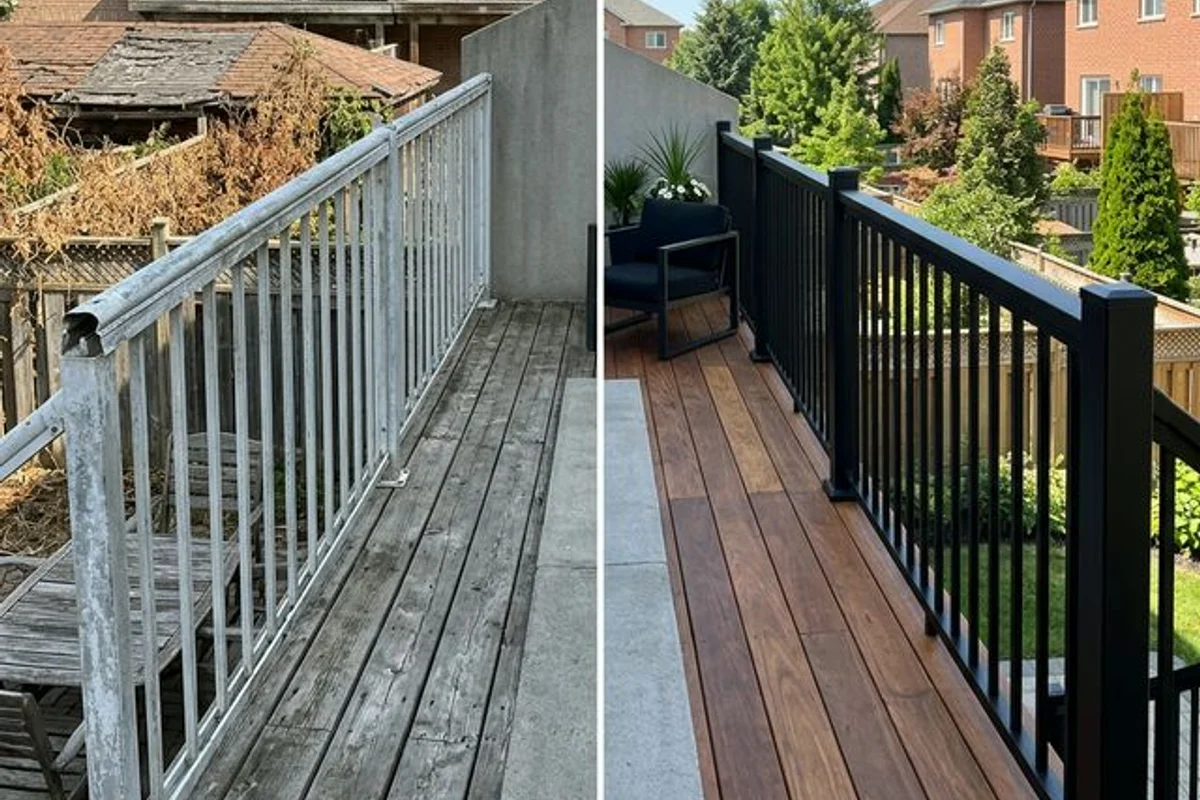
Honest caveat: if the deck is straight, level, and ground-floor and you want basic aluminum, a kit can be the right call. Custom fabrication earns its keep everywhere a kit has to be forced to fit.
The full comparison is in our guides to DIY railing kits vs custom fabrication and upgrading builder-grade aluminum on a Langley townhome.
Aluminum Deck, Balcony, and Stair Railings — Built to the Site
Custom aluminum railing installation covers the same applications as our steel work. The system is chosen by where it goes — and every one is measured before it is fabricated.
Aluminum Deck Railings
For raised decks — any walking surface more than 600 mm above grade needs a guard — a site-measured aluminum deck railing replaces the kit that has to be forced to fit around stairs, angles, and fascia conditions.
Deck railings in Vancouver →Aluminum Balcony Railings
Aluminum's light weight suits balcony railing replacement on aging strata buildings, and colour-matched runs keep every unit consistent — the exact RAL code, not the nearest factory colour.
Balcony railings in Vancouver →Aluminum Stair Railings
Stair guards follow pitch, landings, and the actual geometry of the run — with graspable handrails at 865–1,070 mm and a continuously graspable profile where code requires them. Kits cannot follow a stair that was not built straight.
Stair railings in Vancouver →Aluminum Picket Railings
Welded aluminum pickets for homes and townhomes — strength, rhythm, and low upkeep, in the same vertical language as our steel picket work but lighter on the structure and the budget.
Compare with steel pickets →Rust-Proof, Light, and Repeatable
Aluminum is naturally rust-proof and lightweight — a practical choice for large strata projects and budget-conscious residential work.
It never develops red rust, puts less load on aging balcony structures, and keeps multi-unit runs consistent. Welded custom fabrication adds what kits leave out: clean joints, engineered anchorage, and a strata's exact RAL colour — matched perfectly by our in-house powder coating rather than settled for from a factory catalogue.
When We'll Point You at Steel or Stainless Instead
Steel gives more design freedom — twists, curves, seamless flat bars — and superior structural rigidity, which is why our public-space and heavy-use guards use heavy-wall steel framing: see our custom steel picket railings. On salt-air waterfront and pool decks, bare-metal durability belongs to 316 stainless steel railings. We recommend by site, not by what we feel like selling.
| Deck / balcony guard height | 1,070 mm |
| Interior stairs within a dwelling | 900 mm |
| Maximum opening | rejects a 100 mm sphere |
| Handrail height / profile | 865–1,070 mm, continuously graspable profile |
Code applies to every material equally — full numbers in our BC Building Code railing height guide. Colour options: the RAL powder-coat colour guide.
Custom Aluminum Railing Fabrication, Installed by the Crew That Welds It
Every custom aluminum railing runs through the same workflow as our steel and stainless work: site measure, shop drawings, welding, in-house powder coating, and installation — one crew from weld to install, with no subcontracted hand-offs.
We fabricate in Coquitlam and install custom aluminum railings across Metro Vancouver and the Fraser Valley: Vancouver, Burnaby, Surrey, Coquitlam, Port Coquitlam, New Westminster, Richmond, Delta, Maple Ridge, and Langley — from single-deck replacements to colour-matched townhome and strata runs.
Custom Aluminum Railing
Questions, Answered
How much do custom aluminum railings cost in Vancouver?
+
Generally less than comparable custom steel — aluminum is lighter on the wallet — but every quote is site-specific: pricing depends on guard length and height, the infill, the powder-coat colour, mounting conditions, whether engineering is required, and strata approval requirements. Send photos and rough dimensions and we price after a site measure.
What is the difference between custom aluminum railings and aluminum kits?
+
A kit is stock extrusion lengths field-cut and bolted together on your deck: visible splice joints, surface-mounted base plates that can loosen over time, and usually three factory colours. Custom aluminum is fabricated to your site measurements with welded joints, engineered post anchorage, and in-house powder coating in any of 200+ RAL colours. For a straight, level, ground-floor deck a basic kit can be the right call — everywhere else the difference shows within a few winters.
Does aluminum rust in Vancouver's climate?
+
Aluminum is naturally rust-proof — it will not develop red rust. The weak points are the finish and the connections: anodized finishes chalk under sustained rain cycling, and bolted kit connections loosen over time. We powder coat instead of anodizing and weld instead of field-bolting, which removes both failure modes.
Is aluminum or steel better for a railing?
+
Steel feels premium, gives more design options — twists, curves, seamless flat bars — and delivers superior structural rigidity for public and heavy-use guards. Aluminum is lighter on the wallet, naturally rust-proof, and lighter on the structure. Both keep your family safe when built to code; the difference is feel, aesthetics, and customizability.
Can I replace the builder-grade aluminum railings on my townhome?
+
Yes. Builder-grade aluminum is surface-mounted with bolted base plates and can be removed without structural modification. On strata properties, written strata council approval is required before replacing exterior railings classified as common or limited common property. Confirm the actual scope with the municipality; like-for-like replacement is not an automatic permit exemption.
Do aluminum railings meet the BC Building Code?
+
Aluminium can be used when the complete assembly meets the applicable design requirements. Part 9 defaults to 1,070 mm guards with 900 mm exceptions for specified residential conditions; ordinary required-guard openings use a 100 mm sphere. Handrails generally use 865–1,070 mm, with separate graspability and accessibility checks. Loads, connections and professional documentation depend on the project.
Do aluminum railings need painting or maintenance?
+
No repainting cycle. Powder coat is the finish — factory-applied and cured, not brushed on — so maintenance is an occasional wash. This is the opposite of anodized kit finishes, which chalk under sustained Fraser Valley rain cycling, and of wood, which needs refinishing on a schedule.
What colours are available for aluminum railings?
+
Any of 200+ RAL colours from our in-house powder-coating facility — matte black, white, bronze, or your strata's exact colour code, matched perfectly rather than settled for from a three-option factory catalogue. Matte black remains the most requested finish for modern homes and townhomes.
Written by LOUEI Metal Arts — custom metal fabrication, Coquitlam, BC.
Get a Custom Aluminum Railing Quote
Send photos of the deck or balcony and rough dimensions — we will tell you honestly whether custom aluminum, steel, or stainless fits your site before anything is priced. Call Office: 604-388-6086 or Direct: 778-848-1149.
Primary-source code reference · checked September 24, 2026
Code references for this page
These links go to governments, regulators and the original professional or certification bodies—not other railing businesses. Code text, older local bulletins and advisory guidance are labelled separately. This is an editorial source check, not a professional sign-off, product certification or approval of your project.
Which code applies?
BC province versus the City of Vancouver
Use BCBC 2024 with its published amendments outside the City of Vancouver, and VBBL 2025 inside the city. Vancouver is not the same jurisdiction as North Vancouver or West Vancouver. Permit dates and transition rules matter. A newer national model code does not automatically replace the locally adopted edition.
- Province of BC — BC Building Code 2024Government code register
- Province of BC — BCBC amendments, revisions 1–6Government amendment register
- City of Vancouver — current Building By-law and transition informationMunicipal code register
- NRC — National Building Code of Canada 2025National model code; local adoption must be checked
Guard height and openings
Ordinary Part 9 guards; exceptions must be read with the clause
Articles 9.8.8.1, 9.8.8.3 and 9.8.8.5 cover when a guard is required, its height and openings. The usual trigger is a drop over 600 mm within 1.2 m of the walking surface. Default height is 1,070 mm; qualifying residential guards can use 900 mm, including certain exterior guards at no more than 1,800 mm above finished ground. The ordinary required-guard opening rule prevents a 100 mm sphere passing. Exactly 4 inches is 101.6 mm: metric limits control.
- Province of BC — BCBC 2024, base text (read with amendments)Reference: 9.8.8.1–9.8.8.5 · PDF page 979Building code
- City of Vancouver — VBBL 2025, Volume 2 v3.00Reference: 9.8.8.1–9.8.8.5 · PDF page 30Municipal consolidated code, May 5, 2026
Horizontal cable: the 4.2 m rule and its limits
Separate Part 9, Part 3, exit and pool conditions
For ordinary Part 9 guards, 9.8.8.6.(1) applies the anti-climb requirement above 4.2 m. At or below 4.2 m, horizontal cable is not prohibited by that clause merely because it is climbable; height, openings, loads and connections still apply. Part 3 clause 3.3.1.18.(4) also says more than one storey. Vancouver exit clause 3.4.6.6.(7) has no 4.2 m exception. Pool fencing is separate. 4.2 m is about 13 ft 9.35 in, not 14 ft.
- City of Vancouver — VBBL 2025, Volume 2 v3.00Reference: 9.8.8.6.(1) · PDF page 32Municipal consolidated code, May 5, 2026
- City of Vancouver — VBBL 2025, Volume 1 v4.00Reference: 3.3.1.18.(4); 3.3.1.14; 3.3.4.7; 3.4.6.6.(7) · PDF page 308Municipal consolidated code, May 5, 2026
- Province of BC — BCBC 2024, base text (read with amendments)Reference: 3.3.1.18.(4); 3.4.6.6.(7); 9.8.8.6.(1) · PDF page 983Building code
- City of Vancouver — 2025 code seminar, guard design (page 20)Municipal explanatory presentation, not legislation
- BC Code Interpretation Committee — 24-0010, objects near guards (2024)Advisory interpretation; local authority decides
Loads, anchors and structural materials
The whole assembly and its supporting structure
Use the applicable row of Table 9.8.8.2 or Article 4.1.5.14, not one load for every railing. The Part 9 residential top-load row is 0.5 kN/m OR 1.0 kN concentrated, whichever is critical, with 1.5 kN/m vertical and separate infill loading. Handrail loads under 9.8.7.7 differ. Article 9.8.8.2.(2) refers to adjacent vertical elements; it is not a universal horizontal-cable tension test. Cable diameter, post spacing and pretension need system-specific design. Structural steel, aluminium and glass have separate design references in Part 4.
- City of Vancouver — VBBL 2025, Volume 2 v3.00Reference: 9.8.8.2 and Table 9.8.8.2; 9.8.7.7 · PDF page 31Municipal consolidated code, May 5, 2026
- Province of BC — BCBC 2024, base text (read with amendments)Reference: 4.1.5.14; 4.3.4; 4.3.5; 4.3.6; Table 1.3.1.2 · PDF page 524Building code
- Engineers and Geoscientists BC — Designing Guards for Building Projects v2.0 (2018)Professional practice guidance, not a new code edition
Read the applicable clause and its exceptions, referenced standards and amendments together. The municipal consolidated PDFs are convenience copies; enacted text controls. Proprietary standards are linked through their issuing authorities—we do not claim access to, or reproduce, paywalled standards. Explore the complete topic-by-topic official-source register.