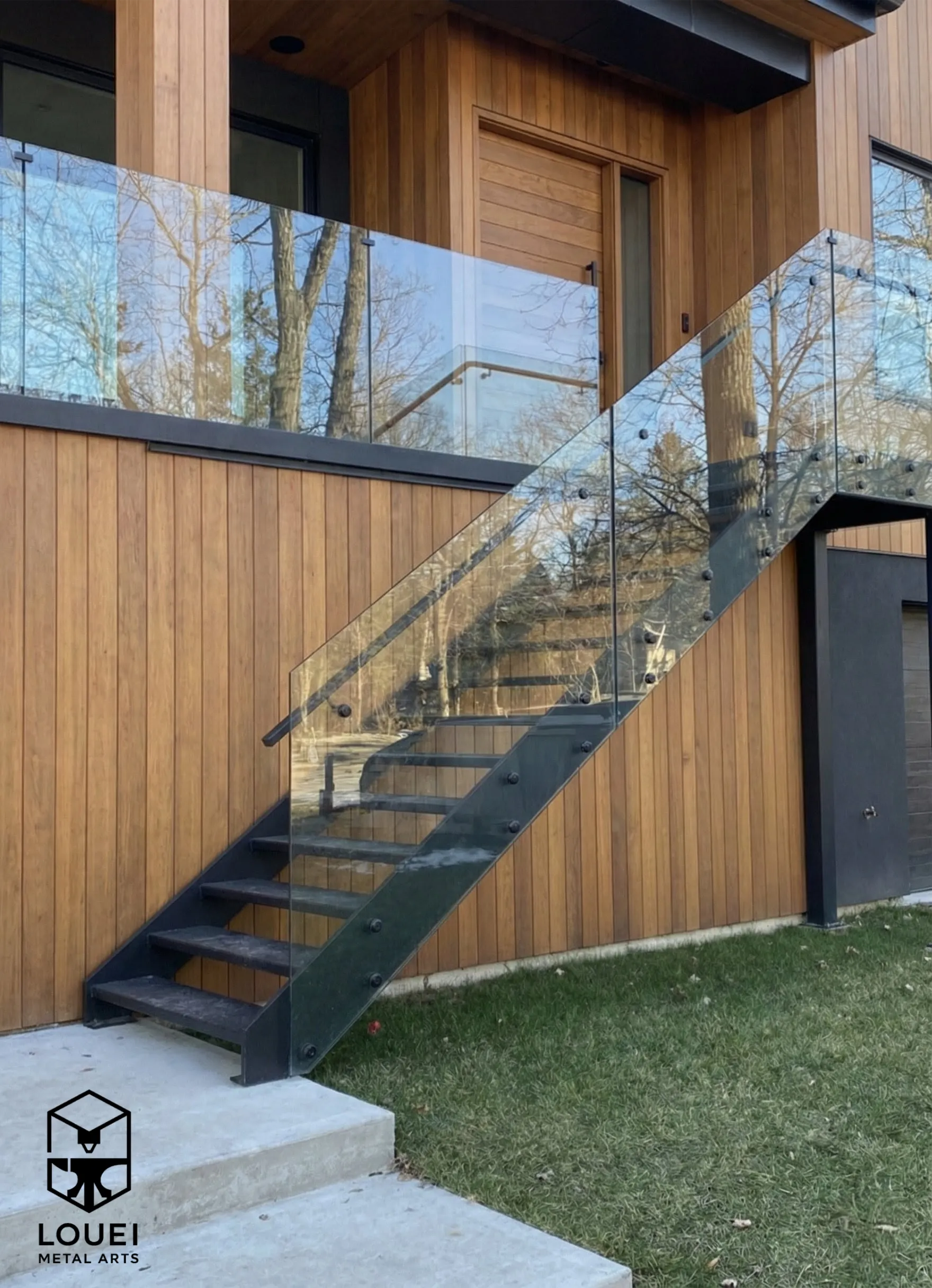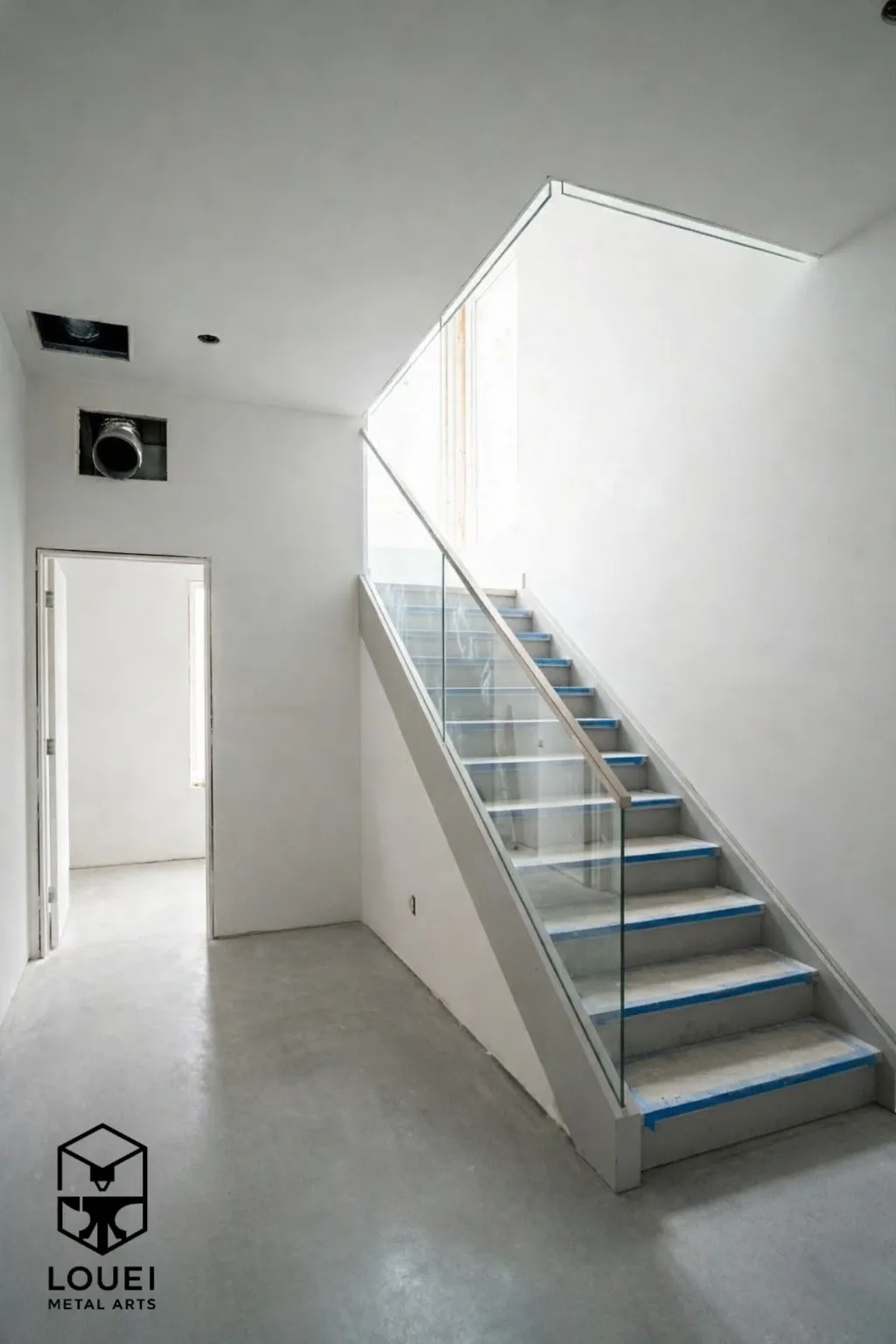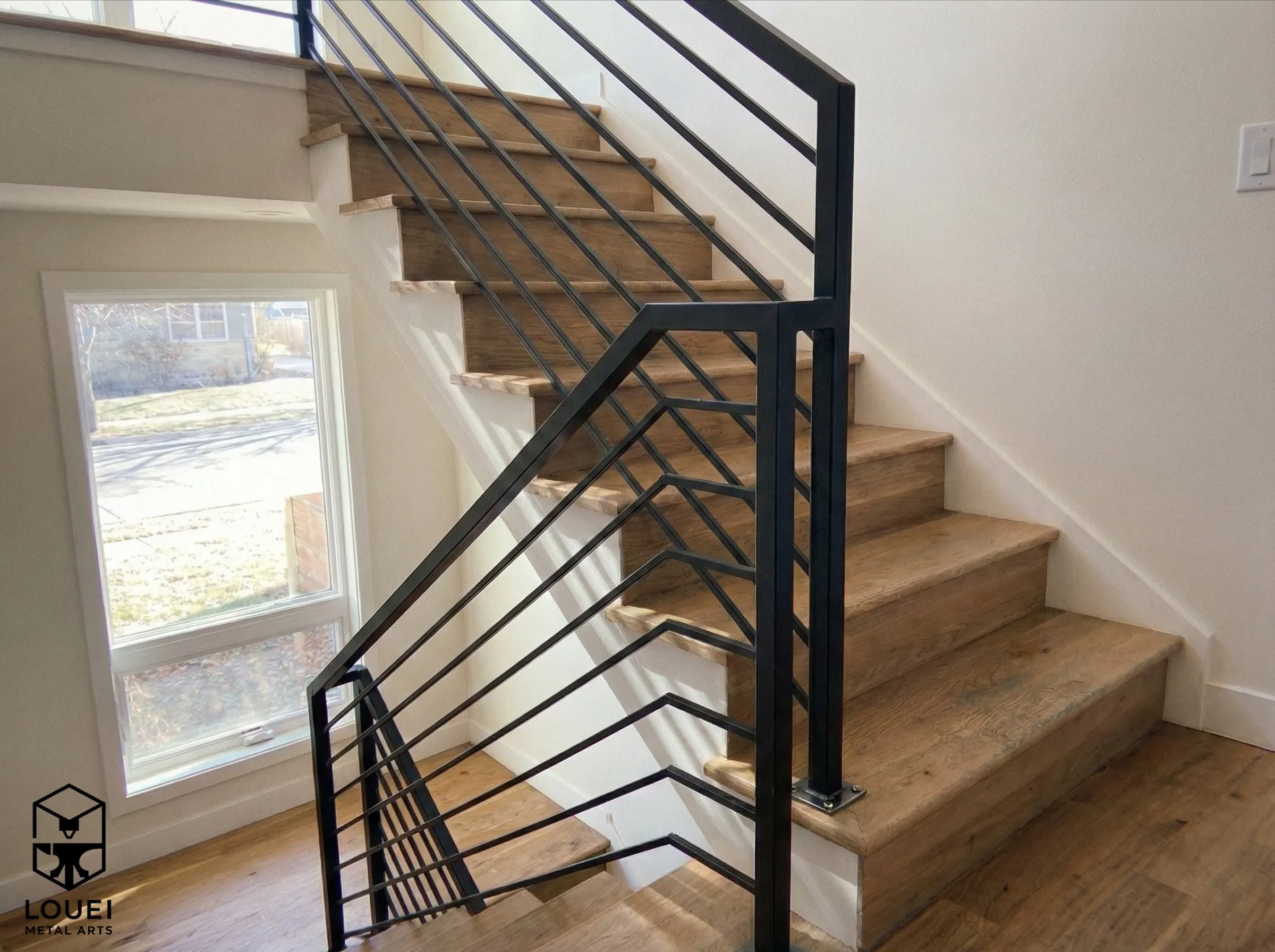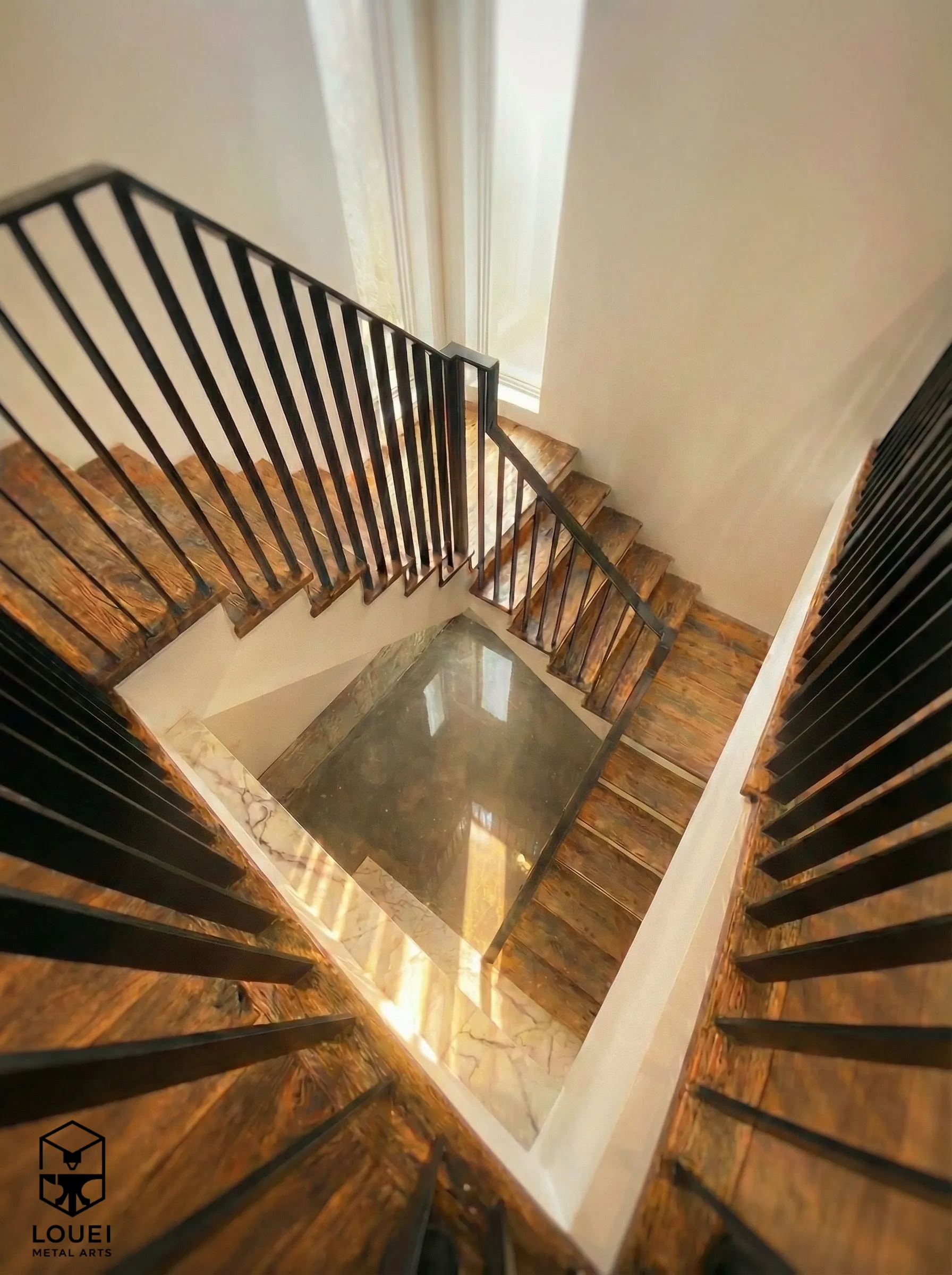
Custom stair railing in Vancouver by LOUEI Metal Arts

Stairs · Geometry First · Guard + Handrail Planning

Stair Railing VancouverCustom built around the stair geometry, open side, landing, and grip.

Custom stair railing in Vancouver, planned around the stair itself: pitch, rise and run, landing, open side, wall side, attachment points, interior or exterior exposure, and whether the stair needs a guard, a handrail, or both. Every LOUEI stair railing is custom-fabricated and planned around the confirmed condition before the first weld. Depending on geometry, the system can be picket, glass, aluminum, custom welded metal, or a guard-and-handrail combination.

The stair-specific layer underneath Custom Railings.

Quick Answer

What railing is best for stairs?

The best stair railing depends on geometry first, style second. A straight interior stair, an open-sided floating stair, an exterior concrete stair, and a multi-landing turn stair all push the decision differently.

Glass keeps the stair visually open. Picket and welded metal hold rhythm and durability. Aluminum and stainless details suit exterior exposure. Plenty need both — integrated.

Fast direction

Glass
Openness, light, and modern architecture are the priority.
Metal or picket
Strength, durability, and rhythm matter.
Aluminum or stainless
Exterior exposure matters.
Handrail planning
The main need is graspable support.
Send photos
You are not sure whether the stair needs a guard, a handrail, or both.

The full recommendation arrives after LOUEI sees the stair geometry, open side, wall side, and landing.

Guard + Handrail

A stair railing is not always the same thing as a handrail.

Most clients use "railing" for everything along a stair. Two different functions live under that word, and a competent stair design names them separately.

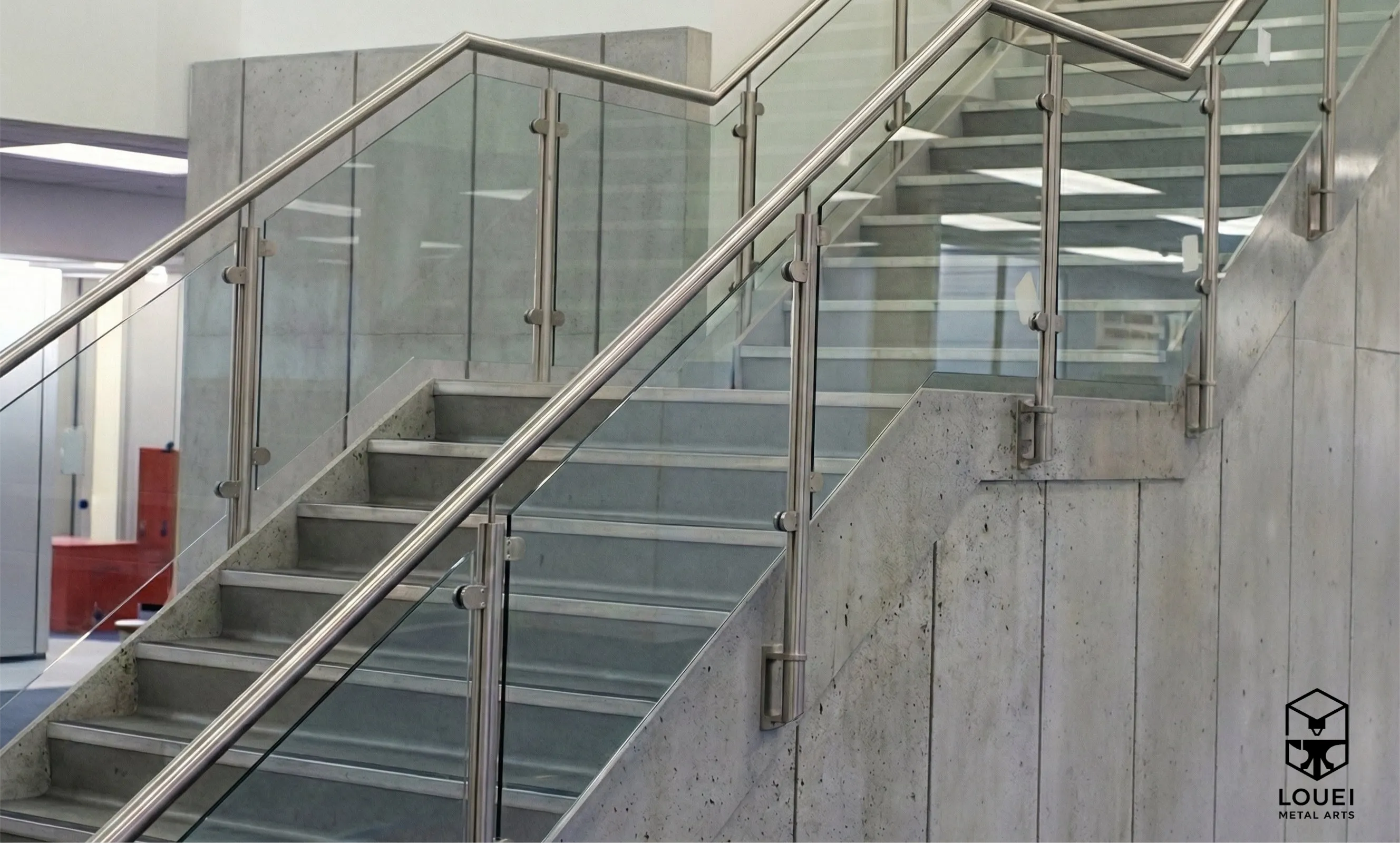
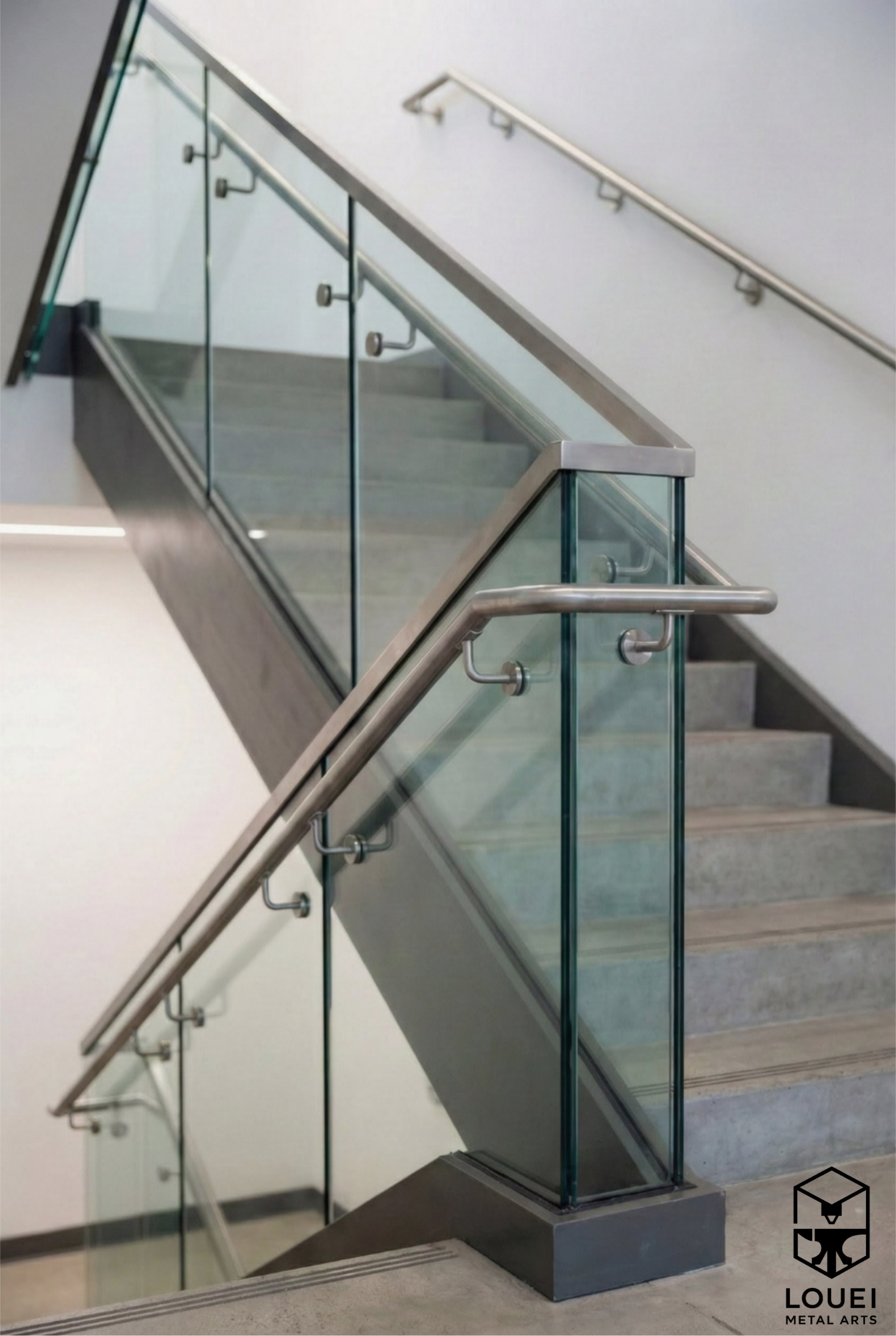
Stainless steel handrail integrated with a glass stair guardrail on concrete stairs — both functions, one stair — by LOUEI Metal Arts

A guard protects an open side of a stair, landing, balcony, or floor edge — it helps protect against a fall. A handrail is the graspable support used by the hand going up or down stairs. For dedicated handrail work, see Handrails. A stair railing is the broader system: posts, infill, panels, pickets, glass, rails, brackets, and transitions. Depending on the stair, it may include a guard, a handrail, or both.

Edge protection

Guard.

Protects an open side of a stair, landing, balcony, or floor edge. Helps protect against a fall.

Use when

  • · The stair has an open side
  • · The landing edge is open
  • · There is a drop beside the stair
  • · The system must protect a fall edge

Common systems

Glass guards, metal guards, picket guards, custom welded guards.

A guard is about edge protection. It may or may not be comfortable to grip.
Graspable support

Handrail.

The graspable rail used by the hand moving up or down stairs. Different from a guard.

Use when

  • · The stair needs graspable support
  • · There is a wall side
  • · The user needs help moving up or down
  • · Accessibility or senior safety is the priority

Common systems

Wall-mounted handrails, post-mounted handrails, round or shaped metal rails, stainless or powder-coated handrails.

Treat the handrail as a grip and support element, not just the top edge of a guard.

Integrated stair railing

Both.

When the stair has an open side AND needs graspable support, both functions must work together.

Use when

  • · The stair has an open side and needs graspable support
  • · The guard top rail is not suitable as a handrail
  • · The stair connects to landings or exterior transitions
  • · The design must solve fall protection and grip together

Common systems

Glass guard with metal handrail, picket guard with separate handrail, custom welded stair railing with integrated grip.

This is where custom fabrication earns its place — safety, structure, geometry, and appearance solved together.

Geometry First

The stair shape decides the railing.

Stair railing in Vancouver is driven by geometry: pitch, rise and run, landing, open side, wall side, stringer condition, tread material, attachment points, and whether the stair is interior or exterior. Material selection follows the stair, not the other way around.

Pitch

The angle of the stair affects post height, panel shape, handrail height, and how the railing transitions to landings.

Rise and run

The step dimensions affect the line of the railing, the handrail path, and how posts or brackets land on treads, stringers, walls, or floors.

Landing

Landings often need guard continuation, handrail returns, corner transitions, and clean alignment between stair and flat sections.

Open side

The open side usually needs guard planning. The system must protect the drop while following the stair pitch.

Wall side

The wall side usually needs handrail planning. Brackets, blocking, wall finish, and grip shape matter.

Attachment points

A stair railing can attach to treads, stringers, side plates, walls, concrete, steel, or wood framing. The attachment changes the whole system.

Interior / Exterior

Interior and exterior stairs solve different problems.

Interior stair railings are driven by architecture, light, finish, and the line of the stair. Exterior stair railings add weather, corrosion, anchoring, drainage, and surface conditions to the equation.

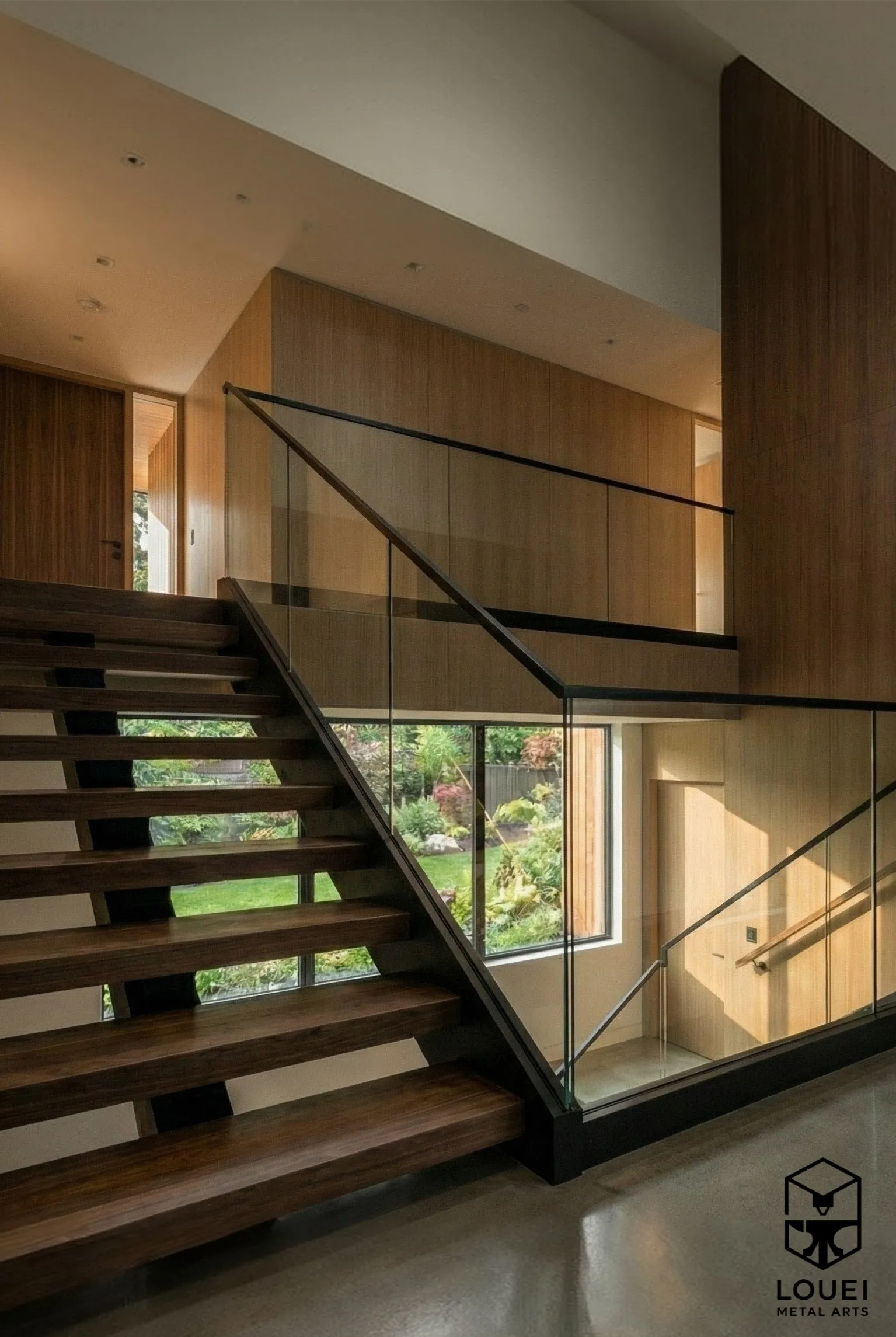
Interior stair railing with glass panels and black metal handrail by LOUEI Metal Arts

Interior stair railing

Priorities

  • · Clean architectural line
  • · Glass openness
  • · Black metal contrast
  • · Stainless details
  • · Floating stair edge protection
  • · Landing guard continuation
  • · Handrail comfort
  • · Finish coordination with floors and walls

Common systems

Glass, metal, picket, stainless, custom welded details, guard + handrail combinations.

LOUEI checks

Wall blocking, tread and stringer structure, landing conditions, finished floor transitions, and whether the handrail should be integrated or separate.

Exterior stair railing with glass guard and stainless hardware by LOUEI Metal Arts

Exterior stair railing

Priorities

  • · Weather resistance
  • · Corrosion protection
  • · Secure anchoring
  • · Finish durability
  • · Guard height
  • · Handrail grip
  • · Concrete, wood, steel, or masonry attachment
  • · Drainage and exposure

Common systems

Powder-coated metal, picket, aluminum, stainless details, exterior glass, custom brackets.

LOUEI checks

Rain exposure, concrete condition, framing, steel substrate, existing anchors, handrail needs, and whether the railing connects to a deck, balcony, landing, or walkway.

Stair Conditions

Open side, wall side, and landing change the system.

Most stair railing confusion comes from treating all sides the same. A wall side, open side, and landing edge each do a different job.

Open side

Where guard planning matters most. Glass, metal, picket, or custom welded railing protects the edge while following the stair pitch.

LOUEI asks

  • · What is below the open side?
  • · Is the stair interior or exterior?
  • · Can posts attach to treads, stringers, side plates, or floor structure?
  • · Does the top rail also need to function as a handrail?

Wall side

Where handrail planning matters most. Wall brackets, blocking, wall finish, grip shape, and return details matter.

LOUEI asks

  • · Is there solid backing?
  • · Should the handrail be round, rectangular, or custom shaped?
  • · Should it continue around a landing?
  • · Is accessibility part of the project?

For dedicated handrail work, see Handrails →

Landing

Where stair pitch becomes flat. This transition often determines whether the railing looks clean or awkward.

LOUEI asks

  • · Does the guard continue around the landing?
  • · Does the handrail return into a wall or post?
  • · Is there an open landing edge?
  • · Is the stair L-shaped or U-shaped?
  • · Does the landing connect to a balcony, deck, or hallway?
Stair Shapes

Straight, L-shaped, U-shaped, curved, and floating stairs do not use the same railing logic.

The shape of the stair changes the railing before the material is selected.

Custom glass stair railing on a straight interior staircase with stainless top rail by LOUEI Metal Arts

Straight stair

Simplest geometry.

Main decisions

Open side vs wall side. Guard vs handrail. How the railing terminates at top and bottom.

Likely systems

Glass, metal, picket, aluminum, or handrail-only where appropriate.

Custom metal guard on an angled L-shaped stair by LOUEI Metal Arts

L-shaped stair

A turn and landing create a transition.

Main decisions

The railing must move from pitch to flat, then change direction cleanly.

Likely systems

Custom welded metal, glass with landing guard, picket with corner detail, or separate handrail return.

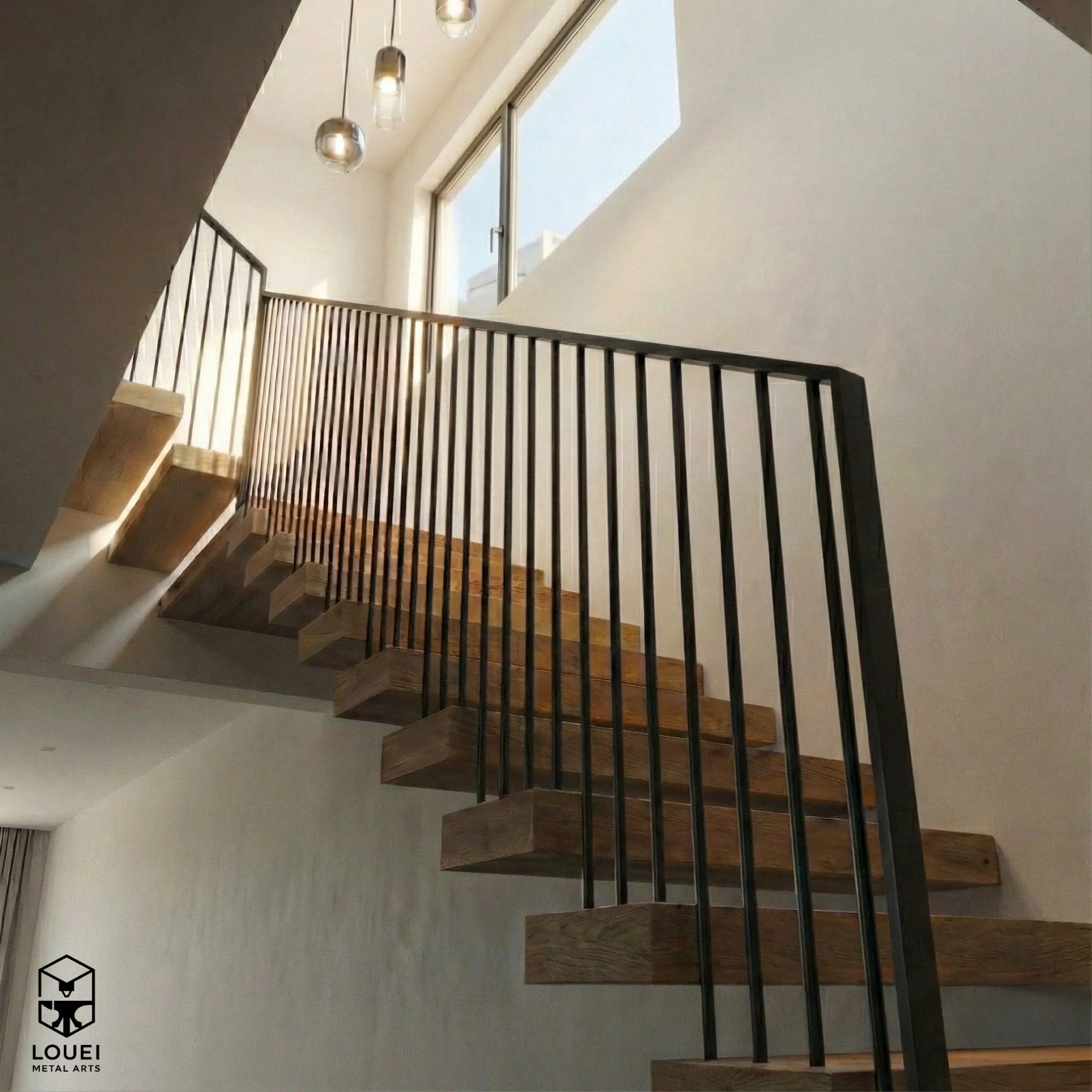
Custom picket railing on a U-shaped wood stair in a Vancouver townhome by LOUEI Metal Arts

U-shaped stair

Two runs and a middle landing.

Main decisions

Continuity matters. Alignment across both runs is the priority.

Likely systems

Glass guard with continuous handrail, custom welded metal, or picket with matched spacing.

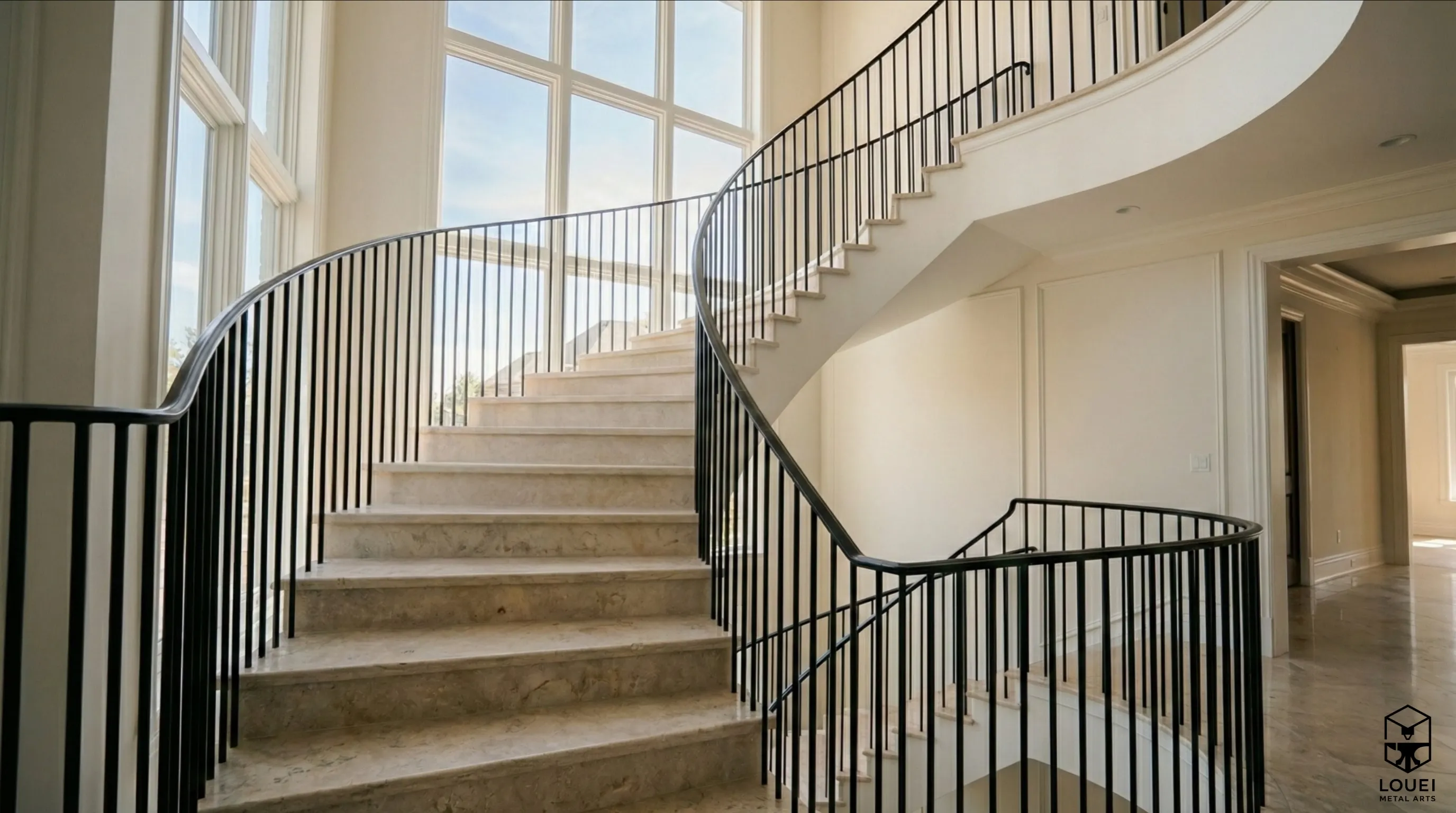
Custom curved picket stair railing in a luxury Vancouver home by LOUEI Metal Arts

Curved stair

Standard kits rarely fit cleanly.

Main decisions

Curved geometry usually requires custom fabrication, rolled metal, and shaped handrails.

Likely systems

Custom rolled metal, shaped handrail, custom glass, or panel coordination where feasible.

Custom picket railing on a floating oak stair in a Vancouver home by LOUEI Metal Arts

Floating or open-riser stair

The railing becomes a major architectural feature.

Main decisions

Light, openness, post placement, glass alignment, and handrail integration all matter.

Likely systems

Glass, black metal, stainless details, custom welded guard + handrail, or cable where the stair condition makes sense.

Send the geometry. The shape leads the recommendation.

Glass Stair

Glass stair railing keeps the stair open.

Glass works when the stair is a visual feature and the goal is openness, light, and architectural clarity. It can be especially strong for open-riser stairs, floating stairs, modern interiors, exterior stairs with view priority, and landings where the guard should not feel visually heavy.

Consider glass when

  • · The stair is open to a living area
  • · The stair is floating or open-riser
  • · The landing guard should feel transparent
  • · The view or light through the stair matters
  • · The client wants a clean architectural edge

Watch for

Glass support method · handrail requirement · pitch transitions · landing transitions · wall/floor attachment · cleaning expectations · glass-to-post gaps · exterior exposure where applicable.

Explore Glass Railing for the broader system.

Custom glass stair railing with stainless posts and handrail on concrete stairs by LOUEI Metal Arts

Post-and-clamp glass. Practical when visible posts are acceptable and the structure supports post layout.

Standoff glass. Useful where side mounting is available and the stair stringer or side surface can support it.

Base-shoe or channel glass. Cleanest visual line, but requires suitable structure and careful planning.

Metal Systems

Metal and picket stair railings are built for rhythm and strength.

Not every stair should disappear. Many stairs need a stronger line, a more practical guard, or a durable exterior system.

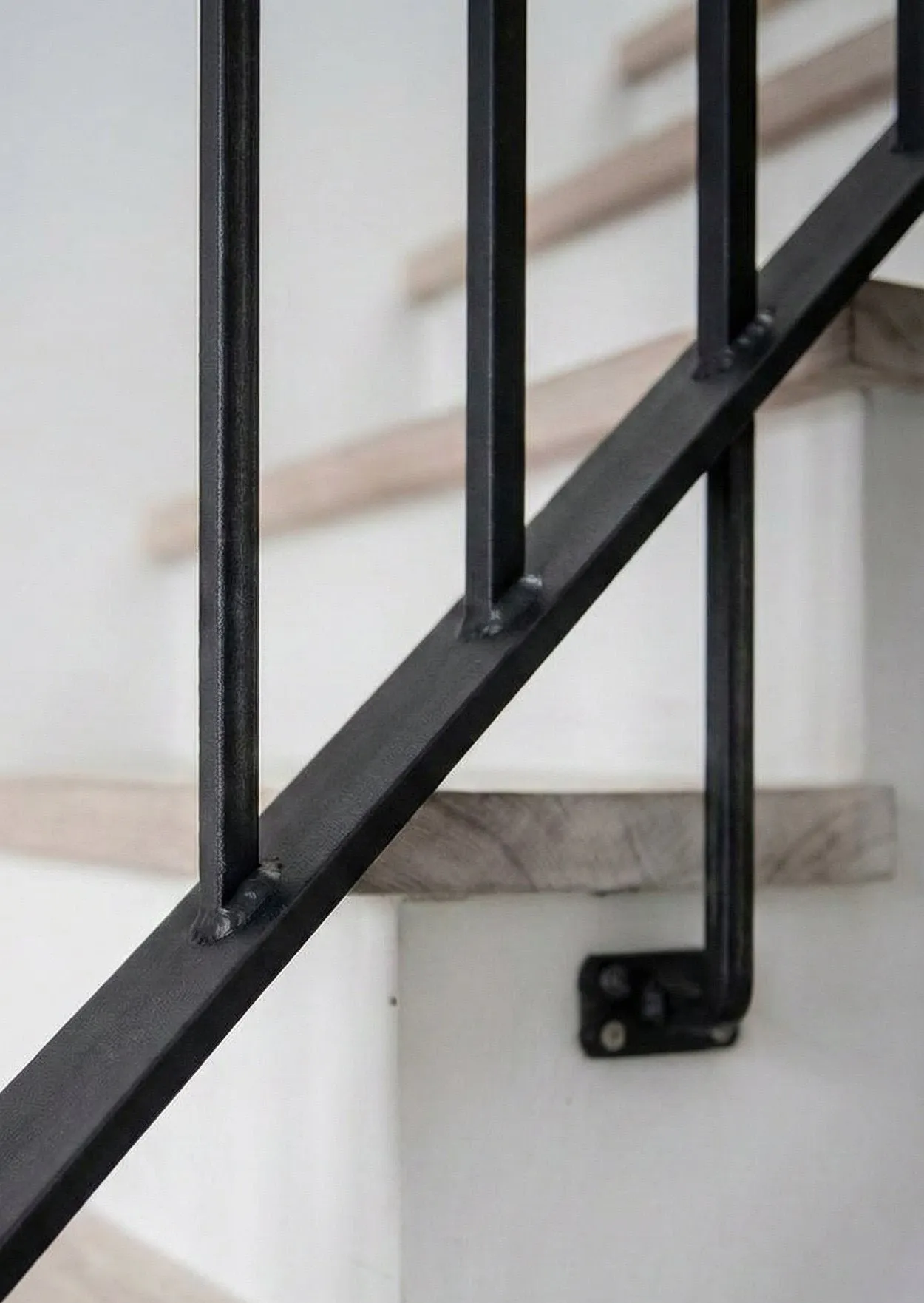
Welded steel picket stair railing fabricated by LOUEI Metal Arts

Consider metal, picket, or aluminum when durability matters more than transparency · the stair is exterior · the railing needs a strong rhythm · the design should match other guards on the property · the stair needs custom welded geometry · the stair connects to deck, balcony, or landing railings.

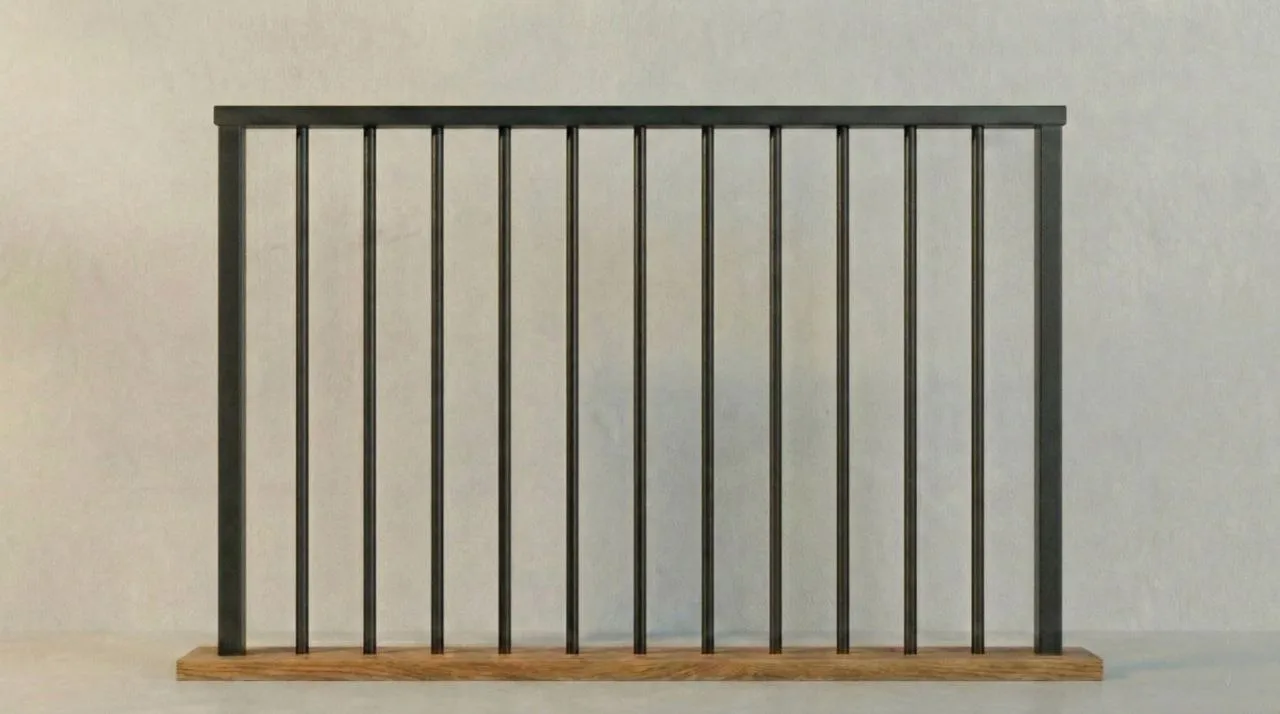
Picket stair railing. Best for durability, exterior stairs, practical guard conditions, family homes, repeatable spacing, and a strong vertical rhythm. Picket Railing

Custom welded metal. Best for unusual geometry, curved stairs, L-shaped or U-shaped stairs, custom posts or brackets, integrated guard + handrail, and architectural metalwork. Metalwork

Aluminum stair railing. Best for exterior exposure, lighter weight, corrosion resistance, and repeatable exterior applications.

Stainless details. Best for exterior hardware, handrail caps, glass fittings, coastal or moisture-heavy conditions, and clean modern details.

Attachment

Stair railing brackets and posts are part of the design.

For LOUEI, brackets and posts are not accessories. They are part of the structural and visual system. The attachment method changes the recommendation.

Tread-mounted posts

Posts attach down into the stair tread or surface. Works when the tread and structure below are suitable. Post layout follows the stair pitch and avoids finish-only surfaces.

Side-mounted posts

Posts attach to the side of a stringer, concrete stair, or fascia. Preserves stair width and creates a cleaner walking surface, but the side surface must be suitable.

Wall-mounted handrail brackets

Brackets support a graspable handrail along a wall side. Wall backing, bracket spacing, return details, and grip shape matter.

Glass standoffs or clamps

Glass systems rely on hardware aligned with the stair pitch and landing. Must be planned around support, spacing, and edge conditions.

Custom base plates or welded brackets

Used when standard hardware does not solve the geometry. This is where custom fabrication prevents awkward field fixes.

Code-Aware

Stair railing code starts with function.

Stairs can involve guards, handrails, or both. Code-aware planning starts with function before style.

Nine questions LOUEI asks before recommending

  1. 01Is the stair open on one side?
  2. 02Is there a drop beside the stair?
  3. 03Is the element acting as a guard?
  4. 04Is a graspable handrail required?
  5. 05Is it interior or exterior?
  6. 06Is there a landing?
  7. 07What is the height or drop condition?
  8. 08What occupancy or building type applies?
  9. 09What material and attachment method are being used?
Kit vs Custom

When a stair railing kit makes sense — and when it does not.

A kit can work for some simple conditions. If the stair is straight, standard, wall-side, and the goal is a basic off-the-shelf handrail, a kit may be enough for a competent installer.

Custom is the better path when

  • · The stair has an open side
  • · The stair has a landing
  • · The stair turns L-shaped or U-shaped
  • · The stair is curved
  • · The stair is floating or open-riser
  • · The project needs glass
  • · The project needs custom welded metal
  • · The railing must act as both guard and handrail
  • · The stair is exterior and exposed to weather
  • · Brackets, posts, or attachment points need custom planning
  • · The railing must match other guards on the property
  • · The stair condition is not standard

LOUEI is not a kit reseller. Custom railing is planned around the stair geometry, then fabricated and installed around the site condition. Where a kit is genuinely the right call, this page can say so. Honesty builds trust.

Avoid

Common stair railing mistakes Vancouver owners make.

Most stair railing mistakes come from choosing the style before understanding the stair function.

01

Confusing guard and handrail.

A guard protects an open side. A handrail supports the hand. A top rail on a guard is not automatically a proper handrail.

02

Choosing glass before checking geometry.

Glass can look excellent on stairs, but pitch, landing transitions, support method, and handrail need must be reviewed first.

03

Ignoring the landing.

Landings often expose weakness in a railing plan. The transition from stair pitch to flat guard needs careful alignment.

04

Using kit parts on non-standard stairs.

Kits can be useful on simple stairs. They usually struggle with turns, floating stairs, custom landings, open sides, and exterior exposure.

05

Treating exterior stairs like interior stairs.

Exterior stairs need weather, anchoring, finish, corrosion, drainage, and grip planning. Interior assumptions do not always transfer outdoors.

Process

From stair photos to installed railing.

Every stair railing project in Vancouver starts with the stair geometry.

01

Photos and geometry context

Photos from top, bottom, side, and landing. Include the open side, wall side, existing railing, treads, stringer, and connection points.

02

Guard / handrail recommendation

LOUEI narrows whether the stair needs a guard, a handrail, or both, plus likely system directions and questions still needing site review. No pricing committed at this stage.

03

Site walkthrough and quote

LOUEI checks pitch, landing, open side, wall side, attachment points, existing structure, exterior exposure, and anything photos did not show. Written quote follows the walk.

04

Custom fabrication, code-aware build

Posts, rails, brackets, glass, pickets, panels, top rails, handrail elements, hardware, and finish details planned around the stair. Geometry-driven fabrication with coordination between guard and handrail where needed.

05

Installation and walkthrough

Alignment, anchoring, guard function, handrail function, opening limits, finish quality, and transition details. The installed railing should feel secure, clean, and built for the stair it protects.

Submission Brief

What helps LOUEI narrow the recommendation.

Phone snapshots work. Drawings help if you have them, but they are not required to start.

Photos

  • · Bottom of stairs
  • · Top of stairs
  • · Side showing pitch
  • · Close-up of open side
  • · Close-up of wall side
  • · Landing if there is one
  • · Existing railing or handrail if any
  • · Exterior context if outside
  • · Where the railing should start and stop

Stair details

  • · Interior or exterior
  • · Straight, L-shaped, U-shaped, curved, or floating
  • · Approximate number of steps
  • · Whether one side is open
  • · Whether there is a wall side
  • · Whether there is a landing
  • · Whether the stair connects to a deck, balcony, hallway, or exterior path
  • · What matters most: openness, durability, grip, style, safety, or matching existing work

loueimetalarts@gmail.com · @loueimetalarts · 604-388-6086

Installed Work

Three stairs. Three geometries.

Each custom system followed the geometry.

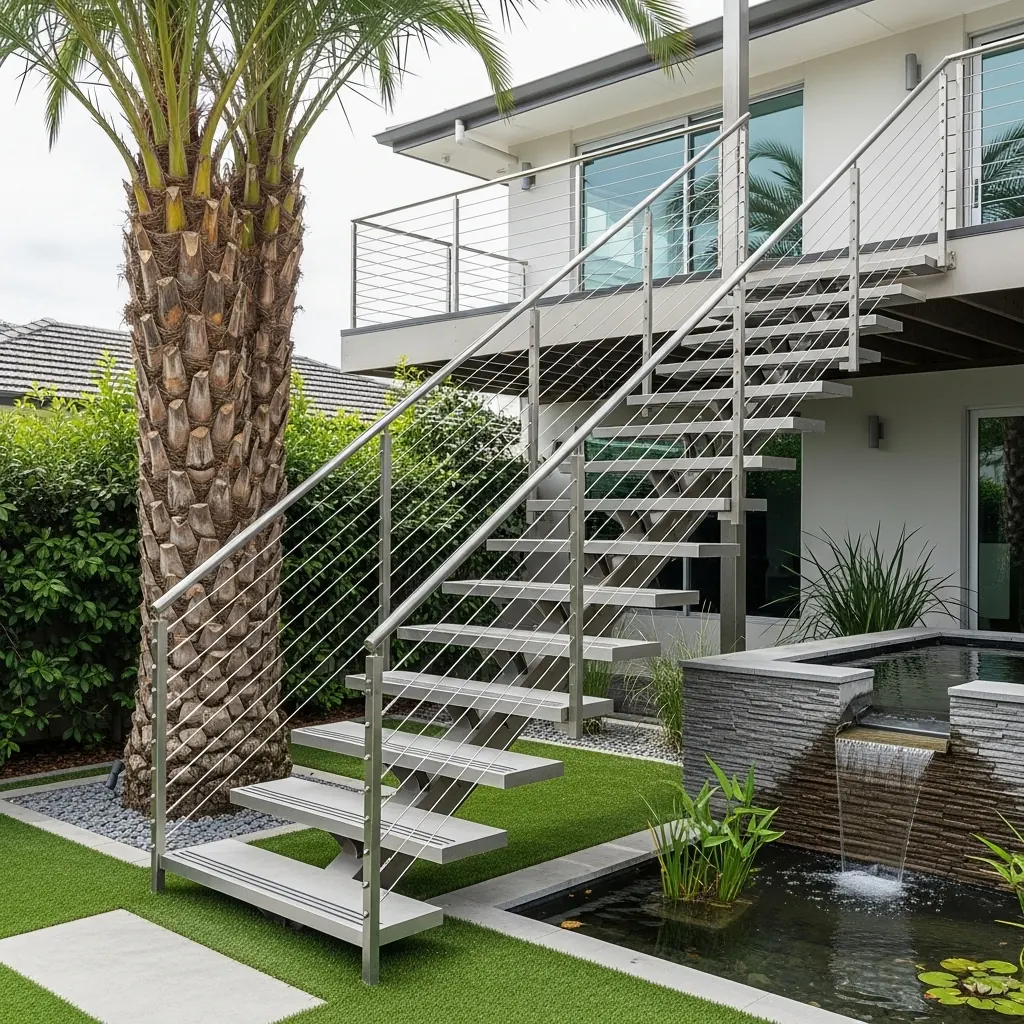
Custom cable infill stair railing on a floating open-riser stair by LOUEI Metal Arts

Floating interior stair

Open-riser stair with visible side.

Priority: Openness and architectural line.

Chosen direction: Custom cable infill with stainless hardware.

The railing needed to protect the open side without making the stair feel heavy.

Custom standoff glass exterior stair railing with stainless hardware by LOUEI Metal Arts

Exterior stair with landing

Weather exposure and landing transition.

Priority: Durability, anchoring, and clean transition.

Chosen direction: Custom standoff glass with stainless hardware.

The system handled pitch, landing, exterior exposure, and attachment points.

Custom welded steel picket stair guard with concealed brackets by LOUEI Metal Arts

Metal picket stair guard

Interior stair where rhythm and durability mattered.

Priority: Strong guard line and practical use.

Chosen direction: Custom welded steel pickets with concealed brackets.

Built to feel permanent, aligned, and matched to the stair geometry.

Terms Explained

Stair railing terms.

Plain-language definitions used in stair recommendations and quotes.

01

Stair railing

The visible system along a stair: posts, infill, glass, pickets, rails, handrails, brackets, and landing transitions.

02

Guard

A protective barrier along an open side or landing edge. It helps protect against falls.

03

Handrail

A graspable rail used by the hand moving up or down stairs. Different from a guard.

04

Open side

The side of a stair not protected by a wall. Usually needs guard planning.

05

Wall side

The side of a stair next to a wall. Usually involves handrail bracket planning.

06

Landing

A flat area between stair runs or at the top or bottom. Often needs guard or handrail transitions.

07

Stair pitch

The angle of the stair. Affects post height, glass shape, handrail path, and alignment.

08

Stringer

The structural side member supporting stair treads.

09

Top-mount

A post or base plate mounted into the tread, landing, or walking surface.

10

Side-mount

A post attached to the side of the stair, stringer, fascia, or structural edge.

FAQ

Stair-specific questions.

For broader railing topics, see the Custom Railings FAQ.

What type of railing is best for stairs?

+

Depends on geometry, open side, wall side, landing, and interior or exterior condition. Glass works for openness. Metal or picket works for durability. Custom is best when the stair is not standard.

Stair railing, handrail, and guard — what is the difference?

+

A guard protects an open edge. A handrail is graspable support. A stair railing is the broader system and may include a guard, a handrail, or both.

Do stairs need a handrail or a guard?

+

Wall-side stairs often need mainly a handrail. Open-side stairs need guard planning. Many stairs need both. The requirement depends on geometry, height, and applicable code.

Is glass railing good for stairs?

+

Yes, when openness and light matter — especially for floating stairs, open landings, and modern interiors. Support method, landing transitions, and handrail need must be reviewed.

Is metal railing good for stairs?

+

Yes, when durability, exterior exposure, or custom geometry matter. Can be picket, welded metal guard, custom handrail, or a guard-and-handrail combination.

What is best for outdoor stair railing in Vancouver?

+

Plan around rain, anchoring, finish, grip, and corrosion. Powder-coated metal, aluminum, stainless details, exterior glass, and picket can all work when matched correctly to the stair.

Can LOUEI build railings for curved or floating stairs?

+

Yes. Curved, floating, L-shaped, U-shaped, and open-riser stairs benefit from custom fabrication because kits rarely match the geometry.

Can I use a stair railing kit instead of custom?

+

A kit may work for a simple straight standard stair. Custom is usually better with an open side, landing, turn, exterior exposure, glass, metalwork, or a guard-and-handrail combination.

Do stair railings need to meet BC Building Code?

+

Stair guards and handrails are planned around applicable code. The requirement depends on location, open sides, height, occupancy, and whether the element acts as a guard, handrail, or both.

What should I send for a stair railing quote?

+

Photos from top, bottom, side, and landing. Include open side, wall side, existing railing, step count, interior or exterior, and what matters most.

Send Photos

Stairs start with geometry.

You do not need to know the system yet. A few photos are enough to start sorting the right path for your stair. Every recommendation is custom to your stair geometry and planned code-aware before the first cut of metal.

Send: photo from the bottom · photo from the top · side photo showing pitch · landing if there is one · open side · wall side · existing railing or handrail if any · approximate number of steps · interior or exterior.

Every recommendation walks the same path: geometry first, then function — guard, handrail, or both — then the system.

Serving Vancouver and communities across BC — see all service areas.