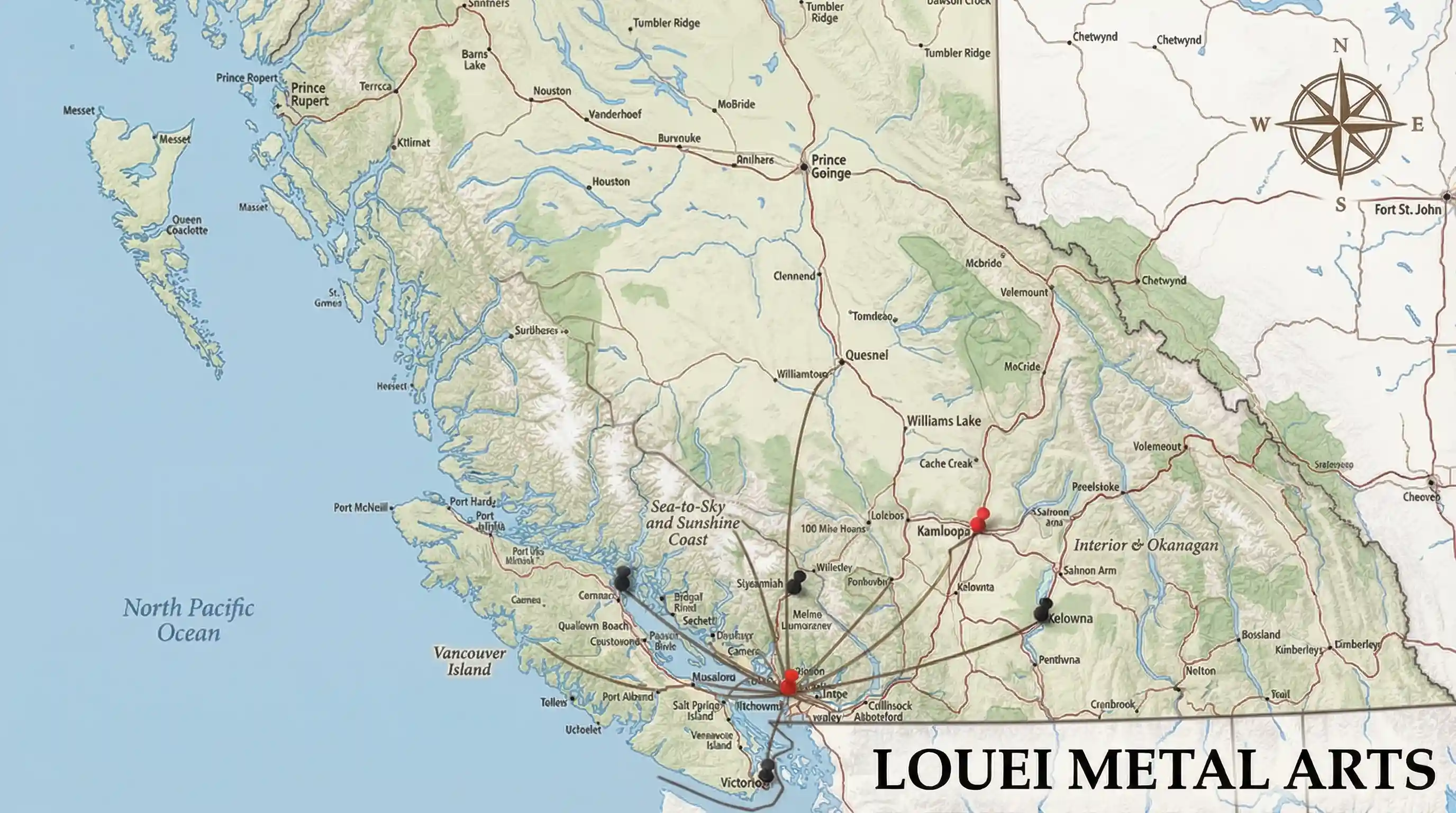
British Columbia Services
Custom Railings in Squamish, BC
Engineered for the Wettest Town on the Highway
The Problem with Railing Systems That Weren’t Designed for Squamish
Annual Precipitation
2,200mm
Moisture Index
2.12
Design Style
Mountain Modern
Building on a Garibaldi Highlands slope is not the same as building on a flat lot. The grade shifts under your footings. The soil holds water for months. And 2,200 millimetres of annual precipitation pushes against every exterior connection, leaving maintenance problems on materials that weren’t specified for this moisture load.
You chose Squamish for a reason: the mountain backdrop, the Howe Sound proximity, the forty-five-minute commute to Vancouver. Your railing system should protect that investment, not fight against it.
Glass panels fog and spot after every storm in this climate. Wood rots at the base within three to five years without annual resealing. Aluminum kit systems from big-box stores aren’t engineered for the lateral loads that sloped mountain lots produce.
The Solution:Custom cable railings solve these problems. Thin stainless steel cables shed rain without spotting, disappear against a treeline, and are typically a smarter long-term investment than frameless glass. Below: how cable systems perform in Squamish's specific conditions, what the BC Building Code requires, and what a mountain-slope installation actually involves. For Squamish-specific building requirements, the District of Squamish Building Permits page outlines the full permit process and inspection scheduling.
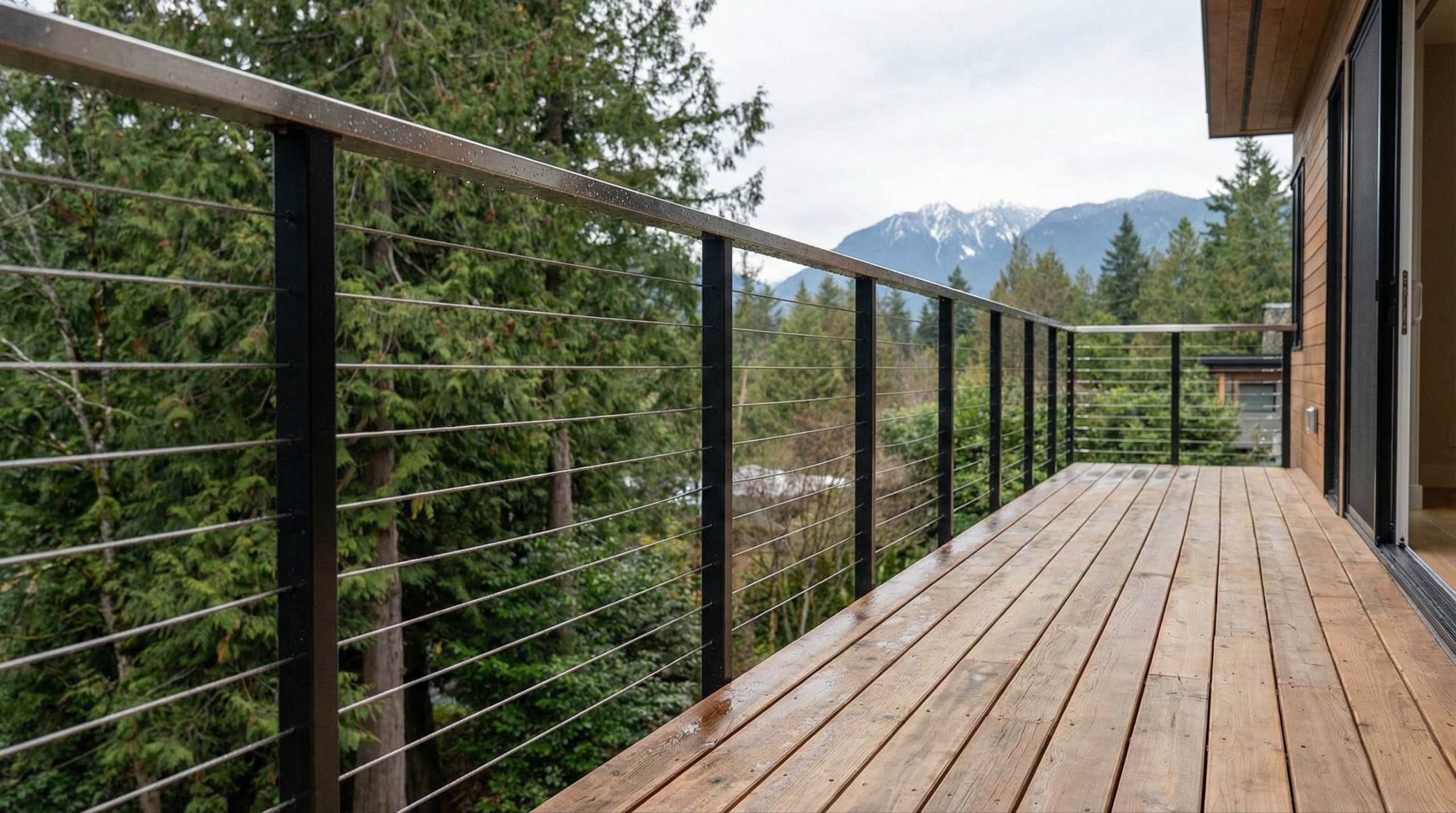
Designed for continuous views.
Why Cable Railings Fit Squamish’s Mountain Modern Aesthetic
New construction in Squamish follows a “Mountain Modern” design language: exposed steel, natural wood, oversized windows, and a deliberate connection to landscape.
Cable railings are the structural expression of this style. Horizontal steel cables echo the layered ridgelines of Sky Pilot and the Tantalus Range. Powder-coated posts pick up the industrial heritage of Squamish’s former logging economy. And at a normal viewing distance, 3.2mm cables virtually vanish — leaving an unbroken sightline from your deck to Howe Sound.
This resonates with Squamish’s demographic. A population that climbs The Chief, bikes the Brackendale trails, and runs Garibaldi Provincial Park backcountry. These homeowners want railings that feel like gear: functional, stripped-back, built to perform in weather. Not suburban. Not decorative.
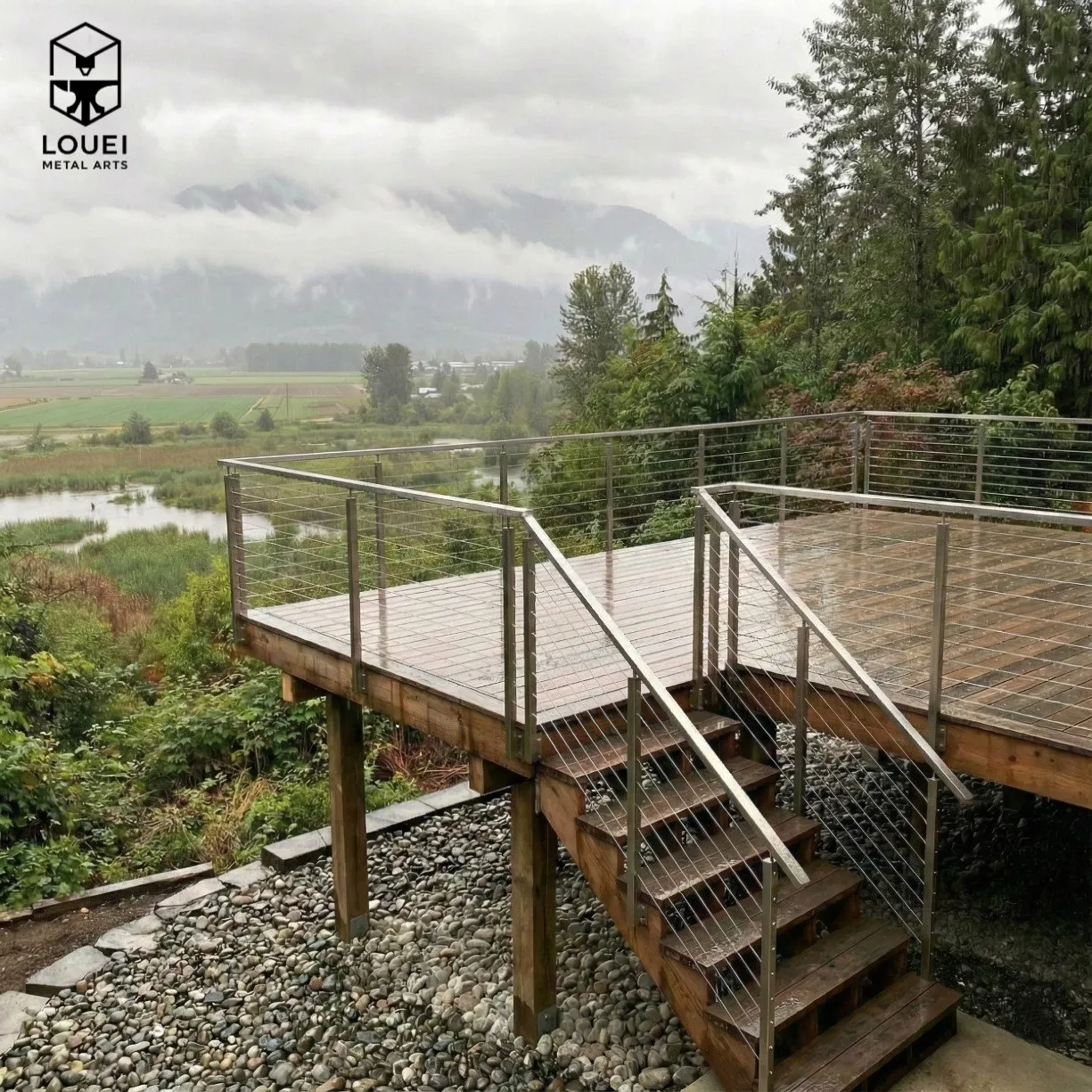
ClearView Black cable railing on a Garibaldi Highlands deck — matte powder coat, 316 SS cables, and a clean sightline to the Tantalus Range.
Explore our cable railing systemsPreserving Views from Garibaldi Highlands to Waterfront Landing
Squamish is a town of views. Garibaldi Highlands faces the Tantalus Range. Loggers Lane and Waterfront Landing face Howe Sound. Polygon’s Garibaldi Springs sits below The Chief with an uninterrupted sightline to the estuary. In every case, your railing determines how much of that view you actually see from your deck.
ClearView Black
Uses powder-coated steel posts with stainless cables — the dark finish disappears against forest backdrops.
ClearView Stainless 316
Full marine-grade stainless, post to cable, for direct Howe Sound salt-air exposure and coastal resilience.
Both systems space cables to pass the BC Building Code’s 100mm sphere test while keeping visual obstruction near zero.
Explore ClearView Systems →Engineering for 2,200mm of Annual Rain and Mountain Slopes
The BC Building Code’s climatic appendix assigns Squamish a moisture index of 2.12 and 160 Pa driving rain wind pressure. In practical terms: sustained moisture that accelerates corrosion at every joint, gasket, and fastener.
Water Shedding
Stainless cables don’t trap water the way glass panel gaskets do. Powder-coated posts shed rain along a cylindrical profile without pooling. We design every Squamish railing installation with a 6mm drainage gap between post base and deck surface.
Slope Engineering
A significant share of Squamish lots sit on sloped terrain. Kit railings don’t accommodate this — custom cable railing fabrication is essential. Posts must be custom-cut using digital inclinometry to follow the slope while maintaining the 1,070mm guard height plumb from the walking surface.
Why Stainless Steel and Powder Coat Outperform in Squamish’s Climate
Wood Railings: Typically show post-base rot within 3–5 years without annual resealing in this transitional zone. Read our guide to replacing wood railings.
Aluminum: Corrosion-resistant but susceptible to galvanic failure where dissimilar metals meet (e.g., aluminum-to-steel connections). See our cable vs. glass comparison for BC weather.
Our Standard:Metal railings — whether cable, glass-framed, or picket — outperform wood in Squamish’s rainfall zone. Powder-coated steel provides superior structural rigidity. For cable hardware, 316 SS with 2–4% molybdenum is the only grade we specify in the Sea-to-Sky corridor — the same alloy used in marine rigging.
Glass Railing Systems for Wind-Exposed Squamish Properties
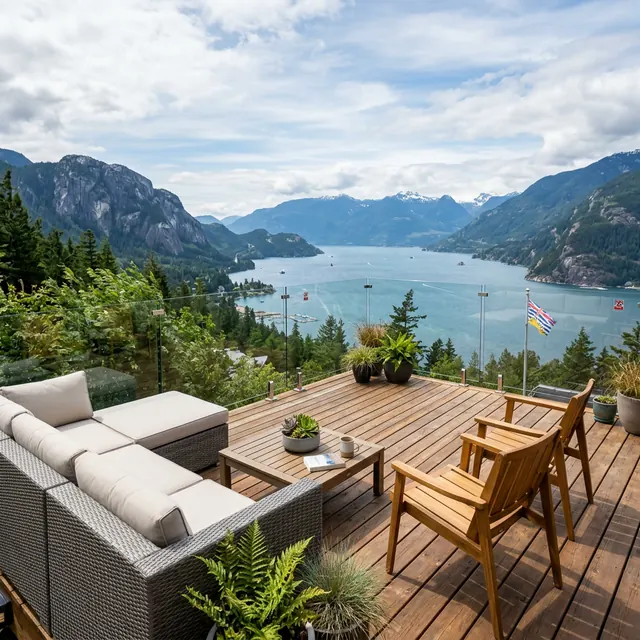
For properties along Howe Sound and the exposed western faces of Garibaldi Highlands, glass panels act as a transparent wind barrier that extends outdoor living by weeks on either end of the season.
"The tradeoff in Squamish is maintenance: glass in a 2,200mm rainfall zone accumulates mineral spots that need periodic cleaning. For homeowners who prioritize wind shielding and an unbroken visual plane, that tradeoff is justified."
Handrails for Sea-to-Sky Stairways and Sloped Entries
Mountain lots often have exterior stairways connecting street level to main entrance, split-level deck transitions, and steep garden paths. For Squamish’s older housing stock on Hospital Hill, retrofit handrails are a common project.
- Exterior stairways connecting street level to main entry on sloped Garibaldi Highlands lots require continuous graspable handrails (the Part 9 exception for up to three exterior risers is limited to specified single-dwelling/house conditions)
- Graspable profile engineered for Squamish's wet conditions — textured stainless steel that maintains grip during rain and does not ice-bond in winter freeze events along the Sea-to-Sky corridor
- Custom-fit to Squamish's typically non-standard exterior stair geometry — Hospital Hill retrofits and Garibaldi Highlands multi-level entries where no two stairways share identical dimensions
Beyond railings, Mountain Modern builds often need custom steel canopies, privacy screens, and decorative brackets. LOUEI Metal Arts fabricates all custom architectural metalwork in-house.
View our handrail systemsPicket Railings for Squamish Townhomes and Multi-Unit Projects
Squamish’s housing stock is diversifying — the Government Road 165-unit project and new strata townhomes along Loggers Lane are driving demand for custom picket railings that meet developer specifications while satisfying strata council aesthetics.
LOUEI Metal Arts fabricates custom steel picket railings to CWB-standard welding, with RAL colour matching for strata-wide consistency. Unlike aluminum kit pickets from big-box stores, our powder-coated steel pickets resist denting and provide the structural rigidity that multi-unit insurers require.
Explore our picket railing systems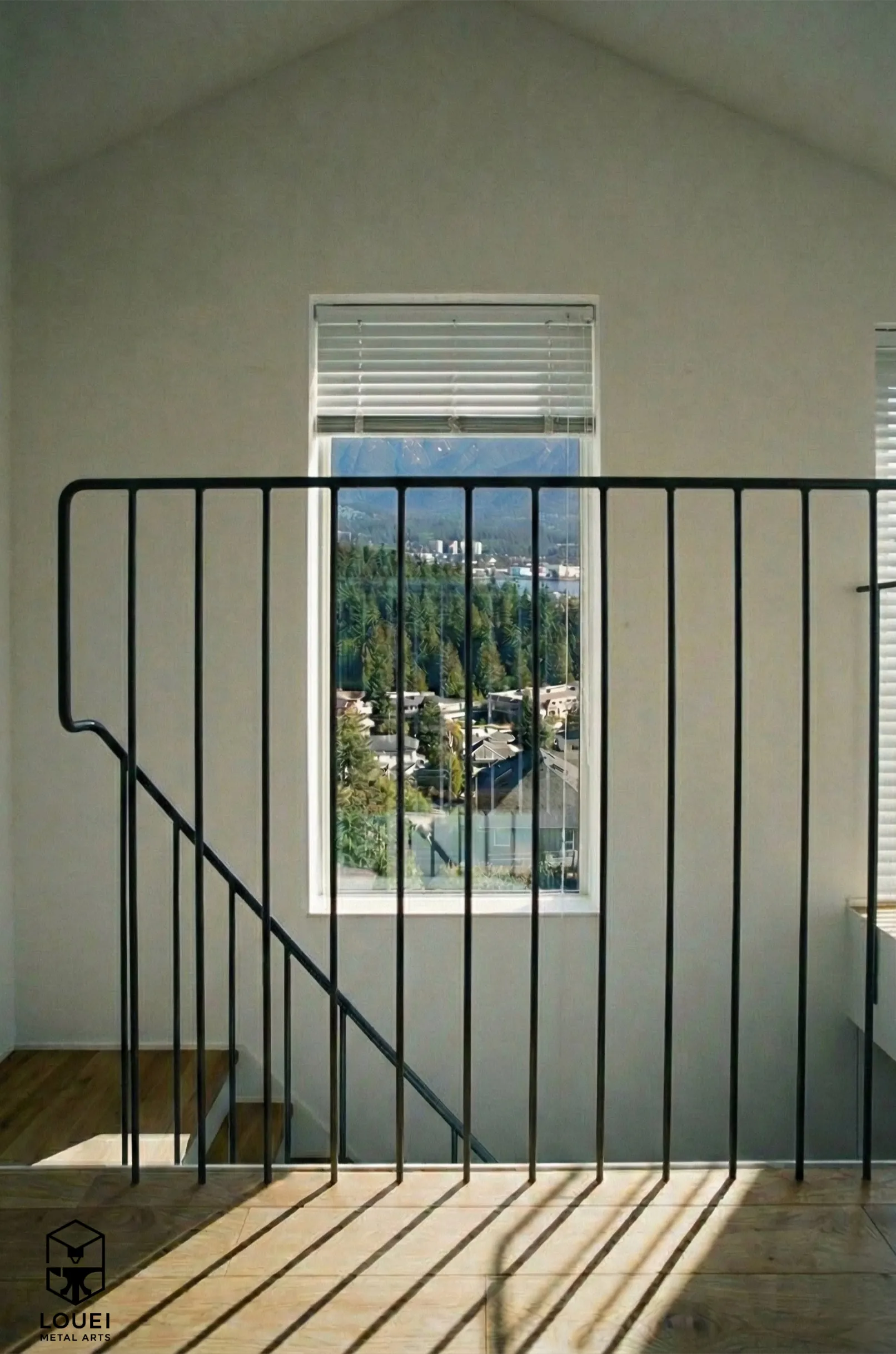
A Typical Squamish Deck Railing Installation
The following is a representative scenario based on common Squamish property types. It is not a completed case study.
Property
New-build in Garibaldi Highlands, 2,800 sq ft, 12-degree sloped lot. Rear deck faces west toward the Tantalus Range.
Scope
55 linear feet wrap-around deck cable railing (two 90° corners + one angle transition following lot slope) plus 18 linear feet on an exterior staircase to lower garden level.
Product
ClearView Black — matte black powder coat (RAL 9005) with 316 SS cables. Black selected to blend with dark cedar and steel exterior.
Challenges
- Three slope-transition points requiring custom-angle post fabrication.
- Rear deck 2.4m above grade = 1,070mm guard height required.
- 2,200mm annual rainfall demands drainage-gapped bases and marine-grade tensioners.
Permit and Code Requirements
District of Squamish Permit Process
The District requires a building permit for any deck structure 0.6m or greater in height. Application fees start at $200. We supply the required P.Eng.-sealed structural drawings.
Sloped Lot Guard Height
On sloped lots, most decks exceed the 1,800mm threshold where the full 1,070mm guard height applies, measured plumb from the walking surface.
Geotechnical Constraints
Squamish's mountainous terrain often requires geotechnical engineers to sign off on deck footings before high-load glass guards can be installed safely.
Marine Shoreline Protection
For properties along Howe Sound, additional DFO and upland environmental setbacks may apply when replacing exterior structures and guards.
Climbability Code
Ordinary Part 9 clause 9.8.8.6.(1) uses a more-than-4.2 m climbability trigger. Part 3, exits and pools have different conditions; height, openings, loads and connections still apply.
Inspection Booking
Inspections can be booked via the District's MyCity portal. Our comprehensive P.Eng. packages ensure smooth sign-offs.
Squamish Neighbourhoods We Serve
Every Squamish neighbourhood presents different railing challenges — slope grades, moisture exposure, aesthetic expectations, and building stock age vary block by block. Here is how our fabrication addresses each area.
Garibaldi Highlands
Premium area with steep mountain-slope lots requiring custom-angle post fabrication and sightlines to the Tantalus Range.
Brackendale
Eagle habitat and riverfront properties needing drainage-gapped post bases and 316 SS tensioners for sustained moisture.
Valleycliffe
Original residential neighbourhood where older wood railings are being replaced by lower-maintenance steel and cable systems.
Crumpit Woods
Dense forest surrounds where ClearView Black cable railing disappears against the canopy. Steep access roads require precise logistical planning.
Hospital Hill
Squamish's hillside requiring continuous graspable steel handrails custom-fabricated to fit non-standard stair treads.
Downtown & Loggers Lane
Densifying core driving demand for strata-grade, CWB-welded picket and glass railing systems for multi-family consistency.
Waterfront Landing
Premium shorefront developments where base-shoe frameless glass systems maximize Howe Sound panoramic views and act as wind barriers.
Dentville
A mix of original character homes and new infill demanding cost-effective picket railing upgrades tailored to evolving aesthetics.
Northyards
Industrial-adjacent properties and modern home designs where matte black cable systems perfectly complement the architectural tone.
Frequently Asked Questions
Railings in Squamish
Do I need a building permit for deck railings in Squamish?
+
Yes. The District requires a building permit for any deck structure 0.6m or higher above grade. We provide P.Eng.-sealed structural drawings, including slope-specific calculations, to satisfy the District's requirements.
What railing materials handle Squamish’s rainfall?
+
Powder-coated steel frames and stainless cables resist moisture without annual resealing. Cables don’t accumulate rain spots, significantly reducing maintenance compared to glass in a 2,200mm rainfall zone.
How long does installation take?
+
A standard project takes about three weeks: day one for slope measurement, 10–12 business days for custom hillside fabrication, and 1–2 days for installation during dry weather windows.
Related Reading
Building Code
BC Building Code Railing Requirements 2025–2026
Permits
Do You Need a Permit to Replace Deck Railings?
Comparison
Cable vs. Glass Railings: Which Is Better for BC Weather?
Wood Replacement
The Ultimate Guide to Replacing Wood Deck Railings
District of Squamish
Building Permit Applications & Inspections
Get a Free Estimate from Your Squamish Railing Contractor
Building on a Garibaldi Highlands slope? Replacing rotted wood railings in Valleycliffe? Outfitting a Waterfront Landing townhome? Contact LOUEI Metal Arts for a free on-site measurement. We drive the Sea-to-Sky from our Coquitlam studio to your property — one crew handles measurement, fabrication, powder coating, and installation. No subcontractors. No hand-offs. Call 778-848-1149 (Direct) or 604-388-6086 (Office).
Primary-source code reference · checked September 24, 2026
Code references for this page
These links go to governments, regulators and the original professional or certification bodies—not other railing businesses. Code text, older local bulletins and advisory guidance are labelled separately. This is an editorial source check, not a professional sign-off, product certification or approval of your project.
Which code applies?
BC province versus the City of Vancouver
Use BCBC 2024 with its published amendments outside the City of Vancouver, and VBBL 2025 inside the city. Vancouver is not the same jurisdiction as North Vancouver or West Vancouver. Permit dates and transition rules matter. A newer national model code does not automatically replace the locally adopted edition.
- Province of BC — BC Building Code 2024Government code register
- Province of BC — BCBC amendments, revisions 1–6Government amendment register
- City of Vancouver — current Building By-law and transition informationMunicipal code register
- NRC — National Building Code of Canada 2025National model code; local adoption must be checked
Guard height and openings
Ordinary Part 9 guards; exceptions must be read with the clause
Articles 9.8.8.1, 9.8.8.3 and 9.8.8.5 cover when a guard is required, its height and openings. The usual trigger is a drop over 600 mm within 1.2 m of the walking surface. Default height is 1,070 mm; qualifying residential guards can use 900 mm, including certain exterior guards at no more than 1,800 mm above finished ground. The ordinary required-guard opening rule prevents a 100 mm sphere passing. Exactly 4 inches is 101.6 mm: metric limits control.
- Province of BC — BCBC 2024, base text (read with amendments)Reference: 9.8.8.1–9.8.8.5 · PDF page 979Building code
- City of Vancouver — VBBL 2025, Volume 2 v3.00Reference: 9.8.8.1–9.8.8.5 · PDF page 30Municipal consolidated code, May 5, 2026
Horizontal cable: the 4.2 m rule and its limits
Separate Part 9, Part 3, exit and pool conditions
For ordinary Part 9 guards, 9.8.8.6.(1) applies the anti-climb requirement above 4.2 m. At or below 4.2 m, horizontal cable is not prohibited by that clause merely because it is climbable; height, openings, loads and connections still apply. Part 3 clause 3.3.1.18.(4) also says more than one storey. Vancouver exit clause 3.4.6.6.(7) has no 4.2 m exception. Pool fencing is separate. 4.2 m is about 13 ft 9.35 in, not 14 ft.
- City of Vancouver — VBBL 2025, Volume 2 v3.00Reference: 9.8.8.6.(1) · PDF page 32Municipal consolidated code, May 5, 2026
- City of Vancouver — VBBL 2025, Volume 1 v4.00Reference: 3.3.1.18.(4); 3.3.1.14; 3.3.4.7; 3.4.6.6.(7) · PDF page 308Municipal consolidated code, May 5, 2026
- Province of BC — BCBC 2024, base text (read with amendments)Reference: 3.3.1.18.(4); 3.4.6.6.(7); 9.8.8.6.(1) · PDF page 983Building code
- City of Vancouver — 2025 code seminar, guard design (page 20)Municipal explanatory presentation, not legislation
- BC Code Interpretation Committee — 24-0010, objects near guards (2024)Advisory interpretation; local authority decides
Loads, anchors and structural materials
The whole assembly and its supporting structure
Use the applicable row of Table 9.8.8.2 or Article 4.1.5.14, not one load for every railing. The Part 9 residential top-load row is 0.5 kN/m OR 1.0 kN concentrated, whichever is critical, with 1.5 kN/m vertical and separate infill loading. Handrail loads under 9.8.7.7 differ. Article 9.8.8.2.(2) refers to adjacent vertical elements; it is not a universal horizontal-cable tension test. Cable diameter, post spacing and pretension need system-specific design. Structural steel, aluminium and glass have separate design references in Part 4.
- City of Vancouver — VBBL 2025, Volume 2 v3.00Reference: 9.8.8.2 and Table 9.8.8.2; 9.8.7.7 · PDF page 31Municipal consolidated code, May 5, 2026
- Province of BC — BCBC 2024, base text (read with amendments)Reference: 4.1.5.14; 4.3.4; 4.3.5; 4.3.6; Table 1.3.1.2 · PDF page 524Building code
- Engineers and Geoscientists BC — Designing Guards for Building Projects v2.0 (2018)Professional practice guidance, not a new code edition
Read the applicable clause and its exceptions, referenced standards and amendments together. The municipal consolidated PDFs are convenience copies; enacted text controls. Proprietary standards are linked through their issuing authorities—we do not claim access to, or reproduce, paywalled standards. Explore the complete topic-by-topic official-source register.