You hired a contractor. The railing looks great. The stain on the old wood is gone, the new system is sleek and modern, and you are already picturing summer barbecues on the deck.
Then the building inspector arrives.
The tape measure comes out. A 100 mm test sphere appears. The inspector crouches at the bottom of the guard, pushes against a cable, measures the gap between the glass panel and the post. Writes something down. Pushes against a post. Writes something else.
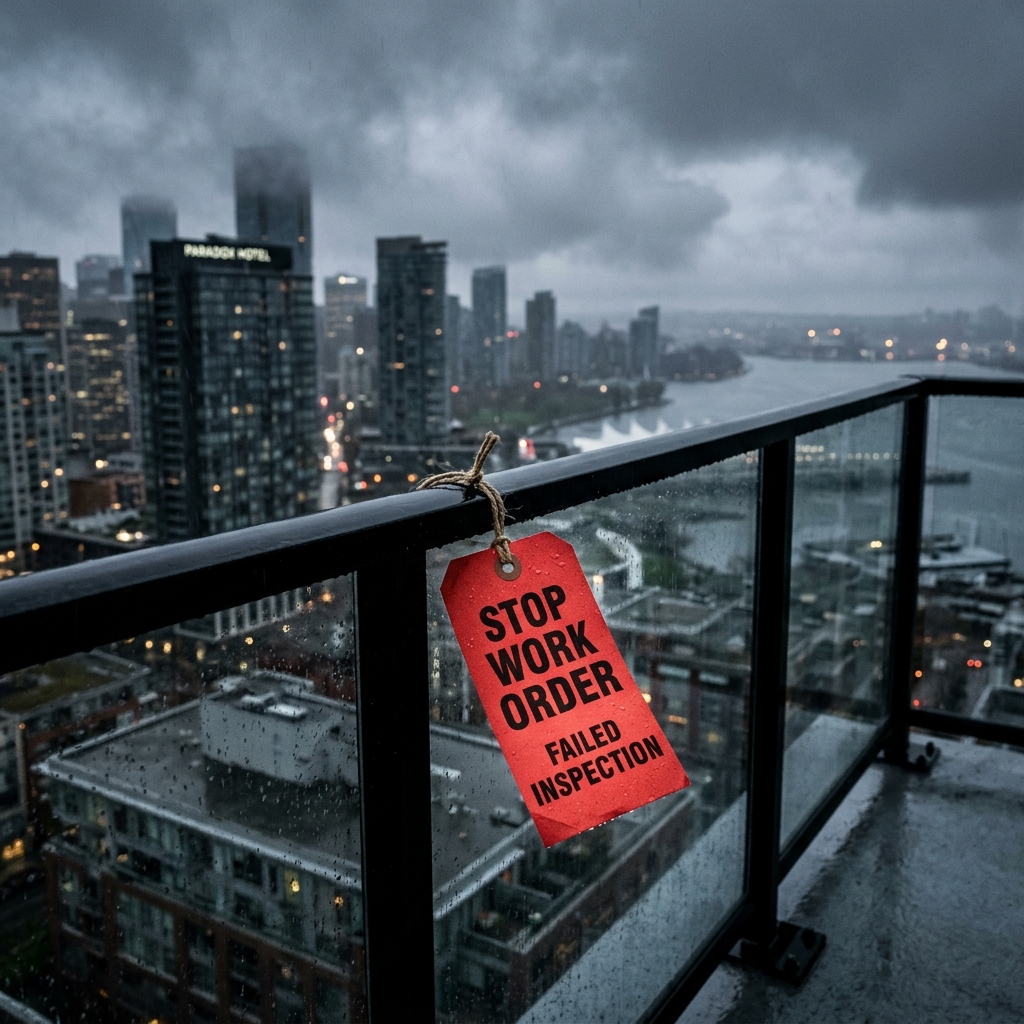
Fifteen minutes later, your new railing has a deficiency notice taped to it and your project has stopped.
This is not a hypothetical. It happens across Metro Vancouver every week — to homeowners who assumed their contractor "knew the code," to DIY builders who measured everything except the one thing the inspector checks first, and to strata councils who approved a replacement without verifying the new system met current requirements.
A failed railing inspection is not a minor inconvenience. It triggers a cascade of consequences that can stall your project, complicate your insurance, and follow your property for years.
This guide covers what actually happens when a railing fails — step by step — and then gives you the exact 8-point checklist inspectors use, so you can verify compliance before they arrive.
Why Railings Get Inspected
Guards are life-safety elements. The code treats them accordingly.
A railing — technically called a "guard" in code language — is not a decorative feature. It is a structural life-safety system. Its job is to prevent people from falling off elevated surfaces. The BC Building Code classifies guards alongside fire exits, structural framing, and load-bearing walls in terms of inspection priority.
Guards are inspected because they fail. A deck railing that gives way when someone leans against it can cause a fall of two metres or more onto concrete, rock, or a lower deck level. Falls from elevation are one of the leading causes of serious residential injuries in BC.
This is why building departments across Metro Vancouver — Vancouver, Burnaby, Surrey, North Vancouver, Coquitlam, Richmond, West Vancouver, and others — treat railing inspections seriously. Inspectors are not checking whether your railing looks nice. They are checking whether it will hold when someone falls against it.
For a full breakdown of when a railing project triggers an inspection, see our permit guide.
The Consequence Cascade
A failed inspection is not a single event. It is a chain reaction.
Deficiency Notice
The inspector identifies specific code violations and issues a written deficiency notice. The notice lists exactly what failed — guard height, sphere spacing, load capacity, anchoring, handrail graspability, or glass specification. The railing is tagged as non-compliant.
Work Stops
No further construction or finishing work can proceed on the railing or the area it protects until the deficiencies are corrected. If the railing is part of a larger renovation, related work may also be halted.
Correction and Re-Inspection
You must fix every listed deficiency and schedule a re-inspection. Depending on the severity of the failure, this may require partial or complete removal and reinstallation of the railing. If the original installer cannot or will not correct the work, you need to hire someone who can.
Retroactive Permits (If None Were Pulled)
If the railing was installed without a required permit, the deficiency notice can trigger a retroactive permit process with heightened scrutiny. For a full breakdown of what happens when permits are skipped entirely — including penalty fees and forced removal — see our permit guide.
The Insurance Question Nobody Asks Until It Is Too Late
This is the consequence homeowners never see coming. A failed inspection creates a documented record that your guard was non-compliant. If someone is subsequently injured on that railing — a guest falls, a child slips through an opening — your homeowner's insurance has grounds to challenge the claim. The documented deficiency is evidence of a known hazard that was not corrected. The risk is not limited to inspected railings. An uninspected, non-compliant railing carries the same liability — you simply do not discover the gap until a claim is filed.
The Resale Trail
A failed inspection does not expire. When you sell, the buyer's home inspector will measure your railing. If a previous deficiency was never corrected, or if the railing does not meet current code, it appears on the inspection report. Buyers use this as negotiation leverage — requesting remediation before closing, reducing their offer, or walking away. In strata townhomes — common in developments across Langley, Burnaby, and the North Shore — non-compliant balcony railings can trigger building-wide remediation orders from the strata council. For strata-specific approval processes, see our Langley townhome railing guide.
"A railing inspection failure does not end when the inspector leaves. It follows the property — through insurance renewals, through renovation timelines, and through every future real estate transaction — until the deficiency is corrected."
The 8-Point Inspection Checklist
What inspectors actually measure — and the exact numbers you need to hit.
This is the same checklist Metro Vancouver building inspectors work from. If your railing passes all eight points, it passes inspection.
For the full code context behind each requirement, see our BC Building Code railing guide.
If a post, base plate, or supporting surface moves, start by tracing where the movement begins. Our guide explains how to diagnose a wobbly deck or balcony railing before treating a loose fastener as the whole failure.
Guard Height
- ✓ PASS
The Part 9 default is at least 1,070 mm above the walking surface; verify which exception, if any, applies.
- ✓ PASS (EXCEPTION)
Qualifying residential guards may use 900 mm; for the exterior exception, verify the single-dwelling or qualifying-house condition and a height no more than 1.8 m above finished ground.
- ✗ FAIL
Guard is 1,050 mm. Even 20 mm short is a fail.
COMMON MISTAKEMeasuring from the deck surface instead of from the finished floor or walking surface. If your deck boards sit above the structural frame, the measurement starts from the top of the boards — not the frame.
100 mm Sphere Test
- ✓ PASS
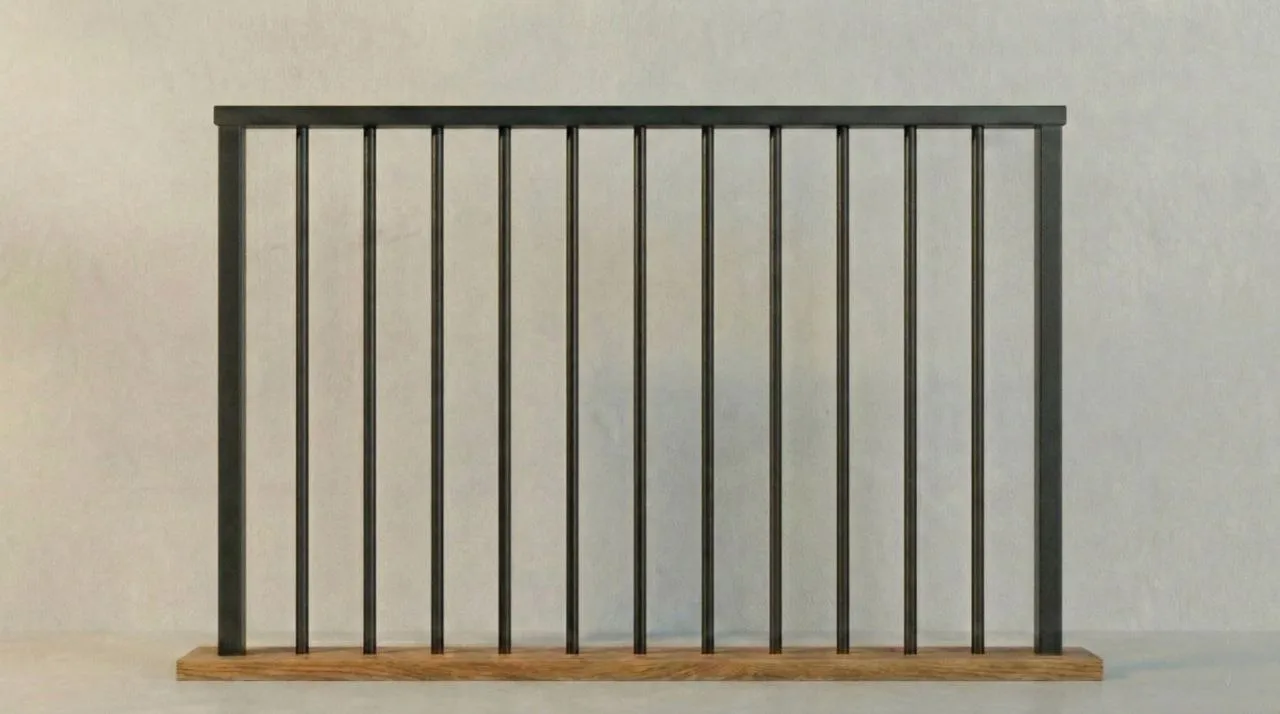
A 100 mm diameter sphere cannot pass through any opening in the guard at any point — between balusters, between cables, below the bottom rail, or between glass panels and posts.
- ✗ FAIL
A sphere fits through any opening anywhere.
COMMON MISTAKEThe gap under the bottom rail. If your deck is not perfectly level (and most decks are not), the gap between the bottom rail and the deck surface can vary along the length of the railing. Inspectors will check the widest point.
Cable Deflection (Cable Railing Only)
- ✓ PASS
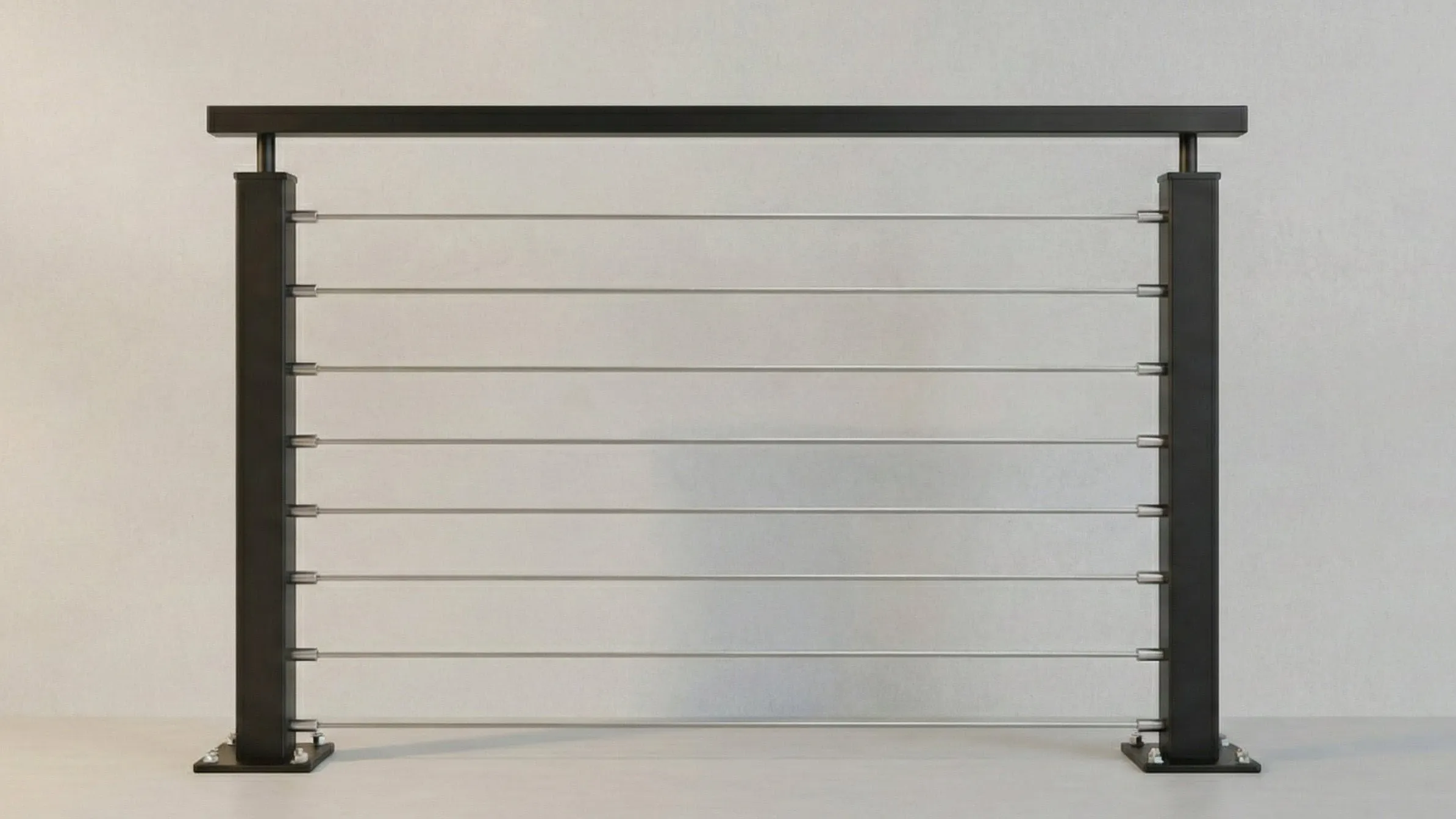
When a lateral force is applied to the cables, the gap between adjacent cables does not open beyond 100 mm.
- ✗ FAIL
Cables flex apart and a sphere passes through under pressure.
COMMON MISTAKEPost spacing too wide. Wider post spacing means longer cable spans, which means more deflection under pressure. Typical compliant post spacing for cable railing is 1,200–1,800 mm depending on cable gauge and tensioning system.
For more on cable railing code requirements, see our horizontal cable railing guide. For cable guards, inspectors are not just looking at spacing at rest — deflection matters. See how cable sag affects code compliance.
Structural Load Capacity
- ✓ PASS
Select the applicable row of Table 9.8.8.2 or Part 4. The Part 9 residential top-load row is 0.5 kN/m OR 1.0 kN concentrated, whichever is critical; separate infill and vertical loads also apply.
- ✗ FAIL
Post rocks or flexes visibly when the inspector pushes against it.
COMMON MISTAKEPosts anchored to deck boards instead of structural framing. A post lag-screwed into a 2x6 deck board will not resist the required load. Posts must be bolted or through-bolted to joists, beams, rim boards, or concrete. Inspectors also check for advanced corrosion—read how climate destroys load-bearing capacity over time.
Post Anchoring
- ✓ PASS
Every post is mechanically fastened to structural framing — joists, blocking, rim joists, beams, or concrete — with appropriate fasteners (through-bolts, structural lag screws, or embedded anchors).
- ✗ FAIL
Posts mounted to deck surface only, or mounted with insufficient fasteners.
COMMON MISTAKESurface-mounted base plates with only four small screws into softwood decking. This passes the aesthetic test but fails the load test. Inspectors will physically push against the post.
For pool, spa, and ritual-bath handrails, code compliance and corrosion-resistant anchoring both matter. See what makes a wet-area handrail last and pass inspection.
Handrail Graspability (Stairs Only)
- ✓ PASS
Stairs have a continuously graspable handrail between 865 mm and 1,070 mm above the stair nosing. The handrail profile allows fingers and thumb to wrap around it. The handrail returns into the wall or post at both ends — it does not terminate in open air.
- ✗ FAIL
Wide flat cap rail used as the only handrail. Handrail that ends abruptly without a return. Handrail too high or too low.
COMMON MISTAKEAssuming the top rail of the guard is the handrail. A wide flat cap rail (common on glass and picket systems) is not graspable. You typically need a secondary offset rail or a profiled top rail that meets graspability requirements. Adding a graspable handrail also unlocks BC senior accessibility funding for eligible homeowners.
Glass Specification (Glass Railing Only)
- ✓ PASS
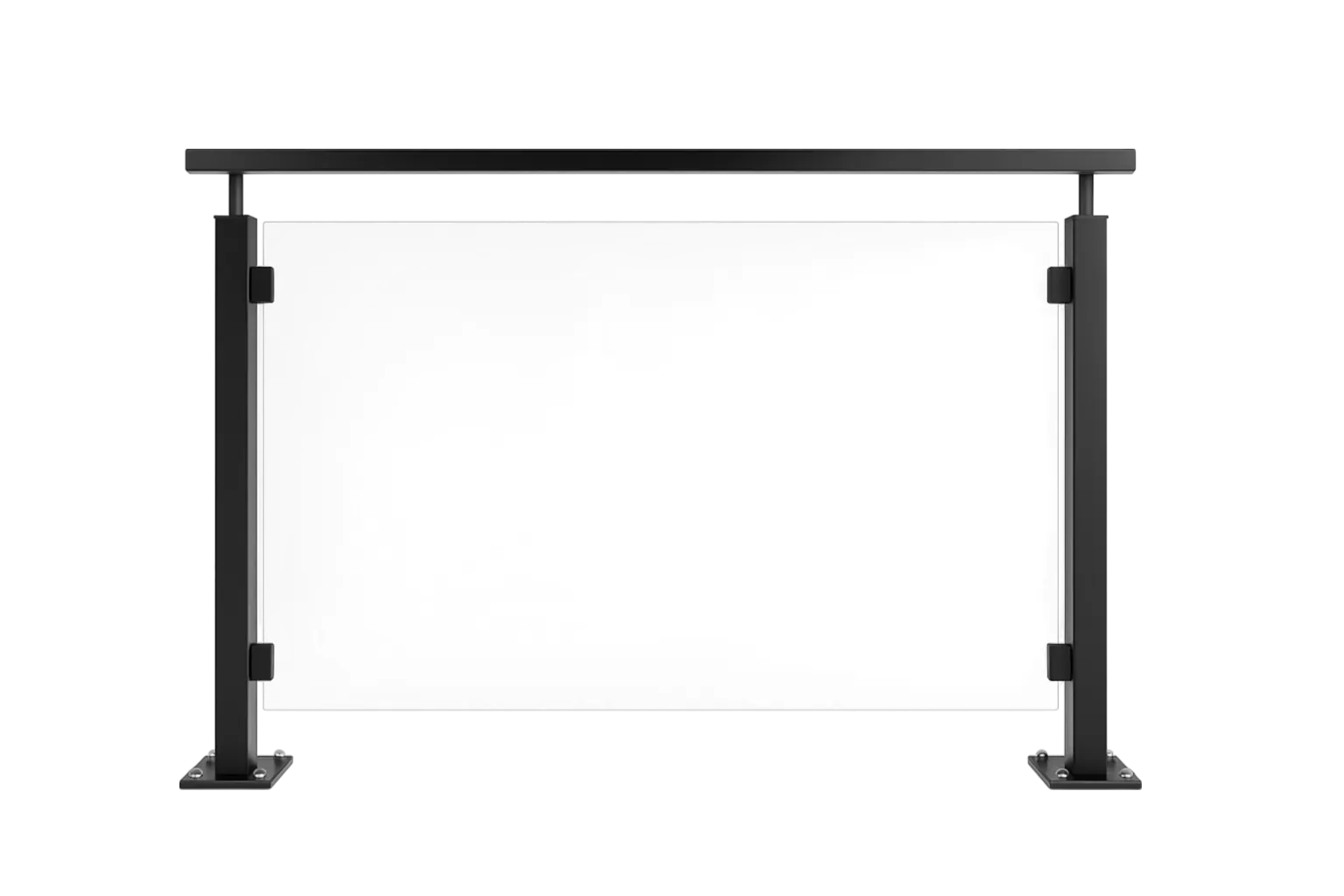
Glass panels are safety-rated — tempered or laminated — to the thickness specified for the span and load. Hardware (spigots, clamps, standoffs) is rated for the panel weight and wind load. Base-shoe channels have drainage provisions.
- ✗ FAIL
Non-safety glass, undersized panels, or hardware not rated for the application.
COMMON MISTAKEUsing generic glass hardware sourced online without verifying load ratings. In many Metro Vancouver jurisdictions, glass railing installations require engineer-sealed details. See our glass railing systems.
Documentation
- ✓ PASS
Approved plans are available on site. If engineer-sealed drawings were required, they are present. If a permit was pulled, the permit number is posted.
- ✗ FAIL
No documentation available for the inspector.
COMMON MISTAKEAssuming you do not need documentation for a "simple" railing replacement. If you changed the system type (picket to glass, picket to cable), a permit and supporting documents are often required. See our permit guide.
Want to know if your existing railing would pass inspection?
Send us a photo of your current railing and we will tell you — honestly — whether it meets current BC code. No obligation, no sales pitch.
What We See When Called to Fix Someone Else's Work
The patterns behind the failures we correct across Metro Vancouver.
We do not only install new railings. A significant portion of our work involves correcting or replacing railings installed by others that failed inspection or were flagged during a home sale. The patterns are remarkably consistent.
The "It Looked Right" Installation
A homeowner hired a general handyman to install a railing kit from a big-box store. The railing looks straight, the pickets are evenly spaced, the finish is clean. But the posts are surface-mounted with four short screws into composite deck boards — no connection to structural framing underneath. The first time an inspector pushes against it, the post rocks. Fail.
Remove posts, add structural blocking between joists, re-mount with through-bolts into framing. Sometimes the entire railing must come off to access the joist bays. See what else fails on these systems in our DIY kit timeline.
The Deck That Settled
A railing was code-compliant when installed five or eight years ago. But the deck has settled unevenly — a common reality in Metro Vancouver's wet soil conditions. The bottom rail gap, which was 80 mm at installation, is now 120 mm at the low point. The 100 mm sphere passes through. Fail.
Adjust or replace the bottom rail to follow the deck's current profile. In severe cases, the deck framing itself needs releveling before the railing can be corrected.
The Cable System Nobody Re-Tensioned
A cable railing was installed with correct spacing and tension. Over three to five years, the cables stretched slightly — normal for stainless steel cable under continuous tension. Nobody re-tensioned them. Now a sphere passes between cables at mid-span. Fail.
Re-tension all cable runs with the existing turnbuckle hardware. If the original hardware does not have adequate adjustment range, replace the turnbuckle fittings. This is a maintenance issue, not a fabrication defect — but inspectors do not care about the cause. They care about the measurement on the day they visit.
The Glass System with Corroded Hardware
A glass railing installed on a Sunshine Coast or North Shore waterfront property used grade 304 stainless spigots instead of 316 marine-grade. Within three to five years in salt air, the hardware corrodes, loosening the glass panels. An inspector finds panels that shift when pushed. Fail.
Replace all hardware with 316 marine-grade stainless. The glass panels are usually fine — the failure is always the metal holding them. For more on material selection for coastal properties, see our railing material guide.
"Every one of these failures has the same root cause: the original installation prioritized appearance over engineering. The railing looked compliant. It was not."
How to Prepare for the First Inspection
The fabricator you choose determines whether your railing passes or fails.
The difference between a railing that passes inspection on the first visit and one that gets red-tagged comes down to three things:
Engineered Before Fabrication
A properly specified railing is designed to code before a single cut is made. Guard heights, sphere spacing, post spacing, load paths, and connection details are resolved in shop drawings — not improvised on site. At LOUEI Metal Arts, every project goes through this process before fabrication begins.
Fabricated as a Complete Assembly
Kit railings arrive as loose components that are assembled on site. This means critical tolerances — sphere spacing, post alignment, bottom-rail gap — depend entirely on the installer's field accuracy. Welded railing systems are assembled and verified in the shop, where tolerances are controlled to the millimetre.
Installed by the Same Crew That Built It
When the fabricator and the installer are the same team, there is no gap between what was designed and what gets bolted to your deck. At LOUEI, the crew that welds your railing is the crew that measures your site and installs the finished system. One team. One standard. No translation errors.
"We do not leave the job site until the railing is ready for inspection. Every measurement is verified against code before we pack up — because a re-inspection is a failure for us, not just for the homeowner."
Build it once.
Build it to code.
Inspection readiness depends on the actual approved design, installation and documentation. The authority having jurisdiction decides acceptance; no first-visit pass is guaranteed.
FAQ
Common questions about railing inspections in BC.

Written by LOUEI Metal Arts
We see failed inspections regularly — not on our own work, but when homeowners hire us to correct or replace railings that were installed by others and did not pass. This guide is based on the deficiencies we encounter most often across Metro Vancouver and the questions homeowners ask us after an inspection goes wrong.
About LOUEI Metal Arts
LOUEI Metal Arts is a premier custom metal fabricator serving Vancouver, Burnaby, Coquitlam, and the Lower Mainland. We specialize in high-end, code-compliant architectural systems.