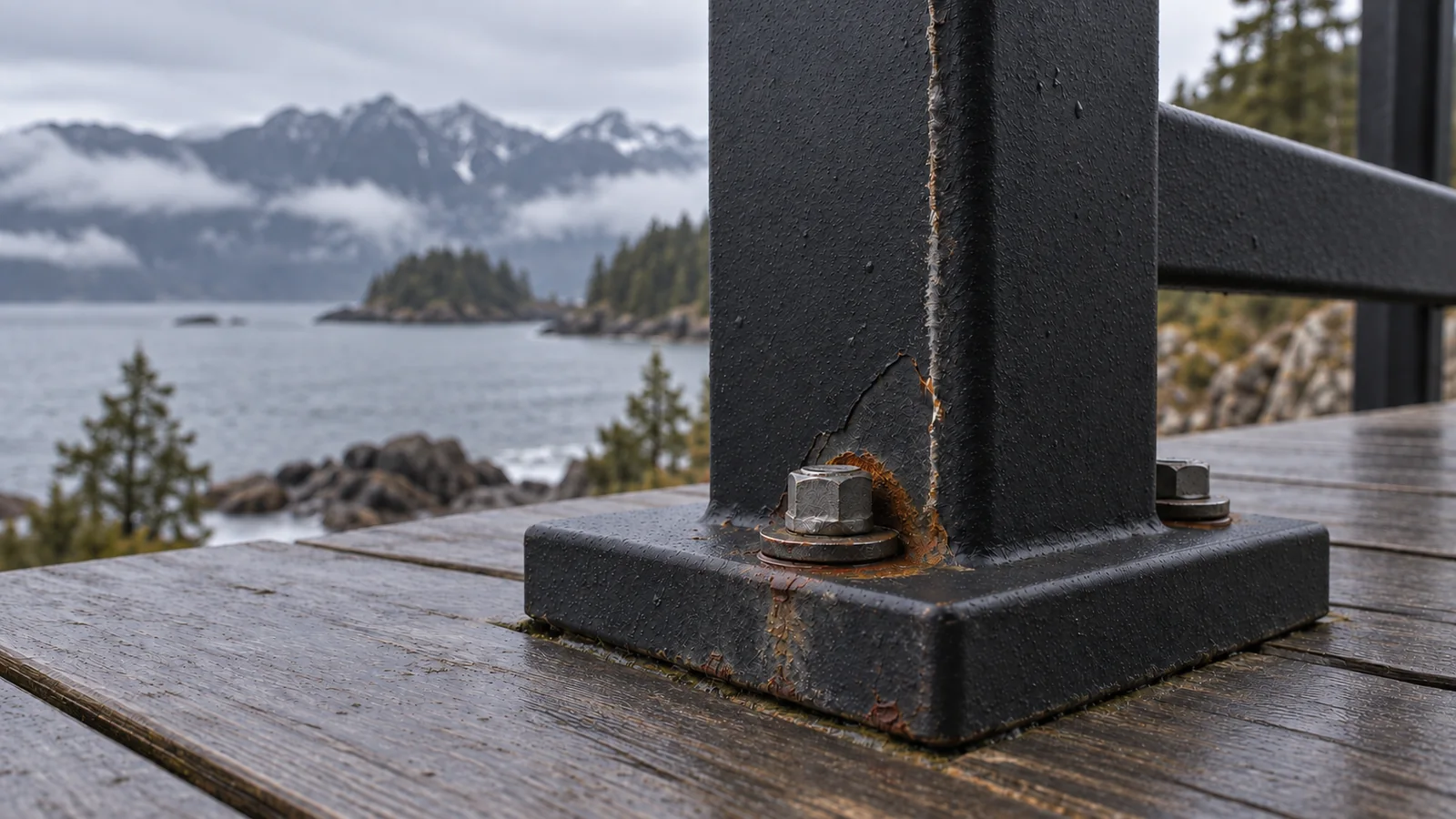
Most weather-related railing failures do not begin on the broad surface you can easily see. They begin at a fastener, post base, weld, splice or coating break—places that can stay wet after the rest of the railing looks dry.
The first stain is often the last step in a much longer process.
British Columbia exposes railings to different combinations of moisture, airborne chlorides, freezing temperatures and sunlight. Those exposures can drive chloride pitting, galvanic corrosion, coating breakdown, water entrapment and freeze-thaw damage—but the outcome depends on the material grade, preparation, drainage, connections and maintenance.
This guide shows where damage usually starts, which visual clues deserve attention and how specifications and detailing can reduce risk. For a material-by-location comparison, use our railing material selection guide.
Official climate sources and recognized technical standards are separated from LOUEI's field observations, so you can see what is measured, what is a known mechanism and what still requires a site-specific assessment.
The 60-second answer
Do not judge an exterior railing by the flat surfaces alone
Salt exposureAsk for the actual alloy and hardware grade; “stainless” or “corrosion resistant” is not a complete specification.
Persistent rainLook for drainage paths, sealed-but-serviceable joints and places where water can remain trapped.
Freeze-thawWater inside a cavity or rigid joint can widen existing gaps as temperatures repeatedly cross freezing.
UV exposureConfirm that pretreatment and coating chemistry are intended for the site’s exterior exposure.
Four Exposure PatternsEach one targets a different material weakness.
For a complete breakdown of BC's four climate zones and what to specify for each, see our material selection guide. This section focuses only on the dominant failure mechanism in each zone.
| ZONE | DOMINANT THREAT | PRIMARY FAILURE MECHANISM | KEY DATA POINT |
|---|---|---|---|
| Metro Vancouver | Persistent moisture | Coating failure at joints → substrate corrosion | Roughly 1,189 mm annual precipitation at Vancouver International Airport (1991–2020 normal) |
| Sunshine Coast & Vancouver Island | Salt + moisture | Chloride pitting of non-marine-grade metals | Exposure varies with distance, wind, shelter and direct salt spray |
| Sea-to-Sky (Squamish, Whistler) | Freeze-thaw | Mechanical joint fatigue, channel cracking | Repeated temperature crossings around 0°C can stress wet joints |
| Okanagan & Interior (Kelowna, Kamloops) | UV + freeze-thaw | Coating degradation, sealant embrittlement | Strong solar exposure plus seasonal temperatures that cross freezing; station and elevation matter |
Source: Environment and Climate Change Canada, Climate Normals 1991–2020
Chloride AttackHow salt exposure challenges the wrong alloy, finish or detail.
BC DATA CALLOUT
Marine aerosol can deposit chlorides on waterfront and wind-exposed properties around the Strait of Georgia and Pacific coast. Exposure is not defined by one universal distance: shoreline orientation, prevailing wind, shelter, elevation, direct spray and cleaning all affect the chloride load at a particular railing.
Source: Environment and Climate Change Canada; NRC corrosion research
The Chemistry
Stainless steel resists corrosion because chromium in the alloy helps form a thin passive film at the surface. Under suitable conditions, a damaged passive film can reform in the presence of oxygen; contamination, crevices and chlorides can interfere with that protection.
Chloride ions — the chemical component of salt — attack this passive layer. They penetrate the chromium oxide film at microscopic weak points (inclusions, grain boundaries, surface contamination), break it down, and initiate pitting corrosion beneath the surface. Once a pit forms, it becomes an oxygen-depleted micro-environment that accelerates further corrosion — a self-reinforcing cycle.
The Pitting Resistance Equivalency Number (PREN) quantifies a stainless alloy's resistance to this attack. The higher the PREN, the more resistant the alloy:
| ALLOY | PREN | RELATIVE PITTING RESISTANCE |
|---|---|---|
| Grade 304 | 18–20 | Lower than 316; exposure and finish need careful review |
| Grade 316 | 24–26 | Improved by molybdenum; still needs suitable finish and maintenance |
| Duplex 2205 | 34–35 | Higher relative resistance; not a substitute for correct detailing |
PREN is a useful alloy-comparison indicator, not a complete service-life prediction. Surface finish, weld treatment, contamination, temperature, chloride concentration, crevices and cleaning can change performance. Grade 316 commonly offers better chloride resistance than 304, while duplex 2205 is higher again; none should be described as maintenance-free or immune without a project-specific specification.
Pools and ritual baths create their own chloride and moisture challenge. See how pool handrail materials and finishes survive wet environments.
What It Looks Like on Your Railing
Possible signs on lower-alloy stainless in a coastal exposure:
Tea staining or localized discolouration around welds, cut edges and sheltered crevices. Tea staining can be superficial, while a deep or growing pit requires closer assessment; appearance alone does not establish structural capacity.
Zinc-plated screws in contact with stainless posts:
Orange rust runoff streaking down the post and staining the deck surface below. This is galvanic corrosion — the zinc corrodes preferentially when in contact with the more noble stainless steel, accelerated by the saltwater electrolyte.
If a product listing says only “stainless steel,” ask for the alloy grade, fastener grade and finish documentation. Do not infer coastal suitability from the word “stainless” alone.
Persistent MoistureWhy detailing matters when joints stay wet longer.
BC DATA CALLOUT
Environment and Climate Change Canada's 1991–2020 climate normals for Vancouver International Airport report roughly 1,189 mm of annual precipitation. Other Metro Vancouver stations can differ substantially with elevation and geography. The design lesson is duration of wetness: sheltered joints may remain damp long after exposed faces have dried.
Source: Environment and Climate Change Canada, Climate Normals 1991–2020
The Physics
Water does not need to form a visible puddle to matter. Capillary action can draw moisture into close interfaces such as bracket-to-post joints, bolt-hole clearances, splice overlaps and exposed cut edges. Sheltered water can evaporate more slowly than water on an open face, increasing the time available for corrosion where a vulnerable metal surface or galvanic couple is present.
A coating specification should therefore address fabrication edges and connections as well as broad post surfaces. Many failures concentrate at joints because that is where moisture, crevices, cut edges and dissimilar hardware can coincide.
What It Looks Like on Your Railing
Possible signs where coated mild steel remains wet at joints:
Blistering or lifting coating at bracket edges and splice joints, rust runoff from coating breaks, water held in channels and corrosion concentrated around fasteners. Flat surfaces may still look acceptable while concealed interfaces remain wet.
Possible signs on a wood railing with persistent wet joints:
Soft fibres, checking, staining, fastener movement or localized decay where balusters, rails and posts meet. These signs justify closer inspection, but only a site-specific assessment can determine remaining capacity. See our wood railing repair-or-replace guide.
Possible signs around hollow aluminium extrusions:
White corrosion product, staining at drain points, loose fasteners or coating disruption near cut ends and bolt holes. Confirm whether the residue is surface oxidation, trapped contamination or more significant localized corrosion before deciding on repair or replacement.
“Powder coated” does not mean waterproof. Ask how cut edges, fastener holes, splice joints and drainage paths are detailed after fabrication and assembly; the coating name alone does not answer those questions.
Freeze-Thaw CyclingWhat repeated freezing can do to a wet joint or cavity.
BC DATA CALLOUT
In the Sea-to-Sky corridor and BC Interior, temperatures can move above and below 0°C repeatedly through the colder months. The local frequency varies by station, elevation and year. Damage risk increases when water is already trapped inside a rigid joint, channel or post cavity.
Source: Environment and Climate Change Canada, Climate Normals 1991–2020
The Physics
Water expands approximately 9% by volume when it transitions from liquid to ice. When water is confined inside an existing crack, cavity, joint or mounting channel, freezing can create pressure that aggravates weak material, rigid sealant or an already-loose connection.
Repeated cycling can be cumulative when the detail continues to admit and retain water. It does not create the same outcome in every assembly: drainage, movement allowance, material condition, sealant selection and connection design all matter.
What It Looks Like on Your Railing
Possible signs around a glass base-shoe channel:
Standing water, blocked drains, displaced gaskets, cracked sealant, corrosion at hardware or unexpected panel movement. These signs have several possible causes; the channel, glass support and surrounding substrate should be assessed together.
For glass railing drainage considerations in freeze-thaw zones, see the glass section of our material selection guide.
Possible signs around a bolted connection:
Recurring looseness, corrosion runoff, cracked substrate, elongated holes or movement that returns after tightening. Freeze-thaw may be one contributor where water is trapped, but loading, installation, substrate condition and hardware selection also need review.
Possible signs of weak coating adhesion:
Chalking, checking, blistering or lifting near edges and damaged areas. Temperature cycling and moisture can aggravate an adhesion problem, but the correct diagnosis may also involve pretreatment, contamination, cure, film thickness or corrosion beneath the coating.
Not sure if your current railing is at risk?
Send clear photos of the full railing, post bases, connections and visible damage, plus the property location. We can provide a preliminary review and explain whether a site assessment or another specialist is the appropriate next step.
Send a Photo for Assessment →UV DegradationHow sunlight exposes weak pretreatment and coating choices.
BC DATA CALLOUT
Interior and coastal climate stations show different sunshine, temperature and precipitation patterns, and results vary by the station and normals period selected. For a railing finish, the practical questions are direct solar exposure, orientation, colour, surface temperature and whether the coating system is documented for exterior UV service.
Source: Environment and Climate Change Canada, Climate Normals 1991–2020
The Chemistry
Ultraviolet radiation breaks the chemical bonds in polymer coatings. Over time, this produces:
Chalking: the surface of the coating becomes powdery as the polymer matrix degrades and releases pigment particles.
Fading: pigments and binder chemistry can lose colour or gloss at different rates. Do not predict performance from colour alone; use the coating manufacturer's documented exterior exposure data for the selected product and colour.
Embrittlement: the coating loses flexibility, becoming rigid and prone to cracking — especially at points of thermal movement (joints, edges, returns).
How to Compare Exterior Coating Specifications
Standard polyester powder coat:
Products in this broad category vary. Confirm that the exact powder, pretreatment, substrate preparation and cure schedule are documented for the project's exterior exposure; the material name alone does not establish service life.
Super-durable polyester powder coat:
These formulations are designed for improved colour and gloss retention compared with standard durable powders. Compare the supplier's tested performance, warranty conditions, approved pretreatment and colour-specific limitations for the actual exposure.
Epoxy powder coat:
Epoxy powders can provide useful chemical and corrosion performance but generally need a UV-stable exterior topcoat when exposed to sunlight. Confirm the complete coating specification and intended service environment.
The Compounding EffectWhen Multiple Mechanisms Attack Simultaneously
BC properties can face overlapping moisture, chloride, sunlight and temperature exposures. The combination—not the region name alone—should inform the specification.
Metro Vancouver
Rain + moderate salt + mild UV.
The rain wicks moisture into joints. The salt accelerates corrosion inside those joints. The mild UV slowly degrades coatings on exposed surfaces. All three work simultaneously.
Sunshine Coast
Salt + rain + wind-driven spray.
Salt deposition and frequent wetting can combine into a demanding exposure. Actual severity changes with shoreline distance, prevailing wind, shelter, orientation, cleaning and the geometry of each connection.
Sea-to-Sky
Rain + freeze-thaw + elevation exposure.
When water remains inside a weak joint, temperature crossings around freezing can aggravate existing gaps or rigid sealants. Drainage, elevation, shelter and local station data affect the actual risk.
Okanagan
UV + freeze-thaw + dry heat.
Strong sun can age unsuitable coatings while cold-weather cycling stresses wet joints. Temperature range, orientation, colour and assembly geometry all influence the result, so the coating and connection should be specified as one system.
What You Can Do About ItBetter specifications and details can reduce exposure risk.
If you are choosing material for a new railing:
See our material selection guide for climate-zone-specific recommendations.
If you want to understand how powder coat quality affects longevity:
See our RAL colour and coating guide for the difference between standard and super-durable formulations.
If you are replacing a wood railing that failed from rot:
See our wood railing replacement guide.
If you are replacing a kit railing that failed from joint corrosion:
See our DIY kit vs custom fabrication guide.
If you are building or replacing a railing in a wildfire-prone area (Okanagan, Kamloops):
See our fire-resistant railing materials guide for non-combustible options.
If you want to know whether your current railing would pass inspection:
See our railing inspection checklist.
If you are considering cable railing and want to understand the code:
See our horizontal cable railing guide. Cable systems depend on hardware that holds tension over time. See why cable railing sags in coastal BC conditions.
Build it once. Build it for your climate.
LOUEI reviews the property exposure, material, coating, connection and maintenance needs before recommending a railing specification.
FAQ
Common questions about railing damage in BC's climate.

Written by LOUEI Metal Arts
This guide combines LOUEI's field observations from railing assessment, removal and fabrication work with official climate sources and recognized material standards. A photograph can identify warning signs, but it cannot confirm hidden condition, structural capacity or the correct project specification.
About LOUEI Metal Arts: LOUEI Metal Arts is a custom metal fabrication studio serving Vancouver, Burnaby, Coquitlam and the Lower Mainland with code-conscious architectural railing systems.
Official Sources & References
- Environment and Climate Change Canada — Canadian Climate Normals 1991–2020 (Vancouver International Airport precipitation and temperature data)
https://climate.weather.gc.ca/climate_normals/ - Environment and Climate Change Canada — Historical Climate Data
https://climate.weather.gc.ca/ - BC Building Code 2024 — Province of BC, Section 9.8 (Guards)
https://www2.gov.bc.ca/gov/content/industry/construction-industry/building-codes-standards/bc-codes - National Research Council Canada — Construction Research
https://nrc.canada.ca/en/research-development/research-collaboration/programs/construction-research-centre - ASTM International — A240/A240M Standard Specification for Chromium and Chromium-Nickel Stainless Steel Plate, Sheet, and Strip (reference for 304, 316, and 2205 alloy composition and PREN)
https://www.astm.org/ - ISO 9227 — Salt Spray Tests (International standard for accelerated corrosion testing)
https://www.iso.org/standard/63543.html - Natural Resources Canada — Climate Change Adaptation for Buildings
https://natural-resources.canada.ca/