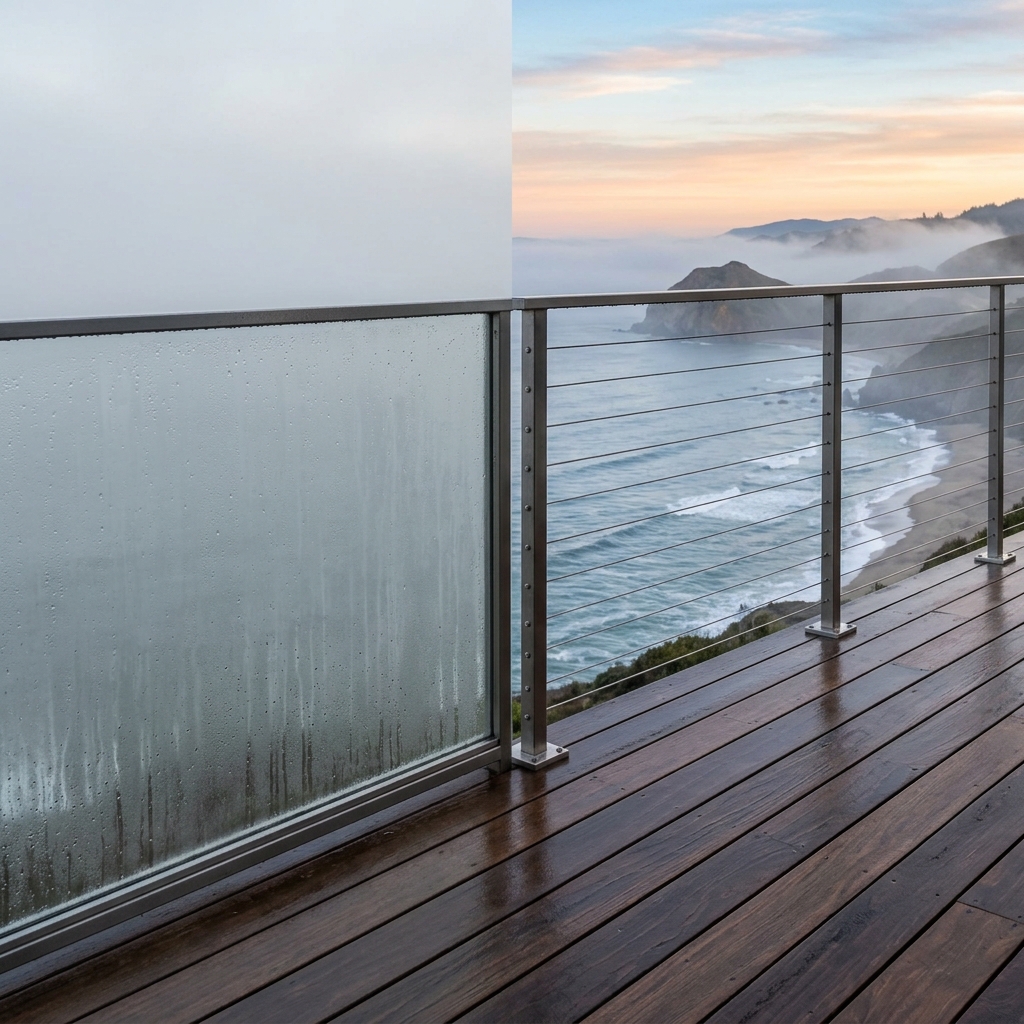
You bought a home on the Sunshine Coast for the view. But if you have glass railings, you're likely waking up to a glowing white wall of morning fog.
Across the Sunshine Coast and its surrounding islands, marine dew is a frustrating daily reality. At 6:00 AM, the humid ocean air hits the cold surface of your glass, completely fogging it over. Instead of enjoying your morning coffee with a pristine view of the ocean, you're forced to grab a squeegee and wipe down every single panel—just to see outside.
By the time the condensation burns off naturally, you've missed the morning calm. You didn't invest in a waterfront property to stare at opaque glass or turn your deck into a daily cleaning chore.
This is exactly why coastal homeowners are tearing out their high-maintenance glass and replacing it with custom cable railings. Cable systems never block your sightline, never trap morning dew, and completely eliminate the need for a squeegee—giving you an unobstructed, fog-free view every single morning.
The 6:00 AM Reality Check
Glass Railing
Surface temperature drops below the dew point. A solid sheet of micro-droplets forms, refracting light in every direction. Visibility is zero.
Cable Railing
Condensation forms solely on the 3mm stainless wire. The gaps between cables (97mm) remain pure air. Visibility remains at 95%+.
01. This Is Not Rain. This Is Condensation.
And it happens every night — even when it has not rained in a week.
If you have read anything about glass railing maintenance in BC, it was probably about rain spots — the mineral deposits that accumulate on glass panels after rainstorms and gradually build into a hazy film. Rain spotting is a real problem, and we have covered it in our Cable vs Glass comparison guide.
But the dew problem on the Sunshine Coast and BC's islands is different. It is more frequent, more frustrating, and less understood.
What Dew Is
Dew forms when the temperature of a surface drops below the dew point of the surrounding air. The dew point is the temperature at which air becomes saturated — unable to hold its moisture in gaseous form — and water vapour condenses into liquid droplets on any cool surface.
Glass is an excellent radiative cooler. At night, glass panels radiate heat rapidly into the clear sky, causing their surface temperature to drop faster than the surrounding air temperature. When the glass surface falls below the dew point — which, in the moisture-saturated marine air of BC's coast, is often only two to three degrees below the ambient temperature — condensation forms instantly.
Why This Happens Almost Every Night on the Coast
The Sunshine Coast and the islands of Howe Sound, the Strait of Georgia, and the upper coast are surrounded by ocean. The ambient air is continuously loaded with marine moisture. The dew point is consistently high — often within one to three degrees Celsius of the air temperature, especially from spring through fall.
On a clear night, the glass radiates heat and drops to the dew point within hours of sunset. By 3 AM, the panels are fully condensed. By 6 AM, they are opaque.
On a cloudy night, cloud cover reflects some of the radiated heat back to the surface, keeping the glass slightly warmer. Dew is less severe but still present on most nights.
On a rainy night, the panels are wet from rain. In the morning, they are wet from both rain and dew. The distinction does not matter — the view is gone either way.
The result: on a typical Sunshine Coast property, your glass railing blocks your view on roughly 300+ mornings per year. Not from rain. From physics.
"Rain is seasonal. Dew is permanent. Rain leaves spots you can clean once a month. Dew leaves a film you have to wipe every single morning — or accept that you cannot see through your own railing until mid-morning when the sun burns it off."
02. The 6:00 AM Test
Same property. Same morning. Same view. Completely different experience.
Glass Railing — 6:00 AM
- ✗Panels coated in uniform condensation film
- ✗Ocean and islands invisible — grey opaque surface
- ✗Water droplets running down panels and pooling in base-shoe channel
- ✗Salt residue from marine moisture accumulating on glass with each dew cycle
- ✗View does not clear until mid-morning sun evaporates the condensation — or until you wipe every panel by hand
- ✗Repeat tomorrow
Cable Railing — 6:00 AM
- ✓Cables are dry or carry micro-droplets invisible to the eye
- ✓Ocean, islands, and mountains fully visible — unobstructed
- ✓No surface to fog — 4 mm cables have negligible condensation area
- ✓Salt deposits rinse off cables with the next rain — no film buildup
- ✓View is identical at 6 AM, noon, and midnight
- ✓Repeat never — because there is nothing to repeat
"You did not move to the Sunshine Coast for the house. You moved for the view. Every morning that a glass panel blocks that view, you are paying the wrong toll for the privilege."
03. The Daily Cycle Nobody Warned You About
What happens on your glass railing every 24 hours — 365 days a year.
Glass begins radiating heat. Surface temperature starts dropping.
Glass surface temperature approaches dew point. First droplets form.
Panels fully condensed. Dew film is uniform. Any breeze carries additional salt-laden marine moisture onto the wet surface.
You wake up. Walk to the deck. See nothing.
OPTION A: You wipe every panel with a microfiber cloth. Takes 10–20 minutes depending on linear footage. Your hands are cold. Your coffee is inside.
OPTION B: You wait. By 9–10 AM, the sun angle is high enough to warm the glass above the dew point. The moisture evaporates. The view clears — just in time for you to leave for the day.
Glass is clear. The view is spectacular.
The cycle begins again.
The Compounding Problem
Each dew cycle deposits marine moisture on the glass. That moisture contains dissolved salt (chlorides from the Strait of Georgia). When the dew evaporates, the salt remains on the surface as a microscopic film. Over days and weeks, this salt film builds into a haze that does not evaporate — it must be scrubbed off with a glass cleaner.
So you are not just wiping dew every morning. You are also deep-cleaning the cumulative salt film every two to four weeks. On a 60-linear-foot waterfront glass railing, that is a significant maintenance commitment — on a property you chose specifically because you wanted to spend your time outdoors, not cleaning.
Cable railing has no continuous surface for salt to deposit on. Rain rinses the cables naturally. There is no film to accumulate. There is nothing to clean.
Tired of wiping glass every morning?
Send us photos of your current glass railing and your Sunshine Coast address. We will show you exactly how ClearView cable railing would look on your property — and how your mornings would change.
Get a Free Consultation →04. Every Coastal Community. Every Island.
If you are surrounded by water, your glass railing is fogging.
This is not a Sechelt problem. It is a marine environment problem. Every community on the Sunshine Coast and every island in the Strait of Georgia, Howe Sound, and the upper coast experiences the same condensation cycle. The more water surrounding the property, the higher the ambient humidity, and the worse the dew.
Lower Sunshine Coast
Gibsons & Gibsons Landing
Howe Sound waterfront. Direct marine exposure. Dew on glass is heaviest on the harbour-facing decks where humidity is highest and wind is calmest.
Roberts Creek
Set back from the waterfront but still within the marine moisture zone. Forest canopy can trap moisture and reduce overnight cooling, slightly reducing dew — but not eliminating it.
Sechelt & Davis Bay
South-facing Strait exposure. Davis Bay waterfront properties experience some of the most severe morning condensation on the Coast due to the combination of open water, south-facing orientation, and calm morning conditions.
Halfmoon Bay
Protected harbour. Calm water = high humidity = heavy dew. Glass railings on waterfront retirement homes here fog consistently from April through November.
Pender Harbour & Madeira Park
Deep, protected harbour waters. Moisture is trapped by the surrounding terrain. Morning fog and dew are among the most persistent on the Coast.
Upper Sunshine Coast
Egmont & Earls Cove
Remote. Exposed. Skookumchuck Narrows brings constant tidal moisture. Glass panels in direct exposure to the narrows are wet nearly every morning.
Powell River & Lund
Northern terminus of the Sunshine Coast Highway. Directly across from Texada Island and Savary Island. Marine moisture from Malaspina Strait produces reliable overnight condensation.
Howe Sound Islands
Bowen Island
Twenty minutes by ferry from Horseshoe Bay. Surrounded by Howe Sound on all sides. Island properties experience heavier and more persistent morning dew than adjacent mainland properties because the water-to-land ratio is higher. Every deck railing faces water.
Gambier Island
Larger, more remote. No commercial services. Properties are vacation homes and permanent residences with extraordinary views — completely obscured by glass dew every morning.
Keats Island
Small island directly off Gibsons. Maximum marine exposure. Minimal wind shelter. Glass panels here are wet 300+ nights per year.
Strait of Georgia Islands
Texada Island
BC's largest Gulf Island. Iron mining history, waterfront residential on the west shore facing the open Strait. Full marine exposure. Dew conditions identical to the Sunshine Coast mainland.
Savary Island
The "Hawaii of BC." Sandy beaches, vacation properties, and extraordinary views of the Coast Mountains. Every glass railing on this island fogs every morning from May through October — peak season.
Thormanby Islands
North and South Thormanby. Remote, accessible only by boat. Properties here are built for the view. Glass railing defeats that purpose for half of every day.
Nelson Island & Hardy Island
Remote, water-access-only communities where every structure faces water. The entire concept of living here is the connection to the ocean. Glass railing interrupts that connection every morning.
What About Hydrophobic Cleaners?
Many homeowners try spraying Rain-X or ceramic coatings on their glass to stop the fog. This works for a short time, causing the droplets to bead up and run off.
But coastal storms and salt spray quickly strip these coatings away. Within a few weeks, you are back to applying chemicals or squeegeeing the glass manually. It reduces the severity of morning dew but does not eliminate it—adding a recurring maintenance task to a surface that was supposed to be low-maintenance.
05. "But Glass Blocks the Wind"
The one legitimate advantage of glass — and how to keep it without losing your view.
This is the fair counterargument, and we are not going to dismiss it. Glass railing acts as a transparent windbreak. On the Sunshine Coast, where southeast winds push across the Strait of Georgia, a glass panel can reduce perceived wind speed by 50–70% on a deck — extending your outdoor season by weeks on either end.
Cable does not block wind. This is a real trade-off.
The Hybrid Solution
The solution we recommend most frequently for Sunshine Coast waterfront properties:
- Glass on the windward side. Panels facing the dominant southeast wind direction. These panels serve as a functional wind barrier — their primary job is shelter, not transparency. The morning dew is less frustrating on these panels because you were not looking through them for the view anyway.
- Cable on the view side. Cables facing the ocean, the islands, or the mountains — the direction you actually look. No dew. No fogging. No morning maintenance. The view is clear 365 days a year.
This hybrid approach gives you the wind protection of glass where you need it and the permanent transparency of cable where the view matters most.
For a detailed maintenance and performance comparison between cable and glass across all six factors, see our Cable vs. Glass BC Weather comparison.
06. The Material That Matters: 316 Stainless on the Coast
Grade matters more here than anywhere else in BC.
The Sunshine Coast and its islands are the most corrosive residential atmosphere in BC. Direct salt spray from the Strait of Georgia attacks any metal that is not marine-grade.
For cable railing, this means one thing: 316 stainless steel for all cables, fittings, and turnbuckles — no exceptions. Grade 304 stainless will develop tea staining within 12–18 months of installation in direct Sunshine Coast exposure.
Every ClearView system installed on the Sunshine Coast uses full 316 marine-grade hardware. For the complete science behind why 304 fails and 316 survives in coastal BC, see our climate destruction guide.
07. How We Get a Railing to Your Island
Fabricated in Coquitlam. Ferried to your doorstep. Installed in a day.
No custom steel fabricator exists on the Sunshine Coast. Every welded, powder-coated railing system must come from the mainland.
We fabricate your ClearView cable railing in our Coquitlam shop — welded, powder-coated, cables pre-swaged — then crate the finished assemblies and ferry them via BC Ferries Horseshoe Bay–Langdale. For Upper Coast and island properties, we coordinate secondary ferry connections or water taxi logistics.
Installation takes one to two days on site. No field welding. No grinding noise. No metal shavings on your deck.
For the full logistics process, ferry coordination, and permit jurisdictions (Town of Gibsons, District of Sechelt, SCRD), see our Sunshine Coast railing service page.
Your mornings should start with the view. Not with a cloth.
ClearView cable railing is fabricated in Coquitlam and installed across the Sunshine Coast and BC's coastal islands. Marine-grade. Dew-proof. Permanently transparent.
CONTACT USFAQ
Common questions about glass railing dew on BC's coast.
Can I stop condensation from forming on my glass railing?
No. You can only manage it by squeegeeing the glass manually or applying hydrophobic coatings (like Rain-X), which wear off quickly in BC's coastal environment. The dew point is a physical reality.
Will frameless glass fog up less than glass with a top rail?
Frameless glass can actually gather slightly more condensation because the exposed top edge allows radiant heat to escape from the glass panel more rapidly at night, dropping the surface temperature below the dew point faster.
Do cable railings require more maintenance than glass on the coast?
No. 316 marine-grade stainless steel cables need only an occasional wipe down or fresh water rinse to remove salt spray. Glass requires constant squeegeeing to see through it on dewy mornings.
Is cable railing structurally safe for coastal wind loads?
Yes. When properly engineered with heavy-walled posts and rigid top rails, our cable systems easily withstand gale-force winds in Squamish, Bowen Island, and the Sunshine Coast without the sail-effect of glass.

Written by LOUEI Metal Arts
We install railing systems on the Sunshine Coast regularly. The dew frustration described in this article comes directly from conversations with homeowners in Sechelt, Gibsons, Halfmoon Bay, and Bowen Island — people who invested in glass for the transparency and discovered that the transparency is conditional on a daily maintenance routine they never anticipated. The switch from glass to cable, or the hybrid approach, is our most common Sunshine Coast recommendation.
About LOUEI Metal Arts
LOUEI Metal Arts is a premier custom metal fabricator serving Vancouver, Burnaby, Coquitlam, and the Lower Mainland. We specialize in high-end, code-compliant architectural systems.