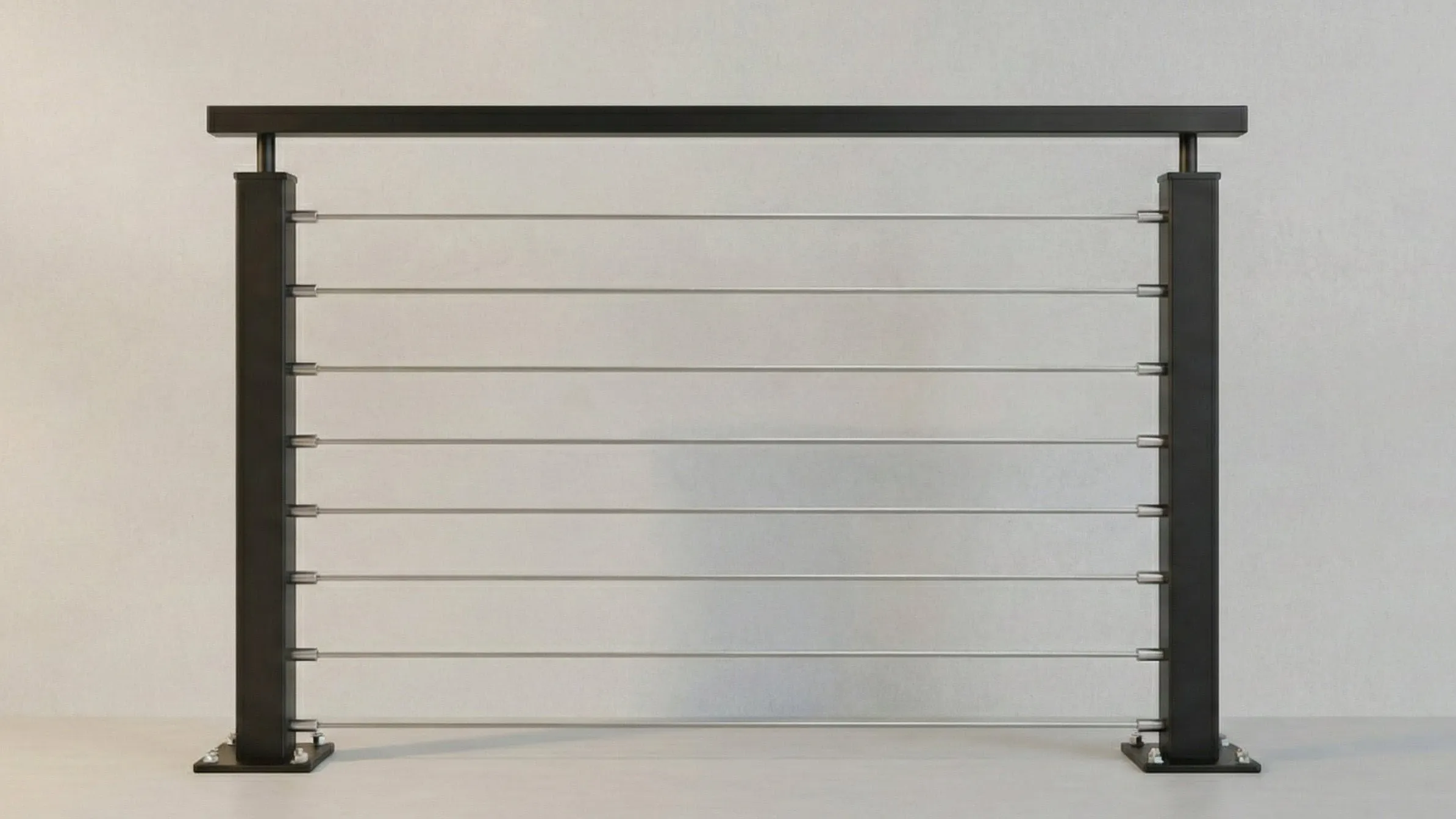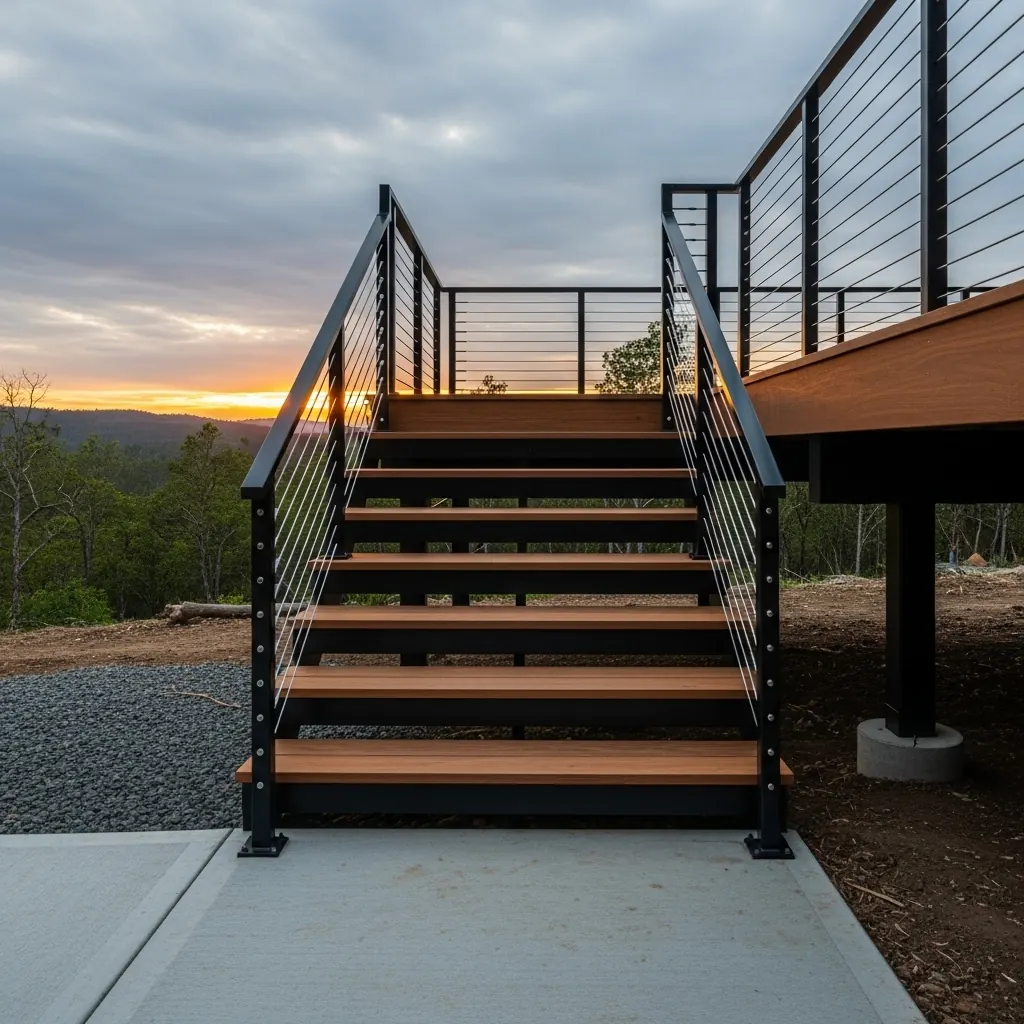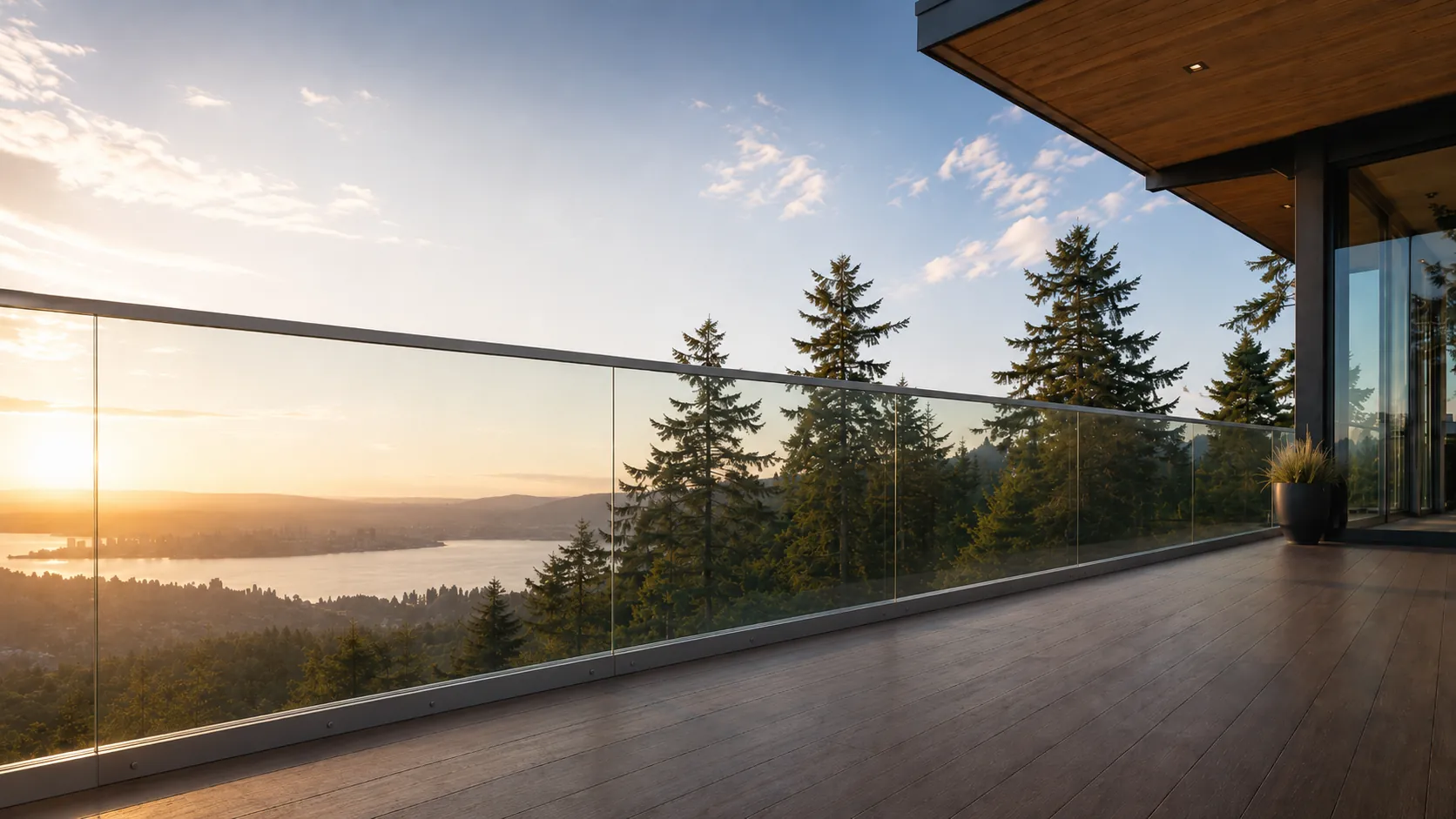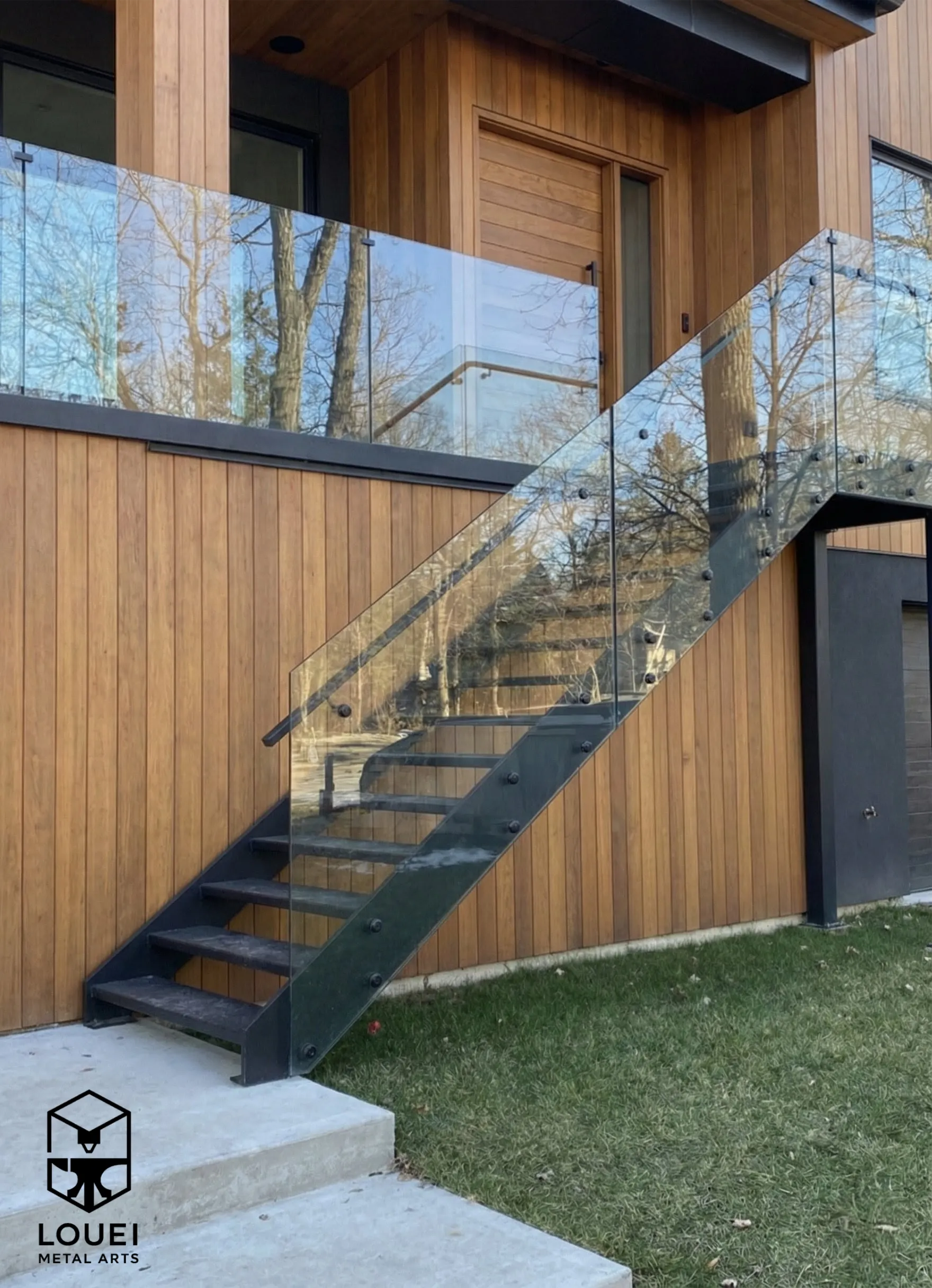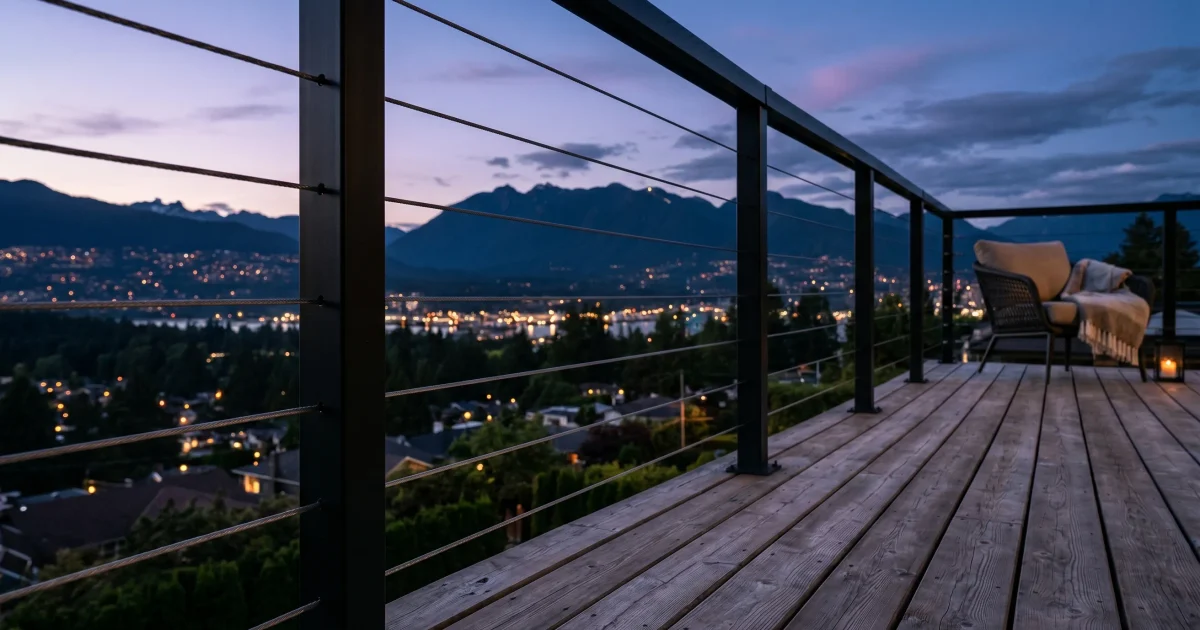
A cable railing lives or dies on one thing: tension. Taut, it's one of the cleanest looks in modern building — a near-invisible barrier that keeps the view. Slack, it looks tired, and it can become a safety problem.
If you're looking down a cable run and seeing a “smile” where there should be a straight line, this guide is for you. We'll cover what a little movement is supposed to feel like, the real reasons cables sag, what BC and Vancouver code actually require for tightness, how to tell whether the problem is the cable or the structure holding it — and why a properly built cable railing should not develop visible or recurring sag in the first place.
Disclaimer: This is general information, not engineering advice. Cable tension, post sizing, span, and mounting are project-specific. For a railing that's flexing, leaning, moving at the base, or failing an inspection, have it assessed by a professional. For the code basics referenced here, see our BC railing code guide.
Sagging Cable Railing at a Glance
| A little give | Normal — steel cable is slightly elastic; a perfectly flat line is impossible |
| A visible “smile” | Not normal — a tension, span, post, mounting, or hardware problem |
| First-year sag | Usually constructional stretch; often needs one careful re-tension |
| Sag that returns | Usually structural — posts, span, top rail, mounting, or hardware |
| The code test | Under load, cables cannot open enough to pass a 100 mm sphere |
| 100 mm vs 4-inch rule | Use 100 mm, not exactly four inches (101.6 mm); read the clause’s exceptions |
| The real fix | Correct the structure and hardware, not just the tension |
Is it supposed to sag at all?
Is it normal for cable railing to sag a little? A tiny amount of give is normal — steel cable is slightly elastic, and physics makes a perfectly flat horizontal line impossible.
Normal give
A well-built railing keeps deflection so small the run still looks straight. Press it, and it should feel taut, move only slightly, then spring back.
Not normal
A visible droop or “smile” between posts points to a tension, span, post, mounting, or hardware issue.
The sightline rule
What you should not see is a standing curve in the cable when nothing is touching it. Stand at one end and sight down the line — clean and straight is the goal; a visible swoop is the signal that something needs attention.
A cable railing is not just a set of wires. It is a tensioned system. The cable, end posts, intermediate posts, top rail, fittings, and mounting all work together. If one part of that system is under-built, the cables may look loose even after they have been tightened. To see all of those parts specified and built together, walk through this tensioned cable railing project in North Vancouver.
Why cable railing sags: the real causes
Why does cable railing sag? The common causes, in order, are constructional stretch, post deflection, spans that are too long, weak mounting, an undersized top rail, and low-grade hardware that slips and bleeds off tension.
First stretch
Constructional stretch is usually a one-time event. New stainless cable settles under its first real load as the strands compact slightly.
Frame movement
If end posts are not stiff enough, spans are too wide, or mounting is weak, the structure can flex inward under cable tension.
Hardware and climate
Cheap fittings can strip, slip, wear, or loosen. In coastal BC, low-grade cable and fittings can also corrode.
Each cause behaves differently
A careful re-tension a few months after installation often settles constructional stretch for good.
Structural causes are not one-time. When the frame flexes, cables go slack no matter how often someone tightens them. The same is true of a top rail that is not rigid enough to resist the inward pull.
Hardware also matters more than people expect. Quality tensioners lock and hold. For a deeper look at how local exposure damages the wrong materials, see our guide to salt air, rain, and freeze-thaw damage.
Metro Vancouver’s wet climate and seasonal temperature swings are part of the maintenance reality here; Environment and Climate Change Canada provides official Canadian historical climate data through its Historical Climate Data portal. For site-specific outdoor conditions, we also explain how we approach exterior railing built for Vancouver exposure.
The key insightPersistent sag is almost never just “loose cable.” It is the structure — posts, span, top rail, mounting, or hardware — telling you the system was not built to hold tension properly.
BC/Vancouver code: how tight is tight enough?
How tight does cable railing have to be under BC code? Under load, the cables must not deflect enough to let a 100 mm sphere pass through the guard opening.
Not a magic tension number
There is no responsible “one number” answer. The right tension depends on cable diameter, run length, post spacing, fittings, and frame stiffness.
The whole guard matters
Cable spacing, cable diameter, post spacing, tension, frame stiffness, and mounting all have to work together. Loosen any one of them and openings can widen under load.
That 100 mm opening limit is the metric version used in BC — commonly called the 4-inch opening rule. It is a child-safety rule. The concern is not only how the guard looks at rest; it is whether the openings stay small enough when pressure is applied.
BC source
BC guard heights, opening limits, and structural load requirements apply on top of the cable-spacing issue; the official source is the BC Codes / BC Building Code, and we summarize the homeowner-facing version in our BC railing code guide.
Vancouver source
Vancouver also has its own Building By-law. The City of Vancouver publishes the current Vancouver Building By-law, so Vancouver projects should always be checked against the current VBBL wording as well as permit requirements.
Horizontal cable railing has a specific history in the City of Vancouver because older guard climbability restrictions created confusion around horizontal elements. Under the current Vancouver Building By-law, the practical question is whether the guard design meets the current opening, height, load, climbability, and project-specific requirements. For the full background, see our guide to horizontal cable railing requirements in Vancouver. For project planning inside the city, see our page on Vancouver custom railing requirements.
The takeaway: a sagging cable railing is not only a cosmetic problem. If the cables deflect enough for the openings to widen beyond the permitted limit under load, the issue can become a code and safety problem. If you are already dealing with an inspection or permit concern, our guide to what inspectors check when railings fail explains the risk in more detail.
Diagnose it: the cable or the structure?
Before anyone reaches for a wrench, find out what is actually sagging. Three checks tell you most of what you need to know.
The sight-down test
Stand at one end and look down the cable run. Are the end posts dead vertical, or do they lean inward toward the middle of the run? Posts pulling inward mean the structure is deflecting under tension — not simply that the cable is loose.
The base check
Look where the posts meet the deck, stair, concrete, or structure. Any gap opening up, cracked finish, movement, loose fasteners, or visible shift at the base matters. Movement there means the post mounting is not handling the tension load properly.
The hand-press test
Press firmly on the middle of a cable. If the cable feels slack but the posts stay put, it may be a tensioning or hardware issue. If the cable feels tight but the posts flex under your hand, the span may be too long, the posts may be under-built, or the mounting may need reinforcement.
Read the pattern
A tension problem lives in the cable or fitting. A structural problem lives in the posts, span, top rail, mounting, or frame. You cannot fix a structural problem by adding more tension.
When the base, anchor, deck edge, or several posts move together, follow our field guide to locating where a loose railing begins to move before treating it as a cable-tension issue.
Fixing sag — and what to leave to a pro
Routine
If the railing is new and the cables have simply taken their first stretch, a careful, even re-tension is normal maintenance.
Professional fix
Sag that returns, posts that lean, base movement, slipping hardware, or a flexing frame are design, fabrication, hardware, or mounting problems.
Over-tensioning bends things
Pull harder than the frame can take and you can bow the posts or top rail inward. That can permanently distort metal, crack or crush wood, loosen anchors, damage finishes, and change the guard's geometry.
Tightening is not the cure for a structure that is already flexing. This is one reason the difference between DIY railing kits vs custom fabrication matters: a cable system is not just a visual product, it is a tensioned guard system.
What the real fix may involve
- Reinforcing posts
- Correcting spans
- Improving mounting
- Replacing weak fittings
- Rebuilding the guard properly when the structure cannot hold tension
The fix is to correct the system, not to crank the cables harder. That is the point to bring in a professional who can assess what is actually failing. If you are there, we can assess it.
For condo, townhouse, or multi-family balcony conditions, cable sag may also be part of a larger strata railing replacement conversation involving property managers, council approval, consistency, and documentation.
How a properly built railing stays tight
The reason most visible sag exists is that it was designed into the system from the start — and it is usually avoidable. A cable railing that stays taut comes down to a few things done right.
End posts engineered for the load. Tensioned cable pulls hard, and the terminal posts take the brunt of it. Built and anchored to handle that pull — properly sized and fixed to structure, not just surface-fastened without enough backing — they do not bow inward, and the cables stay tight.
Post spacing and a rigid top rail matched to the run. Intermediate post spacing and a top rail stiff enough to resist inward pull keep cable deflection within limits without relying on brute tension.
Mounting that matches the structure. A cable railing mounted to concrete, steel, wood framing, fascia, or stair stringers needs the right attachment strategy. Even strong posts fail to perform if the base connection moves. The mounting geometry itself is explained in our comparison of top-mounted and fascia-mounted railings.
Marine-grade hardware and cable, which matters more in coastal BC. We build with 316 stainless cable and fittings — low-stretch cable and tensioners that lock and hold, with stainless components that resist the corrosion our wet winters and coastal air can cause. For broader material decisions, see our guide to choosing railing materials for coastal BC.
This is how we build cable railing: engineered end posts, correct spacing, a structural top rail, proper mounting, and 316 marine-grade components — with P.Eng.-sealed drawings where the project calls for them. When a project needs a custom railing built to spec, the whole system is planned around load, code, geometry, exposure, and finish — not just appearance.
A cable railing built to spec should not need constant babysitting. It is designed to avoid visible or recurring sag.
And because we build the system to handle the load, you stay in control of it. With every cable railing we install, we hand over the Allen key for your tensioners, so if you ever want to make a simple tension adjustment yourself, you can — on a structure that was engineered for exactly that. No guesswork, no forcing, no trying to solve a structural problem with extra tension.
And we stand behind it. We build cable railings to last, but if anything ever does go wrong down the line, we are local and we look after our work — including replacing a cable if it ever needs it. With an out-of-province parts supplier, a problem is your problem; with us, it is ours.
If you are still comparing open-view systems, our guide to cable vs glass railings in BC weather explains where each system works best.
The bottom lineYou can re-tension a poorly built railing forever and never fix it. Build the structure right once, and it stays tight because the whole system was designed to hold tension.
Cable railing sagging?
Or want one that won't?
Whether your existing cable railing needs assessment and correction, or you want a new one built to stay taut, LOUEI designs, fabricates, and installs cable railings entirely in-house — properly engineered end posts, correct spacing, structural top rails, solid mounting, and 316 marine-grade cable and hardware built for Metro Vancouver's coastal climate.
One crew handles measurement, fabrication, finishing, and installation. No subcontractors.
Related guides
FAQ
Common questions about cable railing sag and tension.
Is it normal for cable railing to sag a little?
+
A tiny amount of give is normal — steel cable is slightly elastic, and physics makes a perfectly flat line impossible. A properly built railing keeps that deflection so small it looks straight. A visible droop or “smile” between posts is not normal and signals a tension or structural issue.
Why does my cable railing keep sagging after I tighten it?
+
If sag returns after re-tensioning, the cause is usually structural, not the cable: end posts too far apart or under-built and flexing inward, an undersized top rail, weak mounting, or low-grade hardware that slips. Tightening cables on a flexing structure will not hold — the structure needs correcting.
How tight should cable railing be?
+
There is no universal tension number for every cable railing. The right tension depends on cable diameter, run length, post spacing, fittings, and frame stiffness. The code issue is the result: under load, the cables must not deflect enough to let a 100 mm sphere pass through the guard opening.
Is the BC 100 mm rule the same as the 4-inch rule?
+
Not exactly. Four inches is 101.6 mm; the ordinary required-guard criterion in BCBC 9.8.8.5 is a 100 mm sphere, subject to its exceptions. Use the metric code value. The designer must also address cable movement and the applicable structural loads.
Can I fix sagging cable railing myself?
+
A first re-tension after the cable's initial stretch can be normal maintenance, but over-tensioning can bend posts, distort the frame, and create a code or safety problem. If sag persists, or if posts flex or move, the railing should be assessed by a professional rather than tightened harder.
How often should cable railing be re-tensioned?
+
Expect one re-tension a few months after installation, once the cable has taken its initial stretch. After that, a periodic check — especially after large seasonal temperature swings — is enough for a well-built system. Frequent re-tensioning usually points to a design, hardware, or mounting problem.
Does cable railing sag more in cold weather or coastal climates?
+
Temperature swings change tension as metal expands and contracts, so checking after major seasonal shifts makes sense. In coastal BC, low-grade cable and fittings can also corrode and lose tension over time — which is why marine-grade 316 stainless cable and hardware matter here.
Can I adjust the tension on my cable railing myself?
+
Adjust only within the system-specific written installation and maintenance instructions. Do not tighten a leaning, flexing, corroded or loose guard to compensate for a structural problem. Restrict access if unsafe and have the assembly assessed by a qualified professional; an Allen key does not make an arbitrary tension adjustment safe.
What if something goes wrong with my cable railing later?
+
We're local and we look after our work. We build cable railings to last, but if an issue ever comes up down the line — including a cable that needs replacing — we handle it. That after-sales support is something an out-of-province parts supplier simply cannot offer.
Official sources
- BC Codes / BC Building Code — Province of British Columbia; official source for BC Building Code access and code updates.
- Vancouver Building By-law — City of Vancouver; official source for Vancouver-specific building by-law requirements, bulletins, and VBBL documents.
- Vancouver Building By-law 2025 — Volume 1 PDF — City of Vancouver; official VBBL document for current Vancouver code wording.
- Vancouver Building By-law 2025 — Volume 2 PDF — City of Vancouver; official VBBL document for current Vancouver code wording.
- Codes Canada — National Research Council Canada; official source for Canada’s National Model Codes and code-development system.
- Historical Climate Data — Environment and Climate Change Canada; official Canadian climate data source for temperature, precipitation, climate normals, and weather records.

Written by LOUEI Metal Arts
This guide reflects our work designing, fabricating, and installing cable railings across Metro Vancouver — engineered end posts, correct spacing, structural top rails, proper mounting, and 316 marine-grade components built for the coastal climate. CWB-certified welders, WorkSafeBC coverage, Commercial General Liability, and P.Eng.-sealed drawings where required.
About LOUEI Metal Arts
LOUEI Metal Arts is a custom metal fabrication studio in Coquitlam, building and installing cable railing, glass railing, picket railing, and handrails for decks, balconies, and stairs across Metro Vancouver. No subcontractors — one crew handles measurement, fabrication, finishing, and installation.