Start here
What is actually moving?
Only the rail, cable or glass infill moves
Confirm that the posts remain fixed. The starting point may be span flex, cable tension, a gasket, clamp or other infill hardware.
Inspect the infill and watch for change.
One joint, post or base plate moves
Treat this as a local connection or substrate problem. The anchor, weld, plate, blocking, wood or concrete may need attention.
Arrange a connection assessment.
Several posts or the deck edge move
The problem may extend beyond one railing connection into repeated details, framing, fascia, concrete or the deck edge itself.
Stop testing and assess the full run.
The practical decision
Can it be repaired, or should it be replaced?
Repair may be reasonable
When the problem is local
- Only one component or connection has failed.
- The surrounding wood, concrete and metal remain sound.
- Corrosion or damage is localized.
- The existing geometry can establish a clear load path.
- Waterproofing and inspection access can be restored.
Replacement becomes more likely
When the failure is repeated or widespread
- Several posts or base plates move.
- Corrosion, perforation or cracking is widespread.
- The framing, fascia or slab edge has deteriorated.
- Failures have returned after previous repairs.
- Most of the load path would need to be rebuilt.
About tightening bolts: tightening may help when the fastener, hole, plate and supporting material are sound. It cannot restore stripped holes, rot, split framing, cracked concrete, corrosion-related metal loss or a failed weld.
A safe visual check
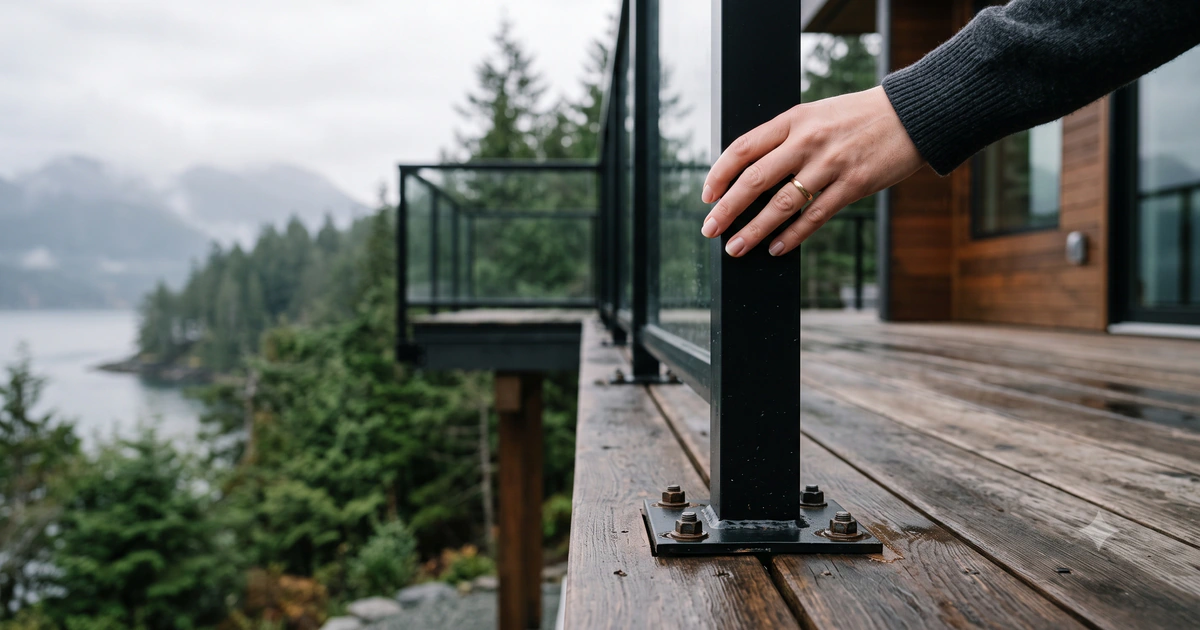
Find where the movement begins
- 1Stand inside the protected area and look at the complete railing run.
- 2Apply only light hand pressure—never your full body weight.
- 3Watch the joint, post base, plate and mounting surface.
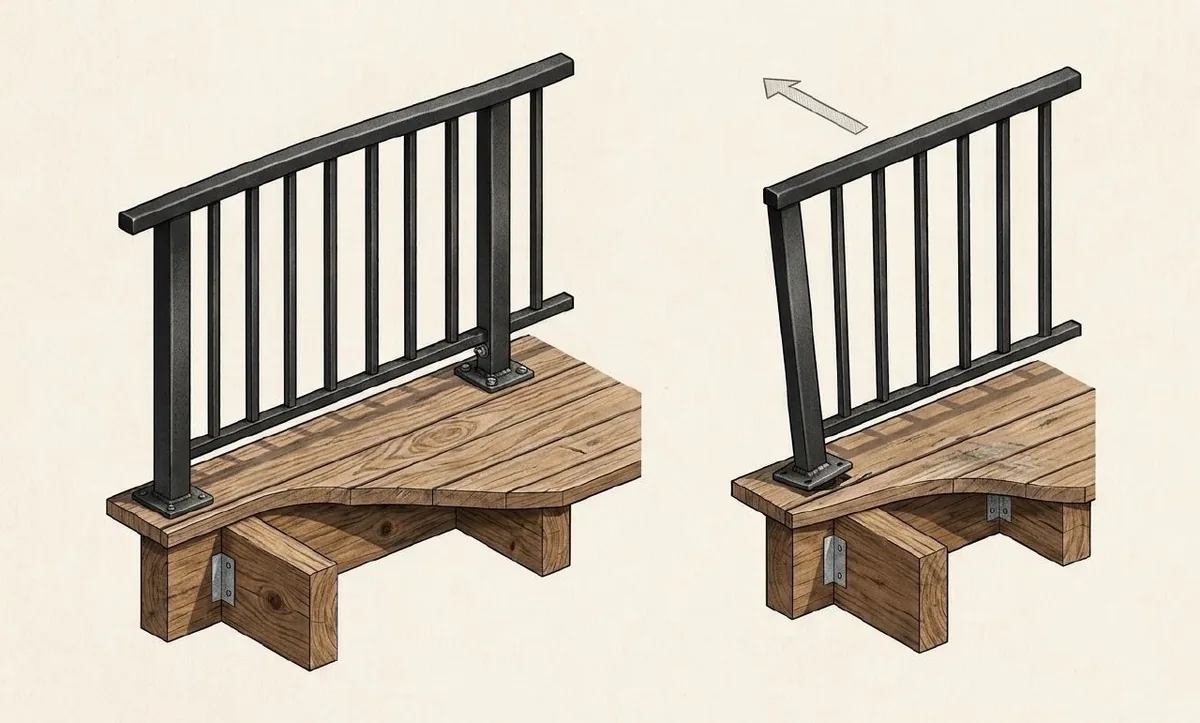
- 4Note whether one connection, several posts or the deck edge moves.
Cable or glass between fixed posts
Tension, gasket, clamp or limited span flex
Inspect the hardware and monitor change
Top-rail joint
Fastener, mechanical joint or weld
Assess it if the joint opens, clicks or shifts
One post or base plate
Anchor, plate, blocking or substrate
Assess the connection
Several posts
Repeated detail, deterioration or weak framing
Assess the full railing run
Deck, fascia or concrete edge
Supporting structure beyond the railing
Stop testing and arrange a review
Common failure points
What usually causes a railing to wobble?
Loose anchors or attachment to non-structural material
Anchors can loosen, strip or move in enlarged holes. A substantial-looking fastener may still miss structural blocking or connect only to decking, tile, membrane, cladding or decorative fascia.
Missing blocking, deteriorated wood or hidden water damage
Weak or split blocking allows posts to rotate. Rot, staining, soft wood, moving fascia or old sealant patches can indicate moisture around a concealed connection. If waterproofing is being renewed, review what happens to the existing railing during membrane replacement before demolition.
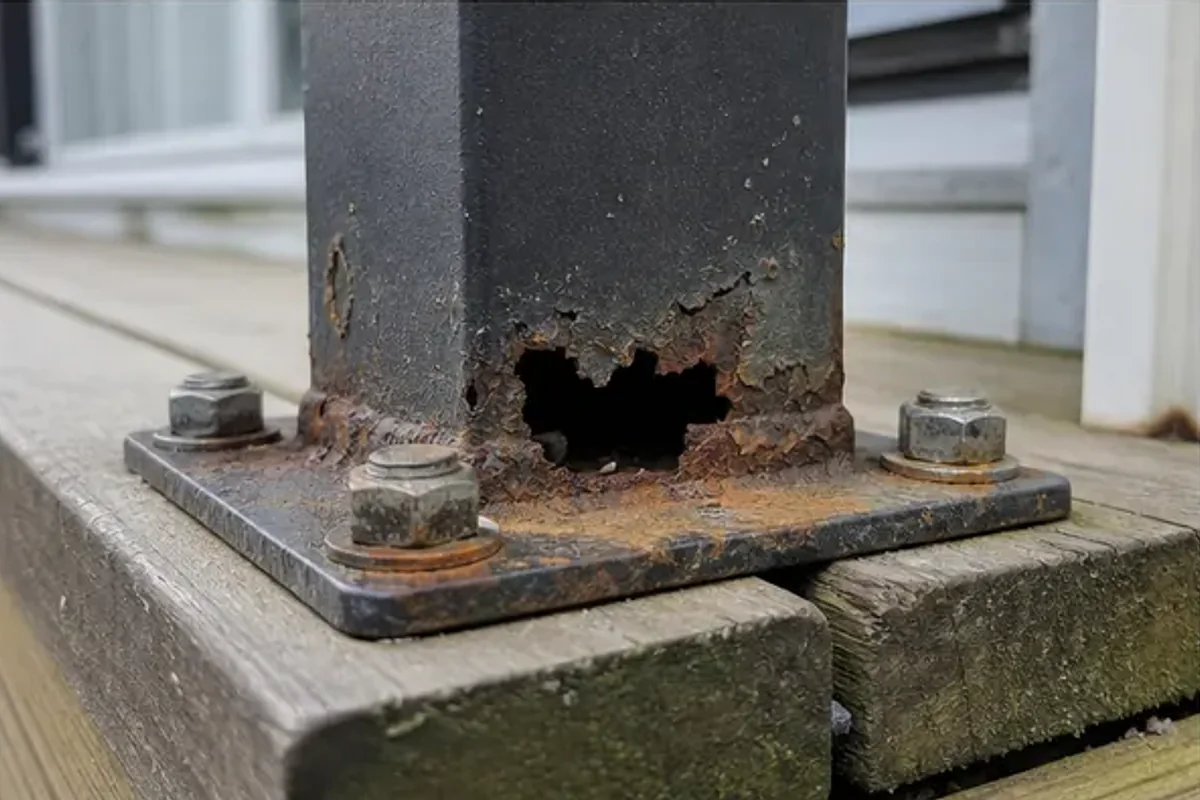
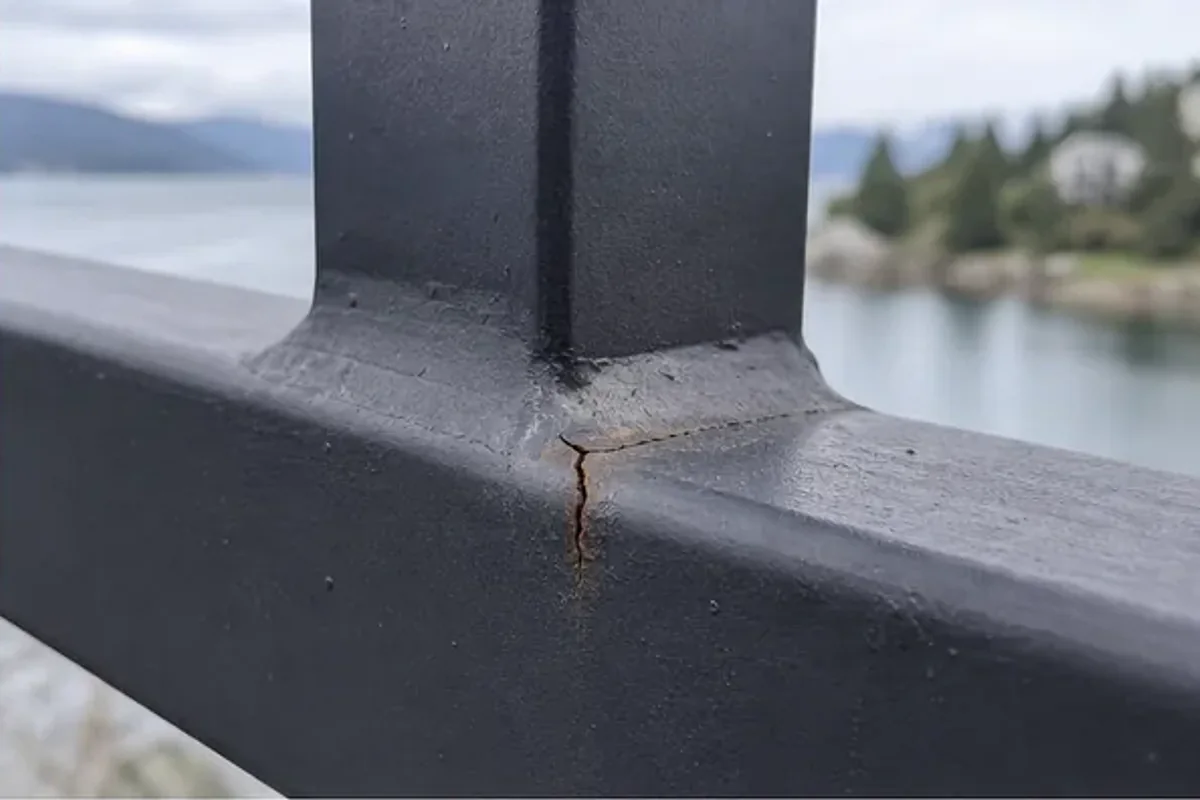
Corrosion, cracked welds or failed joints
Surface rust may affect only the finish. Pitting, perforation, metal loss, an opening weld crack or a moving mechanical joint can affect the connection and needs professional assessment.
Cracked or deteriorated concrete
Cracks, spalling, loose concrete, staining or old patches around anchors can affect the slab edge. A generic replacement anchor is not a responsible fix without confirming the concrete and connection geometry.
System-specific forces or hardware
Cable terminal posts can rotate under combined cable force; retensioning cannot fix a moving post. Glass may rattle at gaskets, clamps or shoes, while aluminum systems can loosen at modular joints and fasteners.
Related: how railing posts connect to a deck or balcony edge and why cable tension can move terminal posts.
Prepare for an assessment
What should you send?
- 01A wide photograph of the complete railing run.
- 02A close-up and short video of the first moving part.
- 03The base plate, anchors and mounting surface.
- 04Visible rust, cracking, staining, rot or water damage.
- 05An underside or rear view, only where safely accessible.
- 06The city, railing type, supporting material and number of moving posts.
Send the views to LOUEI Metal Arts
An initial review can help identify whether the next step is adjustment, connection repair, reinforcement, partial replacement or a new railing system.
BC and Vancouver context
A railing is a safety component—not just a finish
Loads travel through the infill, rails, posts or shoes, connections and anchors into suitable structure. Visible hardware is only part of that path.
Requirements depend on the building, use, jurisdiction and project scope. Vancouver uses its Building By-law; most other BC jurisdictions use the BC Building Code. A loose railing does not by itself establish compliance or non-compliance.
See LOUEI’s guide to current BC railing requirements.
Official sources
- BC Building Code 2024
Province of British Columbia
- Vancouver Building By-law 2025 — Volume 1
City of Vancouver
- Building Safe and Durable Wood Decks and Balconies
BC Housing
This article provides general information. It cannot confirm the safety, code compliance or remaining capacity of a specific railing. Anchors, welds, framing, concrete, corrosion, waterproofing and guard loads may require an on-site assessment and review by the applicable authority or qualified professional.
Quick answers
Frequently asked questions
01Is a slightly wobbly deck railing dangerous?
Movement at a post, base plate, anchor or supporting surface should not be ignored, but the visible amount of movement cannot establish structural capacity. Keep people away from the exposed edge and arrange an assessment.
02Can I fix a loose railing by tightening the bolts?
Only when the fastener, anchor hole, base plate and surrounding material remain sound. Tightening cannot restore rot, cracked concrete, stripped holes, corrosion-related metal loss or a failed weld.
03Why is my railing post loose at the base?
Common causes include a failed anchor, inadequate blocking, deteriorated wood, cracked concrete, corrosion, a damaged plate or attachment to material that is not structural.
04Should I repair or replace a loose railing?
A localized failure may be repairable when the surrounding structure is sound and a clear load path can be restored. Several moving posts, widespread corrosion, failed framing, deteriorated concrete or repeated failures make replacement more likely.
05What photographs should I send for an initial railing assessment?
Send a wide view of the full railing, a close-up and short video of the first moving part, the base plate and anchors, the mounting surface, visible damage and a safely accessible underside or rear view.
06Does a loose railing automatically fail BC Building Code?
No single symptom determines compliance. The railing system, loads, condition, building, jurisdiction and project scope require assessment. Vancouver uses its Building By-law; most other BC jurisdictions use the BC Building Code.
07Who repairs loose deck and balcony railings in Metro Vancouver?
LOUEI Metal Arts assesses and modifies existing metal railings and fabricates replacement systems for Metro Vancouver decks, balconies and stairs. The condition, substrate and site access determine the appropriate next step.
More useful guides
Continue with connection details, cable behaviour or inspection requirements.
Written by LOUEI Metal Arts
LOUEI is a custom metal fabrication studio in Coquitlam, fabricating, installing and modifying railing systems for homes, strata buildings and commercial properties across Metro Vancouver.