Your depreciation report landed, and somewhere in the 30-year forecast is a line about the balcony guardrails — repair or replace, usually inside the next one to five years. Now what?
If you sit on a strata council or manage the building, that one line starts a process most people have never run before, and it is not a maintenance call-out. A building-wide guardrail replacement is a capital project: engineering, a funding vote, owner coordination, and documentation that lands back in the strata records. The fabrication is the straightforward part. The planning and stakeholder coordination is where these projects succeed or stall. This guide walks the whole thing in order, in plain language, so council can move without surprises.
Disclaimer: This is general information, not legal advice. Strata-specific legal and fiduciary questions belong with your strata lawyer or property manager. For the governing rules, see the Province's depreciation report requirements and the Strata Property Act.
- 01Depreciation Report
- 02Assessment
- 03Funding Vote
- 04Engineering
- 05Fabrication
- 06Phased Install
- 07Closeout
Strata Railing Replacement at a Glance
| Item | What council should know |
|---|---|
| Why it's on the report | The Strata Property Act requires a 30-year component forecast; guardrails are a flagged life-safety item |
| Typical lead time | Plan 12–24 months from "flagged" to "installed" |
| Funding | Contingency Reserve Fund and/or special levy, by owner vote |
| Special levy vote | 3/4 vote at a general meeting |
| Engineering | P.Eng.-sealed drawings are required for multi-unit guards |
| Permits | Most municipalities require a building permit; the P.Eng. drawings form part of the application |
| Biggest surprise | Hidden anchor and slab-edge repair found once the old guards come off |
Why It's on Your Report
(and Why It Won't Go Away)
Does your strata have to replace the railings the report flagged? Not on a fixed legal deadline — but the corporation's duty to maintain common property, plus a now-documented life-safety deficiency, makes acting on the report's timeline the responsible and lowest-liability path. Here's why it landed on the report in the first place.
In 2024, BC rewrote the depreciation report rules (Province of B.C. announcement). As of July 1, 2024, every strata corporation with five or more lots must hold a current depreciation report under section 94 of the Strata Property Act; the old ability to defer it by a 3/4 vote at each AGM is gone for good, and reports now renew on a five-year cycle.
There is also a clock. Stratas that have never had a report — or whose most recent one predates December 31, 2020 — must obtain one by July 1, 2026 in Metro Vancouver, the Fraser Valley, and the Capital Regional District (July 1, 2027 elsewhere in BC), per the Province's deadline schedule. These reports carry a 30-year replacement forecast for major components — and the regulation's component list explicitly includes balconies and patios (Strata Property Regulation 6.2). On the wave of 1980s and 1990s buildings now hitting 30 to 40 years of service, original aluminum and steel guards are reaching end of life. That is why balcony railings are one of the most commonly flagged items on a modern report.
The Province is blunt about the underlying obligation: strata corporations are "legally required to repair and maintain common property" (gov.bc.ca) — a duty set out in section 72 of the Strata Property Act. A flagged guard does not disappear — it starts a timeline.
Capital project vs. maintenance repair — why the distinction matters
| Maintenance repair | Capital project (this is you) |
|---|---|
| Reactive — fix on failure | Planned — forecast in the depreciation report |
| Operating budget | CRF and/or special levy, by owner vote |
| One trade, in and out | Engineering, permits, phased install, resident coordination |
| No vote, no drawings | 3/4 vote for a levy; P.Eng.-sealed drawings |
| Days | 12–24 months end to end |
Treating a building-wide guard replacement as a simple repair is the most common planning mistake — and the reason projects blow their timeline. (For full-capital multi-unit work, see our commercial and multi-unit guard work.)
Why It Matters"A flagged railing is not a suggestion. It is a documented, known deficiency on a life-safety system — and 'we knew and didn't act' is the worst place a council can be."
Confirm the Finding
With a Real Assessment
A depreciation report is a high-level forecast, not an engineering diagnosis. The first move is a closer look — by a structural engineer or a qualified fabricator — to confirm what the building actually needs: full replacement, partial replacement, or repair.
A proper assessment establishes the things the report can't: the current code gap (guard height, opening size, and load capacity against today's BC Building Code), corrosion at fasteners and embeds, the condition of the balcony slab edge and waterproofing membrane, and whether the existing posts actually tie into structure. That turns a vague "replace railings" line into a defined scope council can fund and tender.
For the building-specific layer — matching or improving the existing style, deciding whether to replace one area or phase a building-wide standard — see our strata railing replacement and balcony railing pages.
Who Pays, and
How the Vote Works
Who pays for strata railing replacement in BC? The strata corporation pays — funded through its contingency reserve fund, a special levy, or a combination of both, approved by owner vote. A special levy requires a 3/4 vote at a general meeting, and the cost is generally shared among all owners by unit entitlement.
Building-wide guard projects are funded two ways, usually in combination: the Contingency Reserve Fund (CRF) and a special levy.
Under section 108 of the Strata Property Act, a special levy requires a 3/4 vote at an annual or special general meeting when contributions are apportioned the same way as strata fees — generally by unit entitlement (the Schedule of Unit Entitlement), not by who has the largest balcony. Apportioning it any other way requires a unanimous vote, per the Province's special-levies guidance — which is why the "only some units even have balconies" question belongs with your strata lawyer before the meeting, not improvised at the AGM. CRF spending is also owner-approved, with the threshold depending on whether the expenditure was contemplated by the fund — your property manager or strata lawyer will confirm which applies.
One safety valve councils should know: if a levy funds maintenance or repair necessary to ensure safety and the resolution wins majority support but falls short of 3/4, the strata can apply to the B.C. Supreme Court to have the levy approved — a provision directly relevant to life-safety items like guards (Province of B.C.).
Here is the quiet advantage of a current, defensible report: owners can see the replacement was forecast and funded on purpose. That single fact moves a vote.
Practical Takeaway"The vote is where strata projects stall. Councils that walk in with a confirmed scope, a clear funding plan, and a quote that won't change later get to yes faster."
Budget for What's Behind
the Old Railing
The single most common surprise on these projects: once the old guards come off, what's underneath is rarely clean. On the older Metro Vancouver buildings we assess, the recurring finds are corroded embeds, degraded concrete at the drill points, and failed membrane at the guard base — and a meaningful share of units need some repair at the anchor or slab edge before a new guard can go on. Where balcony waterproofing is involved, a building envelope consultant is usually part of the team.
When renewal also includes balcony waterproofing, council should establish what happens to existing railings during membrane replacement before tendering or demolition.
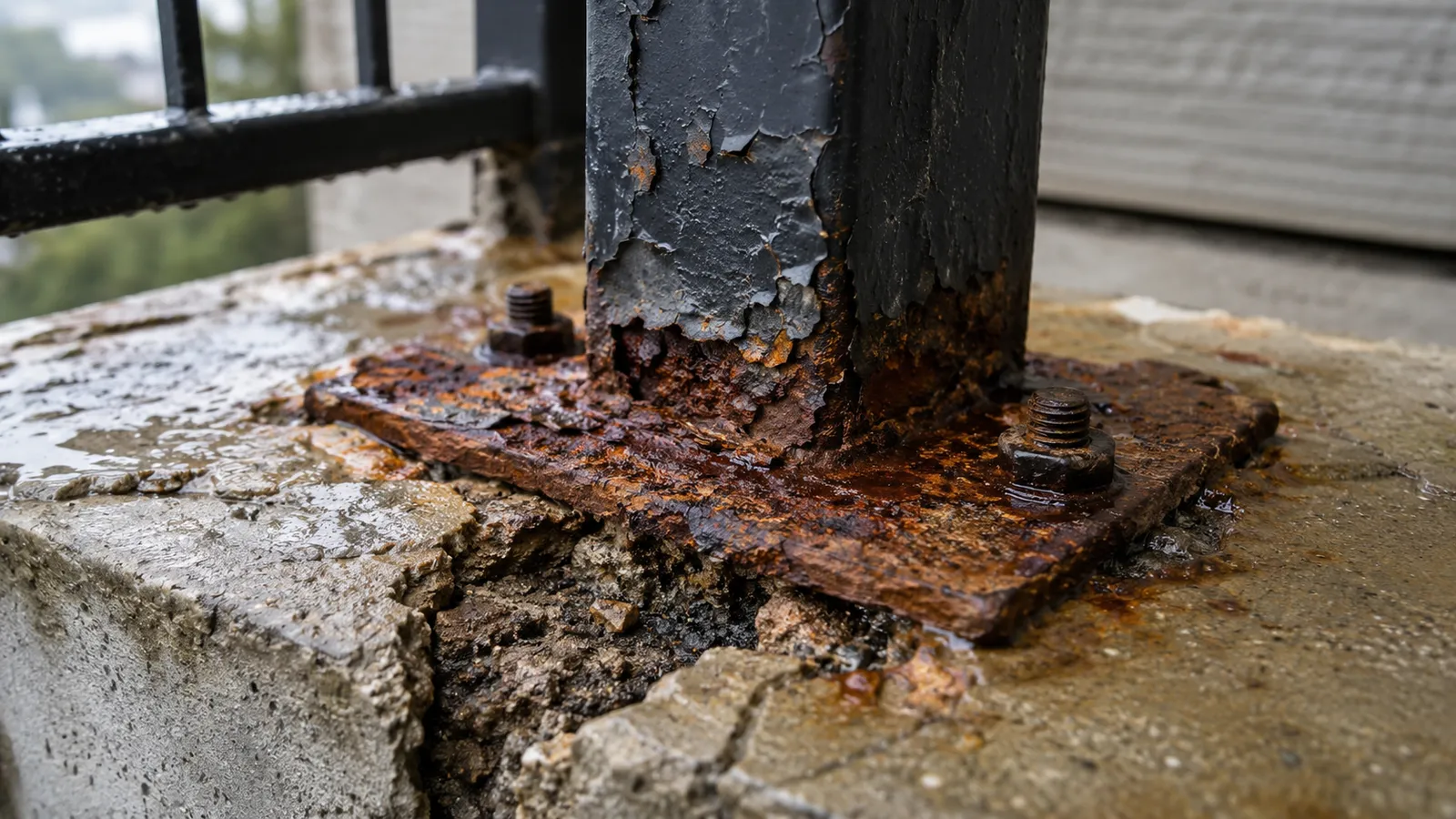
This is exactly why a rock-bottom "fabricate and install" number from the cheapest bidder is a trap — the real scope often appears mid-project, and the cheap quote quietly grows. Build a contingency into the plan for discovered structural work; your engineer will advise the allowance. You can read why coastal-BC conditions accelerate this kind of corrosion and material fatigue in our climate guide.
How Long It Takes, and
Planning Around Residents
How long does a strata railing replacement take? Plan for 12 to 24 months from a flagged depreciation report to installed railings: the assessment, the funding vote, P.Eng. engineering, fabrication, and phased installation across an occupied building each take time. Larger or underfunded buildings sit at the longer end.
Permits are part of that clock. Most Metro Vancouver municipalities require a building permit for a multi-unit guard replacement, with the P.Eng.-sealed drawings forming part of the application — and review timelines vary city to city, so the permit window belongs in the schedule from day one.
The building stays occupied through the work, so sequencing matters as much as fabrication. That means phased work — balcony-by-balcony or stack-by-stack access — and clear resident notice so owners know when their balcony will be out of use and when crews need entry.
Heavy fabrication belongs in the shop, not on your building: cutting, welding, grinding noise and dust stay off-site, and on-site work is mainly anchoring, alignment, and finish. And because a strata reads as one building, the finish should too — one powder-coat batch and one specification across every unit, so the result is uniform instead of a patchwork of slightly different colours and profiles. (For one-off repairs or partial scopes between full cycles, see our repair and re-anchor services.)
Insurance, Liability, and
Why Proactive Beats Reactive
Metro Vancouver strata insurers now look closely at life-safety systems, including guardrails, at renewal. A building with documented-but-unaddressed guard deterioration can face coverage conditions or higher premiums — the report that flagged the railings is visible to more than just council.
Railings installed before the 2006 BC Building Code revisions are grandfathered and legal until they are replaced — but replacement removes the grandfathering. The new guards must fully meet today's code: current heights, opening limits, and load requirements. And a guard that would not be legal to install today is a liability exposure that council is now on record as knowing about. Acting on the report's timeline protects the owners, the building's insurability, and the council itself. (For what a failed code inspection actually triggers, see what happens when a railing fails inspection.)
Critical"The depreciation report creates a paper trail. Acting on it closes the loop. Ignoring it leaves a documented, unaddressed life-safety deficiency on the record."
The Documentation
Council Keeps (Close-Out)
When the work is done, the strata records should hold a complete closeout package: P.Eng.-sealed drawings, a letter of conformance or field-review sign-off, CWB weld certification, material and finish specifications, and the warranty. This is the package that makes the next depreciation cycle, the next insurance renewal, and any future resale disclosure straightforward — and it is the difference between a project that is "done" and one that is defensible.
Council needs a partner,
not just a fabricator.
LOUEI runs strata guardrail replacement as a capital project — confirming scope, coordinating the P.Eng. drawings, fabricating to one specification in our Coquitlam shop, and handing council the closeout documentation for its records. We are rarely the cheapest quote on a strata table; we are often the one council picks anyway, because the document holds up at the AGM and the number doesn't change quietly after work starts.
Depreciation report flagging your railings? Tell us the building, and we'll arrange a site visit to assess the existing railings, scope the replacement, and coordinate P.Eng. structural drawings where required. You'll get a clear, council-ready picture of the work and the closeout documentation your strata keeps on record.
FAQ
Common questions from strata councils.
Does our strata have to replace railings the depreciation report flagged?
+
The report itself doesn't impose a legal deadline to replace, but the corporation's duty to repair and maintain common property — combined with a now-documented deficiency on a life-safety system — makes acting on the report's timeline the responsible path. Confirm your specific obligations with your strata lawyer or property manager.
Who pays for strata balcony railing replacement in BC?
+
The strata corporation, funded through the contingency reserve fund and/or a special levy approved by owner vote. Special levies require a 3/4 vote at a general meeting, and costs are generally apportioned by unit entitlement.
Do we need a structural engineer?
+
Yes. Multi-unit guardrails require P.Eng.-sealed structural drawings covering the new guard system and the anchor and connection details, including any structural repair at the balcony edge.
Do we need a building permit?
+
In most municipalities, yes — a multi-unit guard replacement requires a building permit, and the P.Eng.-sealed drawings form part of the application. Requirements and review timelines vary by city, so confirm with your local building department early.
How long does the whole process take?
+
Plan for roughly 12 to 24 months from a flagged report to installed railings. The assessment, funding vote, engineering, fabrication, and phased installation across an occupied building all take time.
What's the most common surprise on these projects?
+
Hidden structural repair at the anchors and slab edge — corroded embeds, degraded concrete at drill points, and failed membrane at the guard base — found once the old guards come off. Build a contingency into the plan.
Can owners be assessed differently if only some units have balconies?
+
Sometimes, but how a special levy is apportioned is a legal question. Take it to your strata lawyer or property manager rather than deciding it informally at the meeting.
Official sources
- Strata Property Act, RSBC 1998, c. 43 — ss. 72 (duty to repair), 94 (depreciation reports), 108 (special levies) — BC Laws
- Strata depreciation report requirements — Province of British Columbia
- Special levies in stratas — Province of British Columbia
- Strengthened depreciation report regulations (news release, April 2024) — Province of British Columbia
- BC Building Code — Province of British Columbia

Written by LOUEI Metal Arts
This guide reflects our work running strata and multi-unit guardrail replacements across Metro Vancouver — coordinating engineering, fabricating to code in our Coquitlam shop, and delivering the closeout documentation strata corporations keep on file. CWB-certified welders, WorkSafeBC coverage, Commercial General Liability, and P.Eng.-sealed drawings where required.
About LOUEI Metal Arts
LOUEI Metal Arts is a custom metal fabrication studio in Coquitlam, building and installing code-compliant cable railing, glass railing, picket railing, and handrails for decks, balconies, and stairs across Metro Vancouver. No subcontractors — one crew handles measurement, fabrication, powder coating, and installation.