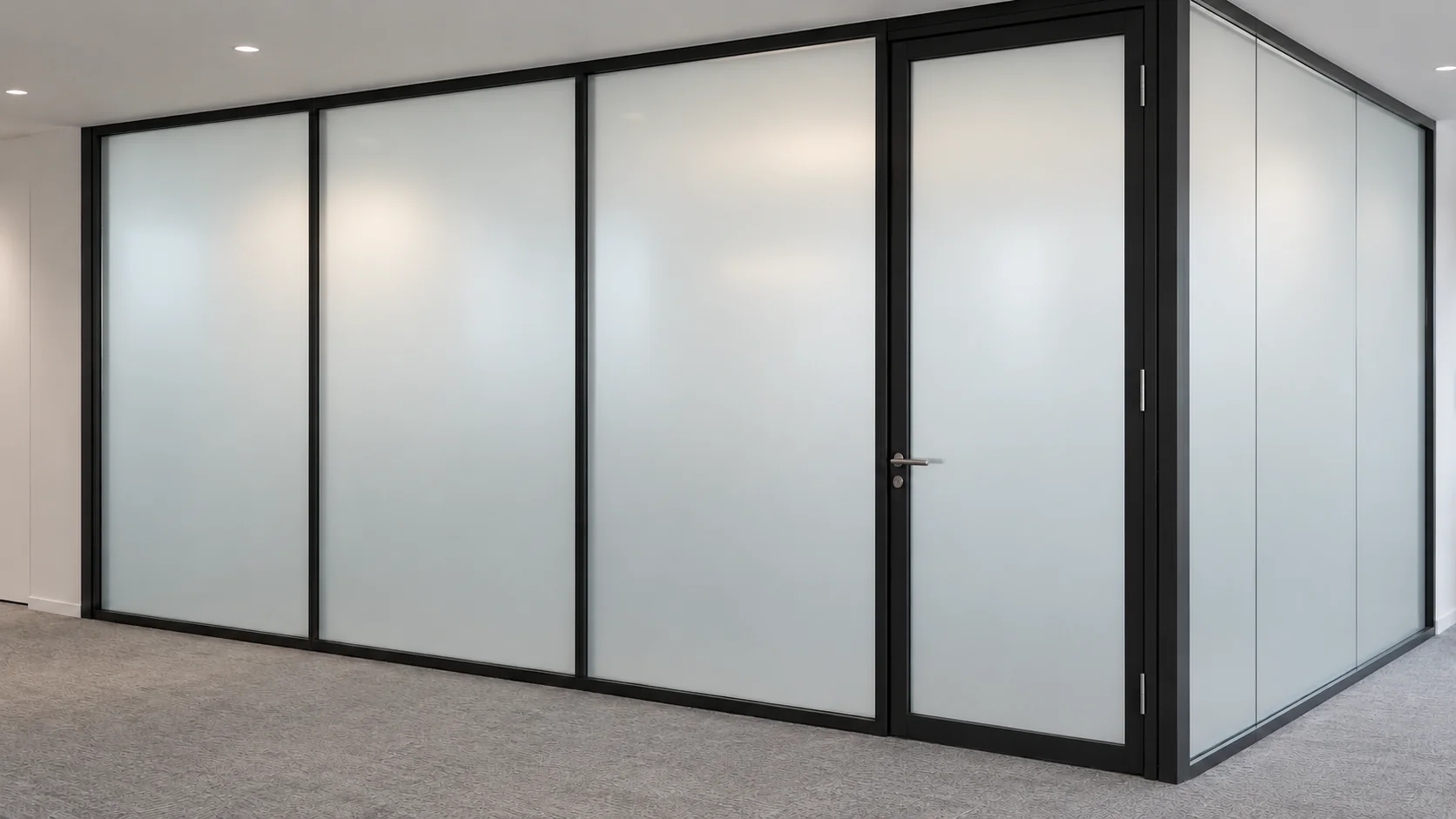
A frosted meeting room should work for the people using it—not just look convincing in a photograph.
For an office in Greater Vancouver, begin with the glass you have and the views you want to screen. This guide helps you prepare a useful brief and ask for a sample review before choosing a system.
At a glance
In this guide
01 — Start with the room
Can smart film work on your existing office glass?
Some adhesive smart films are designed for existing glazing. They are different from switchable glass manufactured with film sealed between glass layers. Confirm which system is proposed for your partition; the two are not interchangeable installation specifications. Manufacturer's retrofit film overview.
Start with what should stay: the glass, frames and doors. Share any known glazing details and existing coatings. The installer should check compatibility, surface condition and available space before film is ordered or cut.
Describe the view you want to change—not simply “more privacy”.
For example, you may want to soften a corridor view into meetings while keeping daylight. Concealing a presentation screen is a different requirement. Write down the important viewing positions so the sample review answers the right question.
See our smart film service for existing glass for the broader application.
02 — Make the comparison useful
Review the sample where privacy matters
Ask to review the proposed film with its matching controller, safely set up by the responsible supplier or installer. Check the actual model and intended glass application. A sample of a different product cannot establish the result for your room.
Use the room's lighting
Compare daylight and normal meeting lighting, including the corridor side. Note which lights are on for each observation.
Move to the important views
Check straight on and from the corridor approach, at the distances people actually use. Record the positions rather than inventing a universal pass distance.
Compare both states
Use a blank test slide or an ordinary object. Note clear-state appearance and what remains discernible in the privacy state.
Keep an honest record
If you record the review, keep the viewpoint and camera exposure consistent. Note the model, lighting and observations; do not edit the images to strengthen the result.
Use an empty room or harmless test material. Keep real client records, staff information and confidential presentations out of photographs and demonstrations. Do not open a controller or improvise a power connection.
This is a practical observation checklist, not a certified privacy test. Record what remains visible and what still needs checking; do not turn a good-looking sample into a promise of complete confidentiality.
03 — Look beyond the switch
Check the clear view, the frosted view and the edges
Frosting and blackout are different requirements. Ask what the selected product actually does with light and visible detail. If faces, movement or screen content must be concealed, include those needs in the sample review rather than relying on the word “opaque”.
Haze describes light scattering through a transparent sample. Review the clear state as well as the frosted state; a clarity figure in one manufacturer's literature is not a specification for another film. Manufacturer's explanation of haze.
Look at the proposed film boundary, glass joints, door gaps and any uncovered panes. Ask where the electrical connection and edge protection will be visible. Agree the coverage on a marked photo before final dimensions are taken.
Visual privacy is only one part of a private meeting. Review sound, open sightlines and screen placement separately.
04 — Include the moving parts
A glass door needs its own detail
Show which panels are fixed and which doors swing or slide. Include the hinges, handles and the full opening movement. Ask how the proposed system accommodates movement without leaving exposed or vulnerable connections.
Agree where the switch and controller will go, how cables will be concealed and how equipment remains accessible. A neat finished appearance should be planned together with servicing access—not added after the film arrives.
Do not treat applied film as proof that existing glass meets safety-glazing or fire-rating requirements. Have the responsible project team check any applicable requirements and the suitability of the complete proposed assembly.
Ask for the selected film's cleaning and edge-care instructions. Tell the installer about existing surface treatments and the office cleaning routine. Do not assume a cleaner suitable for bare glass is suitable for the exposed film surface.
05 — Settle the operating details
Confirm the controls and electrical scope
Ask how the proposed system behaves when switched off, during a power interruption and when power returns. Confirm who can operate it and whether panels switch together. Those answers should match the actual equipment—not a generic demonstration.
For BC projects, check the equipment's accepted approval route. Technical Safety BC identifies acceptable certification marks and approval labels. An overseas marketing badge alone does not establish approval for the equipment being installed. Technical Safety BC equipment approval guidance.
Have a qualified electrical contractor confirm the installation scope, applicable permit requirements and issuing authority. Technical Safety BC directs projects in Vancouver and several neighbouring municipalities to the local authority for electrical installation permits. Electrical permits and jurisdiction.
Before ordering, identify who supplies the film, confirms the glazing details, completes any electrical work and hands over the operating instructions. Keep unresolved items visible in the brief rather than assuming one supplier covers everything.
06 — Make your first message count
Show us the glass and the view you want to change
You do not need to choose a film model before contacting LOUEI Metal Arts. A few clear photos and a short description help explain the existing room, your privacy goal and the information still needed.
- A wide view of the full partition and the room on each side.
- The corridor approach and the sightlines you want to screen.
- Door hinges or tracks, handles, frame edges and panel joints.
- Any existing coatings, known glass details or available drawings.
- The municipality, approximate panel sizes and your main privacy goal.
For example: “We want to keep this meeting-room glass, reduce the view from the corridor and still use daylight. This door opens outward. We would like to understand what a suitable film sample would show.”
Keep dimensions approximate and show the units. Initial photos support a discussion; they do not confirm product compatibility, final film sizes or electrical approval. Remove private content from screens and desks before sending them.
Quick answers
Frequently asked questions
Can smart film be added without replacing the office glass?
Certain adhesive systems are intended for existing glazing. The selected film, glass surface, frames and door details still need a compatibility review. Share the existing condition rather than assuming every partition is a suitable substrate.
Will frosted smart film hide everything inside a meeting room?
Do not assume so. Define what must be concealed and review the proposed product under the lighting, distances and angles relevant to your room. A photograph or the word “opaque” is not a confidentiality guarantee.
What happens during a power interruption?
Ask the supplier to confirm the behaviour of the exact film and control arrangement, including what happens when power returns. Include that condition in the review if it matters to how the room will be used.
What should I send to start a project review?
Send clear photos of the partition, doors and important sightlines, plus your municipality and privacy goal. Include approximate sizes or drawings if available. Remove confidential screen content and documents; product selection and final measurements come later.
Your next step
Show us your meeting-room glass
Send LOUEI Metal Arts photos of your meeting-room glass and explain what you want to screen. We can discuss the application and clarify the next information needed before a system is selected.
Explore our smart film options for existing glass. Prefer email or a call? Both are available on our contact page.
Sources
Official references
- Gauzy — adhesive PDLC film and retrofit applications
- Gauzy — switchable film types and haze explained
- Technical Safety BC — approved certification marks for electrical products
- Technical Safety BC — electrical installation permits and jurisdiction
Sources reviewed October 15, 2026. Manufacturer references explain product types and terminology; they do not identify the film for your project. Confirm the selected product documentation and local approval requirements before installation.